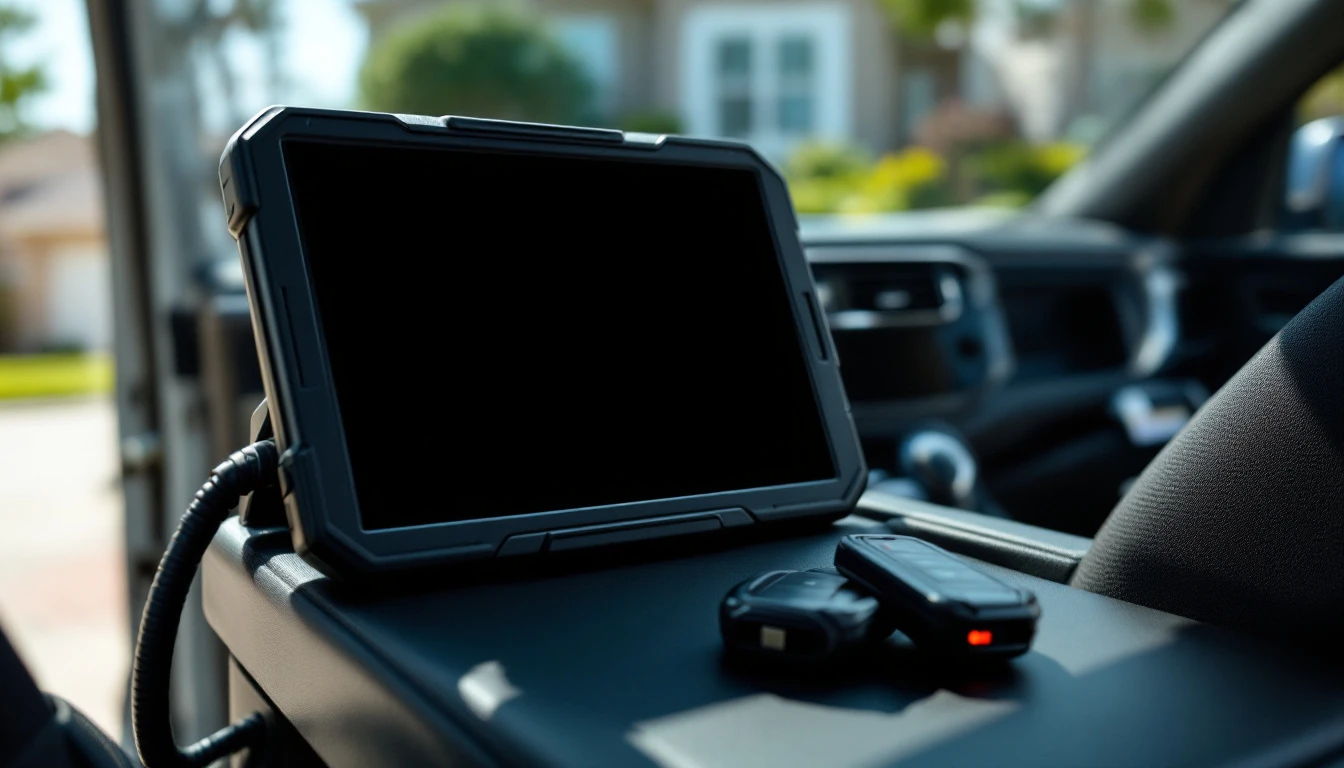
What relearns and module programming cost in Grand Prairie right now
Every figure below is all in for work performed at your address during normal weekday hours, with no separate call-out fee inside the core service area. These are the same bands used across the module guides on this site, restated in one place.
Diagnostic session with a full module scan: $95–$160. Every module on the vehicle is interrogated, not just the engine computer, and the fault is identified before anything is bought. This is normally credited against the work that follows, so it is not an extra cost when the job proceeds.
Immobilizer or key relearn: $95–$180. An existing, healthy module has lost its synchronisation with the keys or with another module, and is re-synchronised. Labour with no part.
Registering keys and remotes to a module: $120–$260. The step that teaches a module which keys belong to the vehicle, performed on its own or after a module has been configured.
Body control module configured to your VIN: $220–$420. A replacement body control module arrives blank or carrying another vehicle’s identity and has to be configured before the car will recognise it.
Body control module configuration plus key and remote registration together: $280–$480. Less than the two added up, because the vehicle is only opened up once.
Replacement smart key, immobilizer or ignition module configured to your VIN: $280–$520, depending on model year and whether manufacturer-side authorisation is required for that platform.
Engine computer, transmission module and instrument cluster work varies too widely by platform to publish as one honest band, so it is quoted against your VIN before anyone is dispatched. Our ECU programming page explains what that work involves.
After hours: add roughly $20–$40. Outlying addresses: $20–$50, named when you book. The price of the module itself is separate from every configuration figure above, and who supplies it is discussed below.
Relearn, registration, configuration: three different jobs
These three words are used interchangeably on the phone and they are not the same work. Knowing which one you are being quoted is most of the protection you need.
A relearn re-synchronises parts that already belong together. The modules are original to the car, the keys are the keys it has always had, and something — almost always a voltage event — has knocked them out of step. Nothing is replaced. The technician uses a write-capable tool to bring them back into agreement. This is the $95–$180 job.
Registration introduces a key to a module. A new key, a new fob, or the existing keys after a module change. The module is told which credentials to accept. This is the $120–$260 job, and it is part of any key replacement as well as any module replacement.
Configuration gives a replacement module its identity. A new or replacement module does not know which vehicle it is in. It has to be written with the correct VIN, the correct option set for that build, and its security relationship with the other modules. This is the $220–$520 work, and it is only needed when a module has genuinely been replaced.
Why it matters: the difference between “the module is broken” and “the module no longer trusts what it is talking to” is the difference between roughly $145 and several hundred dollars, and only a tool that can write to the module can tell you which one you have. Our plain-language explainer on how car key programming works covers the underlying idea.
How to tell which one you need before you pay for anything
Ask what happened immediately before the fault. This is the single most useful question in module work. If the answer is a flat battery, a jump start, a battery replacement, a battery disconnected for other repairs, or a car that sat for weeks, the working assumption is a relearn. Stored key registrations and module synchronisation can be lost when voltage collapses, and nothing is physically wrong with any part.
Try every key you own. If one key starts the car and another does not, the modules are healthy and the fault is in the key that fails. If no key works and they all worked yesterday, the fault is on the vehicle side. Our guide to a spare key that stopped working while the main key is fine works through the first case.
Check the 12-volt battery properly. A battery can light the dashboard and still sag badly under load, and a sagging battery makes healthy modules misbehave. Have it load-tested rather than judged by whether the lights come on. On electrified vehicles this matters even more, because the small 12-volt battery runs the modules while the large drive battery does not. Our Ioniq 5 and Ioniq 6 12-volt battery and key relearn guide is the detailed version of that case.
Get the full scan, not a code read. A basic code reader talks to the engine computer. Immobilizer and key faults live in the body, smart key and security modules, which a basic reader never sees. A full scan shows which modules are present, which are talking to each other, and which one is refusing the key. That is what the $95–$160 session buys, and it is credited against the repair.
Only then decide. If the scan shows every module present and communicating, with a stored fault about key recognition or synchronisation, it is a relearn. If a module is absent from the network, will not communicate, or reports internal failure, it is a replacement and configuration. Our guide to a car that will not start with the fob in hand walks the same ladder from the driver’s seat.
What moves the price inside each band
Model year and platform. Later vehicles place more of this work behind manufacturer-side security authorisation. Credentialed independent shops reach those functions through the National Automotive Service Task Force vehicle security framework, and the extra procedure is the main reason a recent model sits at the upper end of a band.
How many keys have to be re-registered. Some procedures write the complete key set rather than appending to it. Three keys take longer than one. Bring every key you want to keep working to the appointment, because a key left at home may be erased and need a second visit.
Whether the module is new, remanufactured or used. A new or properly remanufactured module is a known quantity. A used module from a salvage vehicle carries another car’s identity and, on many platforms, cannot simply be rewritten. Some can be made to work, some cannot, and some can only be made to work at the bench. A shop that does this work daily can usually tell you in one conversation whether a given used module is a realistic candidate or an expensive lesson.
Whether another shop has already tried. A failed programming attempt can leave a module in a worse state than it started. It is still usually recoverable, but say so when you call, and say what equipment was used if you know.
Time and distance. $20–$40 after hours and $20–$50 for an outlying address.
What does not legitimately move the price: the urgency in your voice, or a number that is revised upward once the technician is on your driveway. Per the FTC’s consumer guidance, a figure that grows between the quote and the invoice is the standard bait-pricing pattern.
The mistakes that turn a relearn into a module
Buying the module first. The most expensive mistake in this field is ordering a part because of a symptom. A car that will not recognise its key looks exactly the same whether the smart key module has failed or has merely lost synchronisation, and a replacement fitted to a car that only needed a relearn still needs configuring — so you pay for the part, the configuration, and the relearn you needed all along.
Buying keys to fix a module fault. If the vehicle side has lost trust, new keys do not help. They are simply more credentials for the module to refuse. Establish which side the fault is on before buying either.
Disconnecting the battery to “reset” it. On older cars this was harmless. On a modern vehicle, pulling the battery is one of the events that causes a loss of synchronisation in the first place. If the car currently works, do not do it as a precaution.
Jump starting carelessly. A reversed lead or a jump from a running vehicle that spikes the voltage can damage modules outright, which is the one route from a flat battery to a genuine replacement. Follow the procedure in the owner’s manual and use the designated jump points, which on many vehicles are not the battery terminals.
Letting a job proceed without the conditional price. An honest quote on this work has two parts: “the scan is $95–$160 and comes off the bill; if it is a relearn that is $95–$180, and if a module has failed, configuration is $280–$520 plus the part.” If you are only given the second half, ask for the first.
Mobile programming versus the dealer
The dealer route starts with a tow. A vehicle that will not start cannot be driven to a service department. AAA roadside and repair-cost research identifies towing as a significant cost in its own right, and on a no-start it is incurred before anyone has looked at the car. A mobile visit diagnoses and, in the relearn case, completes the repair in the same parking space.
The dealer route tends to end in a part. A service department works from the manufacturer’s diagnostic flow, which is thorough but commonly resolves to module replacement where a fault is intermittent. That is a reasonable outcome when the module has failed and an expensive one when it had only lost synchronisation.
Where the dealer is the right call. Warranty and recall work, software campaigns that have to be recorded against the VIN in the manufacturer’s system, and the newest platforms where a function is restricted to the franchised network. Open recalls can be checked free against your VIN through the National Highway Traffic Safety Administration. An honest independent shop names those boundaries rather than attempting work it should not.
The standards are public. The communication between a diagnostic tool and a vehicle’s modules runs over interfaces standardised by SAE International, which is what makes independent programming possible at all. Technician certification standards come from ALOA, and anyone performing locksmith work in Texas is licensed through the DPS Private Security Program.
Three quotes for one symptom: how the same fault gets priced
Take a single, common situation: a push-button car that will not recognise its key the morning after a battery change. Here is how three different approaches price it, using the bands above.
The parts-first quote. “That will be the smart key module.” A module is ordered, fitted and configured: $280–$520 for the configuration, plus the module, plus registering the keys to it. If the original module had only lost synchronisation, every dollar of that was avoidable, and the car would have behaved the same way after a $95–$180 relearn.
The keys-first quote. “Your keys have failed, you need two new ones.” Two replacement smart keys at $150–$300 each on a mainstream vehicle. If the fault is on the vehicle side, the new keys are refused exactly as the old ones were, and the owner now has four keys the car will not accept.
The scan-first quote. “The scan is $95–$160 and comes off the bill. If the modules are all present and the fault is synchronisation, the relearn is $95–$180 and you are done. If a module has genuinely failed, I will show you the fault and price the replacement before I order anything.” The worst case under this quote costs the same as the parts-first quote. The likely case costs a fraction of it.
The lesson is not that modules never fail. They do, particularly after water ingress, a collision or a voltage spike. It is that a module should be condemned by evidence from a scan rather than by a symptom described over the phone, and that a quote which cannot tell you what the cheaper outcome would cost has not considered one.
One more thing a legitimate shop will do: ask who you are. Any work that gives a vehicle a new key or rewrites its security relationship calls for photo identification and a document tying you to the VIN — registration, insurance card or title. That check is part of the credentialed access framework described above, and a shop that skips it would do the same work for anyone who turned up with your car.
Platform notes: where this work shows up most
Trucks with a separate wireless ignition module. On several Ram model years the unit the key communicates with is its own module, and its faults are routinely mistaken for a bad key. Our Ram 1500 and 2500 wireless ignition module programming guide covers how to tell a module fault from a key fault on that platform.
Late-model GM vehicles. The body control module sits at the centre of key recognition, and a replacement has to be configured to the build before keys can be registered. Our Cadillac CT6 and XT6 body control module guide works through that sequence.
Hyundai, Kia and Genesis. The electrified models are the most common relearn calls we take, almost always after a 12-volt battery event. On the Genesis range the immobilizer and smart key functions are more tightly integrated; see our Genesis G90 and GV70 immobilizer module programming guide.
Any vehicle after a body repair, a stereo or alarm installation, or a windshield replacement. Work that involves disconnecting the battery or unplugging modules is a common trigger. If the fault began the day you collected the car from another shop, say so — it narrows the diagnosis considerably.
What to have ready when you call
The year, make and model, and ideally the VIN. The VIN is what allows a real figure rather than a range.
What happened just before the fault. Battery, jump start, another shop’s work, a long period parked, or nothing at all.
What the car does now. Cranks and does not start, does not crank, starts and stalls, a specific message on the dash, a security light behaving in a particular way.
How many keys you have and whether any of them works.
Whether a module has already been bought or fitted, and whether it is new or used. That is enough for the two-part quote described above. See immobilizer programming, BCM programming, dealer-level diagnostics or car key programming.
A Real-World Example
Operator: A representative Grand Prairie case: a late-model crossover with push-button start that would not recognise either of its two smart keys the morning after the 12-volt battery had been replaced at a parts store.
Before:
- Both keys rejected, a key-not-detected message on the dash, engine would not crank
- Owner had been advised to order a replacement smart key module online
- A second suggestion was to buy two new keys, on the theory that both originals had failed at once
What changed:
A full module scan was run before anything was purchased. Every module was present and communicating, the new battery tested healthy, and the stored fault pointed to lost key synchronisation rather than a failed module. The relearn was performed with a write-capable tool, both existing keys were re-registered, and each was tested for entry and starting before the technician left.
Results:
- Vehicle starting on both original keys within one visit, no tow
- Relearn at the $95–$180 band rather than a $280–$520 module configuration plus the part
- No module purchased, no new keys purchased
- Diagnostic session credited against the work
Net: Two keys failing on the same morning, straight after a battery change, was never two bad keys or a bad module. It was one lost synchronisation, and the scan that identified it cost less than either of the parts the owner had been told to buy.
What Experts Say
“The first thing I ask on any module call is what happened the day before. If the answer is a battery, I am almost certainly doing a relearn, and I say so before I leave the shop. The calls that hurt are the ones where somebody has already bought a module off the internet because a forum told them to. Now the car has a part in it that belongs to a different vehicle, and the original problem is still there underneath. Scan first. It is the cheapest thing I sell and it comes off the bill.”
Access to manufacturer security functions for independent shops is administered through the National Automotive Service Task Force vehicle security framework, which verifies the credentials of the technician performing the work — the mechanism that allows an immobilizer relearn or module configuration to be carried out legitimately outside a franchised dealer, and the reason a credentialed shop will ask for proof of ownership before starting.
Frequently Asked Questions
How much does an immobilizer relearn cost in Grand Prairie?
As of October 2026, $95–$180 at your address. A relearn re-synchronises an existing, healthy module with the keys or with another module, so it is labour with no part. The diagnostic session that confirms a relearn is the right job is $95–$160 and is credited against the work.
How much does module programming cost?
Configuring a replacement body control module to your VIN is $220–$420, registering keys and remotes afterwards is $120–$260, and the two together run $280–$480. A replacement smart key, immobilizer or ignition module is $280–$520 to configure. The module itself is a separate cost. Engine, transmission and cluster work is quoted against the VIN.
My car will not start after a battery change. Do I need a new module?
Almost certainly not. A fault that appears straight after a flat battery, jump start or battery replacement is a relearn until proven otherwise, because stored key registrations and module synchronisation can be lost when voltage collapses. Have a full module scan done before buying anything.
What is the difference between a relearn and programming?
A relearn brings parts that already belong to the car back into step, with nothing replaced. Programming, more precisely configuration, gives a replacement module its identity: the VIN, the option set and its security relationship with the other modules. Registration is the separate step of teaching a module which keys to accept.
Can a used module from a salvage yard be programmed to my car?
Sometimes. A used module carries another vehicle’s identity, and on many platforms it cannot simply be rewritten. Some can be made to work, some cannot, and some only at the bench. Ask before you buy one, with the part number and your VIN to hand, because a shop that does this daily can usually tell you in one conversation.
Is the diagnostic fee charged on top of the repair?
No. The $95–$160 diagnostic session is normally credited against the work when the job proceeds. It is only a standalone cost if you decide not to go ahead after the fault has been identified.
Do I need to bring all my keys to a programming appointment?
Yes. Some procedures write the complete key set rather than adding to it, so a key left at home can be erased and need a second visit to restore. Bring every key and fob you want to keep working.
Does the car have to be towed for module programming?
Not for the work on this page. Scans, relearns, key registration and module configuration are performed at the vehicle with mobile equipment. A tow only comes into it for dealer-only warranty, recall or campaign work.
The Bottom Line
In Grand Prairie as of October 2026, a full module scan is $95–$160 and comes off the bill, an immobilizer or key relearn is $95–$180, and configuring a replacement module to your VIN is $220–$520 depending on which module it is. The expensive mistake is not the price of any one of those — it is paying for the third when you needed the second. If the fault followed a battery event, assume a relearn, have every module scanned before buying a part, and insist on a quote that prices both outcomes before anyone starts.
Next Steps
Before you order any part, call (214) 949-1847 with the year, make and model, what happened just before the fault, what the car does now and how many keys you have. You will get a two-part quote — the relearn price and the configuration price — before anybody is dispatched. Bring every key you own to the appointment. See immobilizer programming, BCM programming and dealer-level diagnostics.
Sources cited in this article
- National Automotive Service Task Force (NASTF)
- SAE International vehicle communication standards
- AAA roadside assistance and repair-cost research
- National Highway Traffic Safety Administration (NHTSA)
- FTC consumer guidance on locksmith scams
- Associated Locksmiths of America (ALOA) certification
- Texas DPS Private Security Program