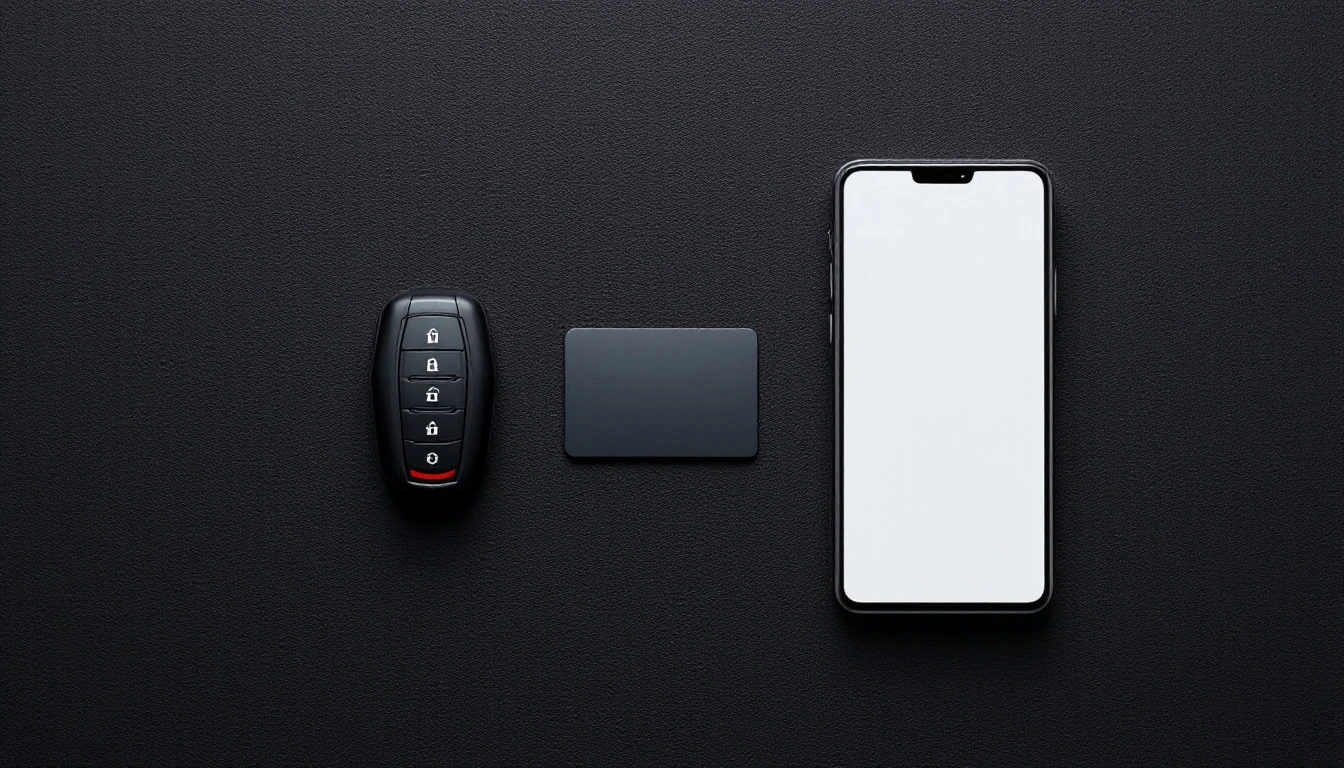
Three credentials, three separate failure modes
The GV60 was Genesis's first bespoke electric model and arrived with a deliberately layered access system. The proximity fob is the conventional credential: transponder authority for the drive system, radio functions for lock and unlock, and passive entry so the car responds as you approach. The card key is a thin credential you hold against a defined reading area — convenient, easy to carry, and easy to demagnetise or bend in a wallet. The phone credential is paired to the vehicle and to an account.
Because they are independent, a symptom that feels like “my car key broke” is usually a symptom of one specific credential. The phone stops working after a handset change or an account event; the card stops working after a year in a back pocket; the fob stops working when its coin cell sags. None of those three implies anything about the other two.
The diagnostic instruction that saves most GV60 owners money is: try all three. If any one of them opens and drives the car, the vehicle is fine and you have a single-credential problem with a known, cheap remedy. If none of them does anything at all, you are looking at a vehicle power condition, not a credential problem.
That is a different mental model from a conventional car, where the key either works or it does not. On this platform the useful question is never “is the key broken” but “which of my three credentials is broken, and does it need replacing or only re-registering?”
Which failure needs which fix
Fob dead, card and phone fine. Almost always a coin cell. Replace it before anything else. If a fresh cell changes nothing, try the inductive backup position at the marked area near the start button — if the car reads the transponder that way, the radio side of the fob has failed and a shell or board decision follows. Genuine fob replacement is the last conclusion, not the first.
Card dead, fob fine. Cards are physical objects carried against other physical objects. Bending, delamination, and antenna damage from a wallet are ordinary. A replacement card is the cheapest credential on the vehicle and is worth having regardless, because it lives flat in a wallet where a fob will not.
Phone credential dead, fob and card fine. Nothing is wrong with the car. Phone credentials un-pair on handset replacement, on operating-system-level identity changes, and after some account events. This is an app-and-account operation, not a locksmith operation, and any shop that quotes you for hardware here is selling you something you do not need.
Nothing works at all. A flat 12-volt auxiliary battery. On an EV the traction pack cannot power the vehicle until 12-volt supply wakes the body modules and closes the contactors, so a car showing 80% range can be completely inert. Handles that do not present are the tell. Restoring power often brings everything back — sometimes with a relearn needed afterwards to clear the low-voltage trust condition.
Grand Prairie pricing, as of August 2026
Replacement proximity fob, supplied, registered and verified on site: $320–$560 depending on model year and fob variant. Replacement card key: $180–$320. Re-registration of existing credentials after a 12-volt event, or a smart-key relearn: $95–$200. All keys lost: $520–$850, reflecting the longer gated procedure and the premium platform.
Diagnostic visit alone: $75–$120, credited against the work if you proceed. On this vehicle that visit frequently ends with a battery recommendation and no key sold, which is the correct outcome and one you should expect a shop to be willing to reach.
Those bands sit above mainstream Korean models and below German luxury flagships — roughly where the vehicle itself sits in the market. Owners comparing against a Hyundai Tucson quote will find the gap surprising; owners comparing against a European luxury EV will find it reasonable. Our 2026 Grand Prairie cost guide puts all of the bands side by side.
As always, treat a phone quote given without a VIN as an opening position rather than a price. The FTC's consumer guidance on locksmith scams documents the low-quote-then-revise pattern in detail, and low-volume premium models are where it does the most damage because the customer has no reference point.
What programming a GV60 credential actually involves
A new fob has to be known to more than one system. Immobilizer authority permits the drive system to operate. Remote keyless functions handle lock, unlock and any remote features the trim supports. Passive entry logic governs handle presentation and push-button start with the credential in your pocket. Each is a separate registration, and a fob registered for only the first produces the classic complaint: “it drives the car but I still have to press the button to get in.”
A card key registers through a related but distinct path, tied to the reading area rather than to the radio receiver. It is a shorter operation than a fob and correspondingly cheaper. Both should be verified physically before the technician leaves — and verified in isolation, with every other credential well out of range.
On a car with three credential types, isolation testing is not optional pedantry. A fob that appears to work while a card sits in the console and a paired phone rests in the cup holder proves nothing at all. Every credential tested alone, every function exercised: drive authority, lock, unlock, handle presentation at each door, and the tailgate.
The technical access framework that makes this work possible for a credentialed independent shop is maintained by the National Automotive Service Task Force, with the underlying vehicle communication standards developed through bodies including SAE International. Our immobilizer programming and smart key programming pages describe the services in more detail.
The security trade-off nobody explains at the dealership
Passive entry systems work by listening constantly for a credential. That convenience has a known exposure: relay-style attacks in which two devices extend the radio conversation between a key indoors and a vehicle outside, making the car believe the key is present. It is a real technique, well documented in vehicle security research and by consumer motoring organisations.
The countermeasures are ordinary. Keep the fob away from the front of the house and away from the driveway — a drawer in an interior room rather than a bowl by the door. Signal-blocking pouches work and cost very little. Many vehicles also support a motion-sensing sleep mode in the fob itself, which stops it transmitting when it has been still for a period; it is worth asking whether your model year offers it.
The card key is quietly the most secure of the three credentials for exactly this reason: it is a short-range credential that has to be presented deliberately. Owners who want the convenience of passive entry for daily use and a low-exposure option for overnight often end up carrying both, which is a sensible pattern rather than a redundant one.
None of this is a reason to avoid the technology. It is a reason to store the fob thoughtfully — the same category of habit as not leaving a spare house key under the mat. Vehicle theft trends and prevention research are published by NHTSA and by insurance research bodies, and storage habits consistently appear among the cheapest effective interventions.
Living with a GV60 in Grand Prairie
North Texas summers are hard on coin cells and on adhesives. A fob that has become intermittent in August is far more often telling you about a battery approaching the end of its useful transmit capability than about a fault in the car. The same heat is why 12-volt auxiliary batteries in EVs here reach end of life sooner than owners expect.
The other local factor is parking. A significant share of GV60 owners in this area park in apartment structures and shared garages, where the vehicle sits for long stretches with telematics awake. That duty cycle is exactly what kills a marginal 12-volt battery, and it is why the “dead key after a trip” call is so common on every EV platform, not just this one.
Practical habit worth adopting: keep the card key in your wallet permanently. It costs you nothing to carry, it is immune to the fob's battery, and it converts the single most common inconvenience on this vehicle into a non-event. Owners who do this rarely call anybody.
And if you own a GV60 with a single credential of any type, get a second. The pattern is the same as on every other vehicle: a spare bought while a working credential exists is far cheaper than a replacement bought after one does not. Our Genesis GV80 and G70 spare key guide works through the same maths on the combustion side of the range.
Mobile versus dealer on a Genesis EV key
Genesis dealer coverage in DFW is real but thin compared with the volume brands, and a low-volume electric model is exactly the case where a part may not be on the shelf. Against that, a credentialed mobile shop completes the majority of GV60 credential work at the vehicle's location with no tow — which matters enormously when the failure mode is a car that cannot be driven.
Per AAA roadside and repair-cost research, avoiding a flatbed is the single largest structural saving on any immobilised-vehicle job, and it exists before any comparison of labour rates. Parts through trade channels rather than a manufacturer counter at list price is the second saving; same-day scheduling is the third.
The dealer genuinely wins on warranty work — and on a vehicle this new, warranty is a live consideration worth checking before paying anybody — on recall or campaign work that must be recorded in the manufacturer's system, and on the small set of configurations where programming access routes through manufacturer-side authorisation. A shop that verifies your VIN before dispatch rather than discovering a limitation in your car park is the shop to use, which is the discipline described on our dealer-level diagnostics page.
For a comparable card-credential platform, our Tesla key card replacement guide covers the same three-credential logic; for how the economics look on European luxury, see our Mercedes key replacement in Grand Prairie guide.
A Real-World Example
Operator: A Grand Prairie owner of a 2023 Genesis GV60 reported that the car "would not recognise the key" after a phone upgrade, and was quoted for a replacement proximity fob by a shop contacted through a phone search.
Before:
- Owner had switched to a new handset two days before the problem appeared
- The proximity fob had been left at home in a drawer for several weeks and its battery was untested
- The card key was in a wallet and had not been tried at all
What changed:
The technician asked three questions before dispatching: does the card key work, does the fob work with a fresh battery, and when did the phone change. The owner tested the card key while still on the phone — it opened and started the vehicle immediately. The phone credential had un-paired during the handset migration, which is an app-and-account operation the owner completed himself in under ten minutes. The fob, tested afterwards, needed only a coin cell.
Results:
- No callout charged — the diagnosis was completed by telephone
- Phone credential re-paired by the owner through the vehicle app after the handset change
- Fob restored with a coin cell costing under $5
- Quoted replacement fob avoided: $320–$560 for a component that was working correctly
Net: Three independent credentials, one of them un-paired by a routine handset upgrade, and the owner never tried the other two before calling. On a vehicle with layered access, "the key does not work" is not a diagnosis — it is a starting point. A shop willing to spend four minutes on the phone establishing which credential failed saved this customer several hundred dollars and lost itself a callout, which is the correct trade for both parties over time.
What Experts Say
“On any car with more than one way in, my first three questions are always the same: have you tried the card, have you tried the phone, and do the door handles come out. Those three answers tell me whether I am selling a fob, doing a relearn, or telling somebody to buy a battery and have a nice evening. The GV60 is the clearest example I deal with, because it has genuinely three separate credentials and they fail for genuinely separate reasons. A handset upgrade breaks the phone key and touches nothing else. A wallet kills a card and touches nothing else. And a flat twelve-volt kills all three at once, which is the only case where the car is actually the problem.”
Per ALOA's automotive certification standards and the NASTF vehicle security access framework, vehicles supporting multiple independent credential types require credential-level fault isolation before any replacement is authorised, because a failure confined to one credential path carries no implication about the vehicle's immobilizer or the remaining credentials.
Frequently Asked Questions
How much does a Genesis GV60 key replacement cost in Grand Prairie?
As of August 2026, a replacement proximity fob programmed on site runs $320–$560 depending on model year and variant, a card-style key runs $180–$320, and re-registering credentials you already own after a 12-volt event runs $95–$200. All keys lost sits at $520–$850. A diagnostic visit is $75–$120 and is normally credited against the work.
My phone key stopped working after I changed handsets. Is the car broken?
No. Phone credentials un-pair on handset replacement and after certain account changes. This is an app-and-account operation you can usually complete yourself in minutes, and it says nothing about the fob, the card key, or the vehicle. Any shop quoting hardware for this is selling you something you do not need.
Can a mobile locksmith program a Genesis GV60 key?
A credentialed mobile shop can program fobs and card keys on the great majority of GV60 configurations at the vehicle's location with no tow. The dealer is genuinely needed for warranty work — worth checking on a vehicle this new — recall or campaign work that must be recorded in the manufacturer system, and a small set of configurations requiring manufacturer-side authorisation.
My GV60 will not respond to anything at all. What is wrong?
Almost certainly the 12-volt auxiliary battery rather than any credential. An EV cannot power its body modules or close its high-voltage contactors without 12-volt supply, so a car holding plenty of traction charge can be completely inert. Flush door handles that do not present themselves are the recognisable tell. Restore 12-volt power first; a relearn may be needed afterwards.
Is the card key more secure than the proximity fob?
For relay-style attacks, yes — a card is a short-range credential that must be presented deliberately, while passive-entry fobs transmit continuously and can be relayed. Many owners carry both: the fob for daily convenience and the card as a low-exposure option. Storing the fob away from the front of the house, or in a signal-blocking pouch, addresses most of the exposure cheaply.
Should I get a spare credential for a GV60?
Yes, and the card key is the cheapest way to do it — $180–$320 against $320–$560 for a fob. It lives flat in a wallet, is immune to fob battery failure, and turns the most common inconvenience on this vehicle into a non-event. As on every vehicle, a credential bought while a working one exists costs far less than a replacement bought after none does.
The Bottom Line
The Genesis GV60 has three independent ways in — fob, card, and phone — and they fail for three unrelated reasons. Establish which one actually stopped working before anyone sells you hardware: a handset upgrade breaks only the phone key, a wallet kills only the card, and a flat 12-volt auxiliary battery kills all three at once while the traction pack sits full. Replacement fobs are $320–$560 in Grand Prairie as of August 2026; a card key is roughly half that and belongs in your wallet permanently.
Next Steps
Call (214) 949-1847 with your VIN, model year, and which credentials you have tried — fob, card, phone. That last answer decides whether this is a $5 fix or a programming visit. See car key replacement Grand Prairie, proximity key programming, and smart key programming for the underlying services.
Sources cited in this article
- Associated Locksmiths of America (ALOA) certification
- National Automotive Service Task Force (NASTF)
- SAE International vehicle security standards
- National Highway Traffic Safety Administration (NHTSA)
- AAA roadside assistance and repair-cost research
- FTC consumer guidance on locksmith scams
- Texas DPS Private Security Program
- U.S. Department of Energy — fueleconomy.gov EV basics