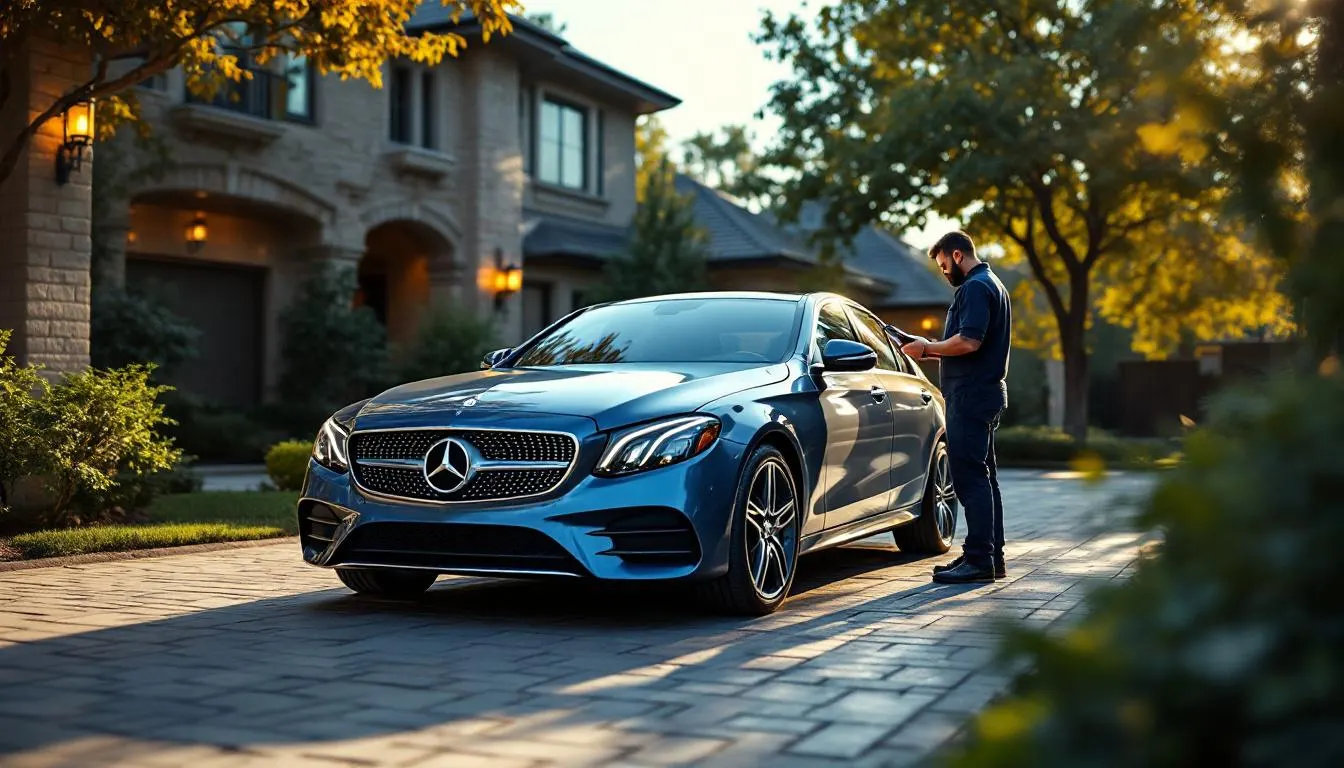
Mercedes immobilizer generations — why FBS3 vs FBS4 matters
Mercedes-Benz vehicles in the Grand Prairie market in 2026 sort cleanly by the immobilizer architecture in the Electronic Ignition Switch (EIS) module, also called the Electronic Steering Lock / EZS (Elektronisches Zündschloss) in earlier German nomenclature. The EIS sits in the dashboard and handles transponder authentication, key list management, and immobilizer authorization. Two generations dominate the current Grand Prairie fleet.
FBS3 (Flexible Belt System 3, roughly 2009–2015). FBS3 EIS modules appear on the W212 E-Class, W204 C-Class, W221 S-Class facelift, W166 ML/GLE, W164 ML late-production, X204 GLK, R172 SLK, and various variants of those chassis. AKL on FBS3 is one of the more manageable bench procedures — AVDI with active FBS3 subscription tier can read the EIS via OBD-II in most configurations, calculate the immobilizer password, and write a new key transponder. Total time on-site typically 2–4 hours depending on configuration.
FBS4 (Flexible Belt System 4, 2016+). FBS4 introduced harder cryptographic protections and appears on the W213 E-Class (2016+), W205 C-Class (2014+ depending on production date), X253 GLC, W167 GLE (2019+), W166 GLE late-production, V167 GLE Coupe, X167 GLS, W447 V-Class metris, and similar. AKL on FBS4 requires bench-level EEPROM work in essentially every configuration. The technician must remove the EIS module from the steering column, open it on the portable workbench inside the service van, read the EEPROM chip directly with specialized programmers, calculate the immobilizer file, write the new key transponder, reinstall the module, verify. Total time on-site typically 4–6 hours.
FBS5 (introduced 2023+ on some new-generation models). The newest Mercedes immobilizer generation is still being characterized by aftermarket platform developers. Current AVDI coverage handles a growing subset of FBS5 vehicles but a meaningful share of brand-new 2026 model-year Mercedes still require dealer-only programming during the first 6–12 months of US release. A credentialed shop will tell you up-front whether your specific year/trim is covered by their current platform subscription.
Why bench-level EIS work is the specialist tier
Abrites Vehicle Diagnostic Interface (AVDI) is the dominant European-specialty platform for Mercedes work, with active brand-license subscription costs running $3,000–$8,000 just for the Mercedes tier (FBS3 and FBS4 may require separate subscription tiers depending on AVDI configuration). On top of the platform investment, FBS4 bench work requires supporting bench equipment: hot-air rework station ($800–$1,500), stereo microscope with adjustable arm ($600–$1,200), precision soldering iron with fine tips ($300–$500), anti-static workstation ($200–$400), chip-clip adapters for the specific EEPROM packages used in EIS modules ($300–$800), and a stock of replacement EIS housings and pins ($400+).
Per ALOA's automotive certification, the Certified Master Automotive Locksmith (CMAL) credential validates competency on this level of bench work. The CMAL exam covers transponder theory, immobilizer architecture, OEM key blade profiles, and ethical practice. The credentialed Mercedes-EIS specialist subset of CMAL holders is even smaller — perhaps a few hundred technicians nationwide who actively maintain the platform subscriptions plus bench equipment plus the operational experience to complete FBS4 AKL reliably.
NASTF VSP credentials matter for FBS4 work specifically because some procedures require dealer-level secure-data access for legitimate authorization. VSP registration requires identity verification, criminal background check, professional references, and ongoing renewal. Without VSP, a locksmith can technically perform FBS3 AKL but operates outside the manufacturer-authorized framework for late-model FBS4 work.
The supply-side reality: the credentialed Mercedes-EIS shop has $25,000–$50,000+ in tooling investment plus $5,000–$10,000 annual subscription costs across AVDI, Autel, NASTF, and supporting platforms. The economics only work if the shop handles a meaningful volume of Mercedes-specific work; this is why the credentialed Mercedes shops in DFW are a small subset of the overall locksmith population.
FBS3 AKL workflow — manageable bench job
FBS3 AKL via AVDI follows a recognizable workflow. Step 1: vehicle identification. Decode the VIN to confirm model year, chassis, and FBS generation. A 2014 W212 E350 sedan is FBS3; a 2017 W213 E300 sedan is FBS4. Same model line, different procedure entirely. Step 2: pre-flight diagnostic. Connect AVDI through OBD-II, scan for fault codes across modules, check for active recalls or pending TSBs that might affect the procedure. Step 3: EIS read. AVDI initiates the FBS3 read sequence, which on most configurations completes via OBD without bench-level removal. The read produces the immobilizer file containing the current key list.
Step 4: immobilizer password calculation. AVDI's FBS3 module calculates the password from the immobilizer file. This is the cryptographic step that distinguishes credentialed AVDI workflow from non-credentialed cloning attempts. Step 5: key cutting. Cut the HU64 or HU92 blade by VIN code (FBS3 blades vary by chassis; the credentialed shop carries the right blank for each). Step 6: transponder programming. Write the new key's transponder identifier into the EIS key list via AVDI. Step 7: verification. Test-start the vehicle, verify all comfort/keyless functions, verify lock/unlock from all doors, confirm panic and trunk release operation.
Total time-on-site for FBS3 AKL: 2–4 hours depending on configuration. The most demanding FBS3 configurations (specifically some 2009–2010 W204 C-Class and W212 E-Class produced during the FBS3 rollout) may require additional bench-level steps that extend total time to 4–5 hours. A credentialed shop will tell you which configuration applies during the booking call based on your VIN.
FBS4 AKL workflow — the deeper bench procedure
FBS4 AKL is fundamentally more involved because the immobilizer file is not readable via OBD-II in most configurations. Step 1: VIN decode + pre-flight (same as FBS3). Step 2: EIS module removal. The technician physically removes the EIS from the steering column. On most chassis this requires removing the steering-column shroud (4–6 screws plus a clip), disconnecting the airbag clockspring connector (always done with battery disconnected and a 10-minute capacitor-discharge wait per Mercedes service procedure), removing the EIS retainer, and unbolting the module from the column. Time: 30–60 minutes depending on chassis access.
Step 3: bench setup. The EIS module goes onto the portable workbench inside the service van. The technician opens the EIS housing carefully (specialized prying tools to avoid breaking plastic clips), exposes the circuit board, and identifies the EEPROM chip. Step 4: EEPROM read. The technician attaches a chip-clip adapter or hot-air-removes the chip for direct reading via specialized programmers (AVDI BIM, Xhorse VVDI Prog, or equivalent). The read produces the raw EEPROM contents containing the immobilizer file.
Step 5: immobilizer file calculation. AVDI's FBS4 module processes the raw EEPROM contents and produces the dealer-key file. This is the cryptographic heart of the procedure. Step 6: key file write. AVDI writes the new key identifier into the EEPROM-staged file, then writes the updated EEPROM back to the chip. Step 7: module reassembly + reinstall. Reverse the disassembly. Step 8: verification. Same as FBS3 plus additional FBS4-specific checks (Comfort Access proximity tuning, KeylessGO if equipped).
Total time-on-site for FBS4 AKL: 4–6 hours. The procedure is sensitive to small errors — an incorrectly written EEPROM byte can brick the EIS module. The credentialed Mercedes-EIS specialist carries the experience and the spare-EIS inventory to handle the rare cases where a re-flash is required mid-procedure.
Honest 2026 Grand Prairie Mercedes pricing
Pricing reflects procedure complexity, parts cost, and labor time. Honest 2026 Grand Prairie-area mobile pricing from a credentialed Mercedes-EIS specialist: Spare key with working key present $250–$420 mobile vs $400–$650 dealer. AKL on FBS3 (W204 / W212 / W221 facelift / W166 / X204 / R172 era) $500–$800 mobile vs $900–$1,500 dealer + tow. AKL on FBS4 (W213 / W205 / X253 / W167 / V167 / X167) $700–$1,100 mobile vs $1,400–$2,200 dealer + tow. Mercedes ESL (Electronic Steering Lock) repair when fault cascades $400–$700 mobile (often a one-stop combined with EIS work).
Three structural cost drivers favoring mobile. First, no towing for AKL. A flatbed from Grand Prairie to Mercedes-Benz of Arlington (4–6 miles) or Mercedes-Benz of Dallas (12–15 miles) adds $100–$200 per AAA-published Texas tow rates. Second, dealer parts pricing. Dealers source EIS-compatible key blanks and SmartKey shells at Mercedes manufacturer MSRP. Independent locksmiths source through trade channels at 50–70% discounts. Third, dealer labor rate structure. Per J.D. Power dealer service customer satisfaction research, suburban DFW dealer service drives bill full diagnostic-and-programming hourly labor for the entire procedure window — and FBS4 AKL is a 4–6 hour window.
Additional factors that can shift pricing within the range: SmartKey shell sourcing ($100–$250 per OEM-branded shell if you want Mercedes-logoed rather than aftermarket OEM-equivalent), NASTF SDRM event fees ($30–$60 for procedures requiring secure-data authentication), after-hours / weekend surcharge ($40–$80 typical), outlying-area trip charge ($20–$40 beyond central Grand Prairie service area).
Mercedes-specific symptoms vs other module faults
Some Mercedes “key issues” turn out to be cascading module faults that masquerade as immobilizer behavior. A credentialed shop performs a multi-system diagnostic scan before quoting AKL, because misdiagnosis at this level is expensive. Common cascading fault patterns:
ESL (Electronic Steering Lock) failure. Mercedes ESL modules from approximately 2003–2014 have a known failure mode that produces an “ignition not authorized” symptom indistinguishable from a key authentication failure. The actual problem is the ESL itself, not the key. Fix is ESL replacement and pairing, not AKL. SRS (airbag) module communication fault. Some Mercedes diagnostic chains require the SRS to be online for the EIS to authorize start; an SRS fault produces a no-start condition that looks like a key issue.
12V battery service-induced trust loss. The EIS can drop a key from the trusted list after a 12V battery disconnect without proper service procedure. The key is intact, the battery is fresh, but the EIS refuses to recognize the fob. Fix is EIS re-pairing of the existing key — not full AKL. CAN bus communication failure. A failed CAN gateway, broken CAN-Bus wiring, or shorted module can produce no-start symptoms that look like immobilizer issues. ABS module fault that cascades. On some chassis the ABS module needs to be online for the immobilizer authorization sequence to complete; an ABS fault can present as a key issue. See our broader writeup of these cascading patterns in the European luxury guide.
The credentialed Mercedes shop's pre-AKL diagnostic protects you from paying $700–$1,100 for FBS4 AKL when the actual problem is a $200–$400 ESL repair or a $50 module re-pairing job. This is why “always quote AKL up-front” locksmiths are doing customers a disservice — the right answer often costs less than the customer feared.
Documentation required at the service appointment
Per Texas DPS Private Security Bureau rules, a credentialed locksmith verifies vehicle ownership before creating new keys. This protects against someone fraudulently creating keys to your Mercedes — a real risk for a $50,000–$150,000 luxury vehicle. Have ready: valid government photo ID in your name, vehicle title or current Texas DMV registration showing your name and the VIN, and proof of insurance matching the VIN and your name.
For leased or financed Mercedes (the majority in the Grand Prairie luxury market), a recent Mercedes-Benz Financial Services or third-party lender statement showing your account and the VIN is acceptable in lieu of the title. For Mercedes-CPO (Certified Pre-Owned) vehicles within the warranty window, bring the CPO documentation as well — some warranty terms affect whether mobile work voids any specific coverage. The credentialed shop reviews this before starting and will tell you up-front if a dealer trip is warranted for warranty reasons.
A note on Mercedes-Benz USA Connect (the connected-vehicle service): some account-linked features (Mercedes me, KeylessGO Digital, in-vehicle assistant) require Mercedes account setup after key changes. The credentialed mobile shop can walk through the post-programming Mercedes me re-pairing during the verification step. This is a customer-driven step, not a locksmith function, but the credentialed shop helps you complete it before leaving.
Choosing a Mercedes-capable Grand Prairie locksmith
Five specific questions to ask any prospective Mercedes locksmith before booking. (1) “Are you ALOA-credentialed with the Master Automotive Locksmith designation, and do you have an active NASTF VSP registration?” A credentialed shop names both credentials and provides registry numbers on request. (2) “What programming platform do you use for Mercedes, and is your subscription current for FBS3 / FBS4?” AVDI with current Mercedes subscription tiers is the expected answer; the shop should know whether your specific year is FBS3 or FBS4.
(3) “Have you done this exact procedure on a [your year/model] Mercedes before?” A specialist gives a confident yes with procedural detail (“Yes, that's a W213 with FBS4 — EIS bench removal, AVDI Mercedes module read, about 5 hours”). A generalist hedges. (4) “What's the all-in price including any blade cutting, programming, and travel?” Per FTC consumer advisories on locksmith scams, written all-in pricing before dispatch is the single most effective scam-protection step. (5) “What happens if you can't complete the work?” An honest answer: “You owe nothing if we can't finish, and we'll tell you up front if we identify a vehicle we can't handle.”
Per BrightLocal's annual local consumer review survey, recent review consistency over volume; a steady 4.5-star average over 2+ years is more credible than a flawless burst. Look for reviews specifically mentioning Mercedes EIS work or W213/W205/X253 procedures to confirm the shop's actual Mercedes experience.
A Real-World Example
Operator: A Grand Prairie homeowner with a 2019 Mercedes-Benz E350 (W213, FBS4) lost both keys after a Saturday family event. One key was misplaced, the second key's fob failed independently the following week. With both keys gone, the vehicle was immobilized in the driveway and the customer faced a Monday-morning commute deadline.
Before:
- Mercedes-Benz of Arlington quote: ~$175 flatbed tow + ~$1,650 dealer FBS4 AKL + ~$220 SmartKey parts = ~$2,045 total, plus 7–10 day service-drive wait
- A non-credentialed mobile shop ("we do everything"): quoted $400 over the phone with no FBS4 mention. Customer confirmed FBS4 capability and the shop withdrew the quote — wasn't equipped
- A credentialed Mercedes-EIS specialist (ALOA-MAL + NASTF VSP + active AVDI Mercedes subscription): quoted $950 all-in for one new key, in writing, in-driveway, Sunday afternoon availability
What changed:
Customer authorized the credentialed shop. Technician arrived Sunday at noon, performed pre-flight diagnostic (confirmed no cascading faults), removed the EIS from the W213 steering column (~45 minutes including airbag-safe disconnect protocol), bench-read the EEPROM, calculated the FBS4 immobilizer file via AVDI Mercedes module, wrote a new SmartKey transponder, reassembled and reinstalled the EIS, verified all functions including Comfort Access. Total on-site time: 5h 20min. Total billed: $950 matched written quote.
Results:
- Time on-site: 5h 20min (within the 4–6 hour FBS4 AKL band)
- Total price: $950 all-in matched the upfront written quote
- Customer outcome: working SmartKey in hand Sunday evening, full Monday commute capability restored
- Net savings vs the dealer route: approximately $1,095 ($2,045 dealer total minus $950 mobile total), plus ~6–9 days of time saved
Net: Per AAA repair-cost research, mobile automotive locksmith services consistently run 35–60% below dealer service-department pricing — and the structural advantage is largest on FBS4 AKL because the dealer route requires a flatbed tow plus 4–6 hours of dealer-rate diagnostic-and-programming labor. The non-credentialed mobile shop's $400 quote was honest in the sense that they realized mid-call they couldn't complete the work; the right outcome for everyone.
What Experts Say
“Mercedes EIS work splits sharply at the FBS3 / FBS4 boundary. A Tier 2 specialist with AVDI Mercedes subscription handles FBS3 AKL via OBD workflow without bench removal in most configurations. FBS4 is fundamentally a bench job — you cannot read the immobilizer file via OBD on W213, W205, X253, W167 in standard configurations, and the EIS must come off the column for direct EEPROM access. The customer-facing implication: ask whether your shop has done FBS4 bench work, not just whether they do Mercedes generally. The platform investment is significant and not every shop carries it.”
Per ALOA's automotive certification standards, the Certified Master Automotive Locksmith credential validates competency on bench-level EEPROM work including Mercedes FBS4 EIS pairing. Operators without this credential can still handle older mechanical Mercedes work (pre-2003 vehicles) and basic transponder work on FBS3 vehicles, but FBS4 bench-level AKL sits at the specialist tier and should be disclosed up-front by any honest provider.
Frequently Asked Questions
How long does Mercedes key programming take in Grand Prairie?
Time varies by FBS generation. Spare-key programming with a working key present: 45–75 minutes for most FBS3 vehicles, 60–90 minutes for FBS4. AKL on FBS3 (no working key): 2–4 hours. AKL on FBS4: 4–6 hours of bench work. The credentialed shop will quote a realistic time band before dispatch based on your specific VIN and FBS generation.
Will my Mercedes me connected services reset when I get a new key?
The vehicle-side Mercedes me account remains active. The new key needs to be paired into your Mercedes me Digital Key list if you use that feature; this is a customer-driven step done through the Mercedes me app after the locksmith leaves. KeylessGO and Comfort Access tuning are completed by the locksmith during the post-programming verification step.
My Mercedes won't start but the key fob is intact — what should I expect?
Several possibilities, and the diagnostic order matters. Most common on FBS3/FBS4 vehicles: smart-key trust loss after a 12V battery disconnect, fixed by EIS re-pairing of the existing key ($150–$300, much cheaper than AKL). Second-most-common: ESL (Electronic Steering Lock) failure on some 2003–2014 vehicles, presents as ignition-not-authorized but the fix is ESL repair ($400–$700), not AKL. Third: cascading module fault from ABS, SRS airbag, or CAN bus — the credentialed shop runs a multi-system scan before quoting AKL.
Can you handle Mercedes AMG performance variants?
Yes. AMG variants (C63, E63, S63, GLE63, GLS63, GT, etc.) share the underlying Mercedes immobilizer architecture with their standard counterparts (W205/W213/W222/W167/X167). The EIS, FBS generation, and key procedure are identical to the non-AMG variant. Pricing is the same as the equivalent non-AMG vehicle on the same chassis. AMG-specific features (Race Start, AMG Drive profiles) don't affect the key procedure.
What about Mercedes Sprinter / Metris commercial vehicles?
Yes. Sprinter and Metris use related immobilizer architecture but with chassis-specific procedural variations. Some Sprinter chassis (specifically late 906 and W907) use FBS3-derivative immobilizer; W447 Metris uses FBS4-derivative. AKL pricing for commercial Sprinter / Metris runs $700–$1,100 mobile depending on chassis and configuration. The credentialed shop should confirm specific platform coverage during the VIN check.
Should I add a spare Mercedes key now even with one working key?
Yes, almost always. Adding a spare while you have one working key takes 45–90 minutes via AVDI OBD workflow and runs $250–$420 mobile. Compare to $700–$1,100+ for FBS4 AKL after the working key fails or is lost. The break-even is overwhelming — most Mercedes owners come out ahead by making a spare during the first month of ownership. SmartKey shell sourcing can take 2–5 days for OEM-branded shells, so plan ahead if you want the genuine Mercedes-logoed shell rather than aftermarket OEM-equivalent.
The Bottom Line
Mercedes key replacement in Grand Prairie is mobile-friendly for FBS3 vehicles and specialist-tier work for FBS4. The structural cost gap vs the dealer route is meaningful (40–55% on FBS4 AKL specifically, driven by the tow requirement plus dealer-rate labor billing for 4–6 hours). Choose by credential check (ALOA-MAL + NASTF VSP), platform subscription confirmation (AVDI current for FBS3 and FBS4 if applicable), written all-in pricing, and specific procedural confidence on your year/model — not by lowest advertised price.
Next Steps
For a Grand Prairie Mercedes owner needing key work, the right next step is a 5-minute pre-booking call to verify credentials, platform coverage, all-in pricing, and realistic ETA. See our BMW key programming Grand Prairie guide for the parallel German luxury workflow, and our European luxury keys guide for the broader brand-by-brand context.
Sources cited in this article
- Associated Locksmiths of America (ALOA) certification
- National Automotive Service Task Force (NASTF) VSP Registry
- Abrites Vehicle Diagnostic Interface (AVDI)
- J.D. Power dealer service customer satisfaction research
- AAA roadside assistance and repair-cost research
- Texas DPS Private Security Bureau
- FTC consumer advisories on locksmith scams
- BrightLocal local consumer review survey
- NHTSA vehicle recall lookup