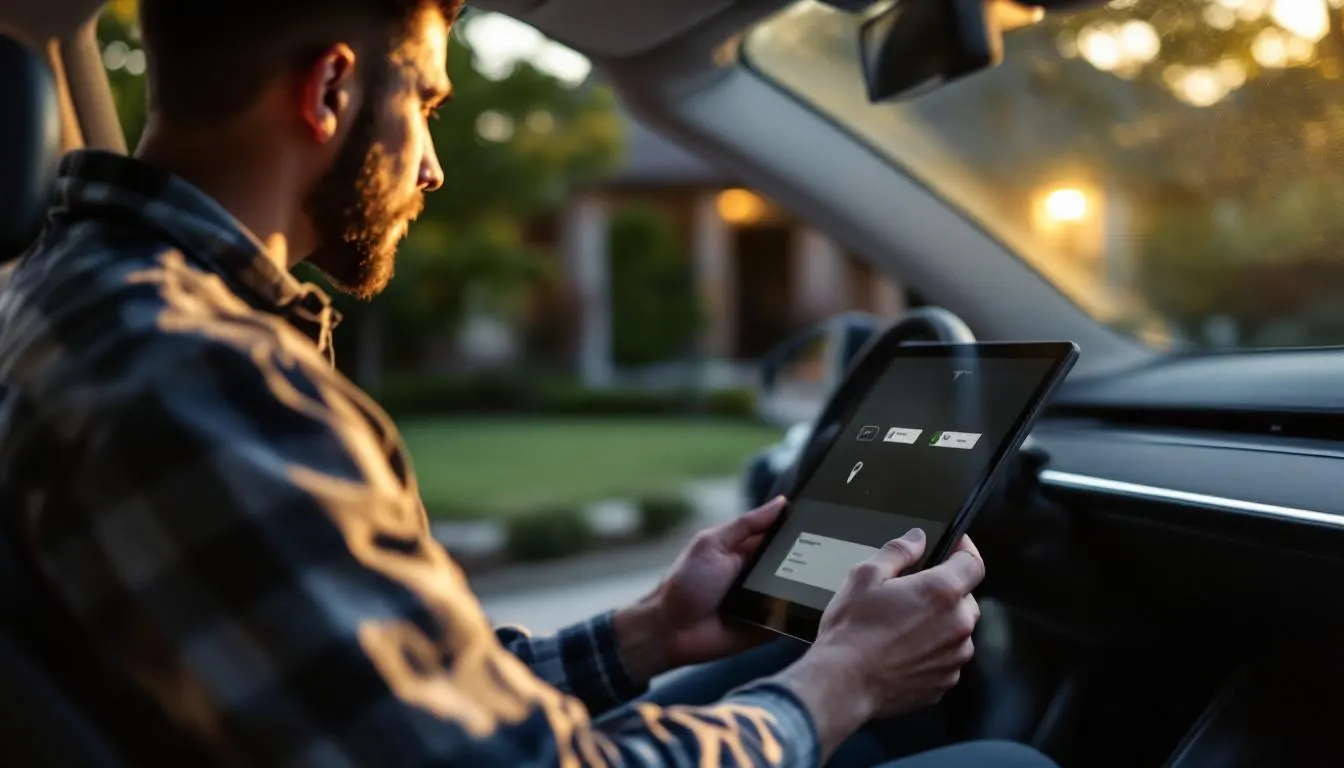
Tesla key types — three different systems
Tesla uses three different key types across its lineup, each with its own pairing workflow. Understanding which key types your specific Tesla uses determines the right service path.
NFC Key Cards. The thin RFID-style credit-card-sized credentials included with every Model 3 (since 2017), Model Y (since 2020), refreshed Model S (since 2021), and refreshed Model X (since 2021). The key card works by being held against the B-pillar reader to unlock the door, then placed on the center console RFID reader area to enable drive. Tesla owners typically receive two key cards with the vehicle plus the option to purchase additional cards from Tesla ($35 each as of 2025–2026 pricing).
Phone-as-Key. Bluetooth-based virtual key paired through the Tesla mobile app on iOS or Android. Phone-as-key works as a proximity unlock and start system without requiring the phone to be in the customer's hand — the vehicle detects the paired phone via Bluetooth and authorizes entry and drive. This is the default daily-use key for most Tesla owners; the NFC card serves as backup.
Traditional Smart Key Fob. Optional accessory for Model S and Model X (both refreshed and pre-refresh generations), standard on the legacy Roadster. The Tesla key fob looks similar to traditional luxury smart keys with passive entry / keyless start. Model 3 and Model Y do not officially support a Tesla-branded traditional fob, though aftermarket alternatives exist with varying reliability.
How Tesla key pairing differs from traditional brands
Tesla's key pairing architecture differs fundamentally from BMW/Mercedes/Audi. Traditional brands pair keys through the immobilizer module via OEM dealer tooling (or AVDI/Autel aftermarket equivalents) with secure-data authentication through NASTF SDRM. Tesla pairs keys directly through the vehicle's center console UI using a sequence built into the Tesla operating system.
Tesla key card pairing flow: the customer (or technician) opens the vehicle's “Locks” menu in the center console UI, taps “Add Key,” holds the new card against the B-pillar reader, places the new card on the center console reader area, and confirms the addition. The pairing takes about 60 seconds. Phone-as-key pairing flow: the Tesla app on the customer's phone is configured with the vehicle, then a one-time pairing handshake completes through Bluetooth proximity authentication.
The practical implication: Tesla key card and phone-as-key pairing don't require AVDI, Autel, NASTF SDRM, or specialized locksmith tooling in the traditional sense. The pairing is a vehicle-UI operation. What a credentialed mobile locksmith brings to Tesla work is: prompt response time when service-center scheduling is constrained, ability to diagnose hardware faults that pairing alone can't resolve, support for traditional Tesla fob work (which does involve more traditional pairing workflows), and remediation when key pairing has gone wrong in ways the customer can't troubleshoot through the Tesla app.
When Tesla service center is the right call
For most routine Tesla key events, the Tesla service center is the structurally correct service path. Three reasons.
First, Tesla card pricing. The NFC key cards themselves are inexpensive — Tesla sells them at $35/card direct to consumers. Adding a replacement card if you've lost one is a $35 part plus 60 seconds of customer-driven pairing. A mobile locksmith can't structurally beat $35 plus self-service pairing. Per J.D. Power dealer service customer satisfaction research, Tesla service tends to score well on routine service satisfaction.
Second, Tesla scheduling. Tesla's service-center scheduling is generally faster than traditional luxury-brand dealer scheduling. The Tesla app routinely offers same-day or next-day appointments for key events. For routine card replacement, the few-hour wait is acceptable.
Third, Tesla mobile service. Tesla itself operates a mobile service fleet that comes to the customer for many maintenance and minor repair events including some key-related work. For Tesla owners specifically, Tesla's own mobile service is often the right first call before considering third-party mobile locksmith dispatch.
When a credentialed mobile locksmith is the right call
Three categories of Tesla situation where a credentialed mobile locksmith adds meaningful value beyond Tesla's direct service.
Emergency response. Tesla service-center scheduling is fast for routine events but constrained for late-night/weekend emergencies. A credentialed mobile locksmith dispatches 24/7 with sub-60-minute response for most Grand Prairie addresses. If you're locked out at midnight, the locksmith arrives in 30–45 minutes. Tesla's mobile service typically doesn't operate at those hours.
Phone-as-key pairing problems and hardware faults. When phone-as-key isn't pairing correctly, when the vehicle's Bluetooth receiver appears faulty, when card reader at the B-pillar or console isn't recognizing valid cards — these are situations where a credentialed technician's diagnostic experience matters. Per AAA roadside-assistance industry data, key-related events are among the top five reasons for roadside service requests.
Traditional Tesla fob (Model S, Model X) work. The Tesla smart-key fob for Model S and Model X involves more traditional pairing workflows that benefit from professional service. Lost fobs need to be deauthorized from the vehicle's key list, new fobs need to be paired, and there are warranty considerations for some procedures. A credentialed shop handles these in-driveway with full verification.
Lockout entry for any Tesla. When you're locked out (key card inside the locked vehicle, phone-as-key not pairing due to dead phone battery), the credentialed mobile locksmith uses the same air-wedge + reach-tool no-damage entry method used on any modern vehicle. Tesla's flush door handles add some specific access considerations but no fundamental procedural change.
Honest 2026 Grand Prairie Tesla pricing
Pricing reflects the unique structure of Tesla's direct-to-consumer model vs traditional luxury locksmith pricing. Honest 2026 Grand Prairie-area pricing:
NFC key card events. Tesla direct: $35 per card plus customer-driven pairing (free). Credentialed mobile: $80–$150 for card replacement + technician-driven pairing including verification. Mobile makes sense for situations where customer can't (or doesn't want to) handle pairing themselves, or for emergency response.
Phone-as-key pairing issues. Tesla direct via service center: included in service-center appointment (typically $0 if not a paid diagnostic). Credentialed mobile: $50–$150 for in-driveway pairing assistance. Mobile makes sense when the issue is intermittent / hard to reproduce and you want a technician to verify resolution.
Traditional fob work (Model S, Model X). Tesla direct: $300–$500 typical for fob replacement + service-center pairing. Credentialed mobile: $300–$500 for fob replacement + in-driveway pairing. Roughly equivalent pricing; choose by convenience.
Lockout entry only. Credentialed mobile: $75–$120 daytime, $100–$180 night/weekend/holiday. Tesla's own roadside service includes lockout entry for owners enrolled in their roadside program.
Emergency response premium. Late-night, holiday, and emergency situations carry mobile pricing premiums of $40–$80 above daytime rates. For situations where Tesla can't respond quickly enough, this premium is meaningful value.
Tesla-specific scenarios that benefit from third-party expertise
Several Tesla situations where a credentialed mobile locksmith adds value beyond what Tesla's direct service typically provides.
Used Tesla purchases with key uncertainty. Buying a used Tesla from a private seller sometimes comes with uncertainty about how many keys exist, who has access to phone-as-key, and whether previous-owner credentials are still active. A credentialed locksmith can audit the vehicle's current key list, identify orphaned phone-as-key entries that should be removed, and walk through a clean key-state reset for the new owner. This is value-added work that Tesla's standard service typically doesn't include unless requested.
Family-vehicle key allocation. Households with multiple Tesla drivers sometimes want to add/remove phone-as-key access as family members come and go (teen drivers, college students, divorce situations). A credentialed shop can audit and clean up the key list as a paid service, including helping the customer understand what each key entry represents.
Lost-or-stolen Tesla scenarios. If a Tesla key card or fob is lost, the existing key remains paired and authorized for entry/drive. The credentialed shop can deauthorize the lost key from the vehicle's trusted list (similar to AKL on traditional brands) and program a new key, ensuring the lost key can no longer access the vehicle. This is a specific security-driven service that benefits from professional execution.
Charging port-lock failures masquerading as key issues. Tesla's charging port latch can fail in ways that produce symptoms looking like access/key issues. The credentialed shop's multi-system diagnostic distinguishes charging port from key-list issues before quoting AKL-style remediation.
When the locksmith arrives — what to expect
For Tesla service appointments, a credentialed mobile shop's workflow looks slightly different from traditional luxury brand work. Documentation: per Texas DPS Private Security Bureau rules, the technician verifies vehicle ownership before performing key work. Have valid government photo ID in your name, Tesla title or Texas DMV registration with your name and VIN, and proof of insurance ready.
Tesla account access. Some Tesla key procedures (particularly phone-as-key pairing audit and clean-up) require coordination with the customer's Tesla app. The locksmith does not handle your Tesla account credentials directly — you complete app-side steps on your phone while the technician walks you through what to confirm. This is the safest pattern for both parties.
Vehicle access. Tesla's flush door handles auto-extend when an authorized key (card, phone-as-key, or fob) is detected nearby. For lockout entry, the technician uses standard no-damage entry methods (air-wedge + long-reach tool through the door seal) to access the cabin and reach the door unlock control. Once unlocked, normal access proceeds.
Pairing verification. After any key change, the technician verifies all pairing scenarios — card at B-pillar unlock, card at center console drive enable, phone-as-key proximity entry, phone-as-key drive enable. For traditional fobs (Model S, X), all proximity-detection functions are verified. The pairing must be confirmed working before the appointment closes.
Choosing a Tesla-capable Grand Prairie locksmith
Five specific questions for any prospective Tesla locksmith. (1) “Are you ALOA-credentialed and have you worked on Tesla vehicles before?” A specialist confirms Tesla experience with specific procedural detail. (2) “What specific Tesla scenario am I in — card replacement, phone-as-key pairing, traditional fob work, lockout entry, or full key-list audit?” The right answer matches the right scope and price; vague “we do Tesla” without specifics is a flag.
(3) “Should I be calling Tesla service center instead?” An honest locksmith will tell you when Tesla's direct service is the better answer. For routine card replacement during business hours, Tesla's $35 card + customer-driven pairing genuinely beats any mobile alternative. The right credentialed shop is honest about this rather than maximizing the customer's spend. (4) “What's the all-in price including any parts, programming, travel, and verification?” Per FTC consumer advisories on locksmith scams, written all-in pricing is essential. (5) “What's your honest ETA right now?” For emergency response, real ETA matters more than “fast” promises.
Per BrightLocal's annual local consumer review survey, recent review consistency matters. Look for reviews specifically mentioning Tesla work, which is less common in general locksmith review pools — the Tesla-experienced credentialed shop will have specific Tesla-related reviews.
A Real-World Example
Operator: A Grand Prairie resident with a 2022 Tesla Model Y dropped both key cards into a lake during a Saturday recreational trip. With both cards gone, the customer relied on phone-as-key for the drive home — but the next morning the phone battery died and the proximity-pairing didn't work as expected, leaving the customer locked out with the vehicle in their own driveway.
Before:
- Tesla service center: next-day appointment slot available, $70 for two replacement cards plus self-service pairing; required driving to Tesla Plano
- Tesla mobile service: requested, but earliest dispatch window was 3 days out due to demand
- Credentialed mobile locksmith: same-day response within 35 minutes for lockout entry plus card-replacement-and-pairing service in driveway
What changed:
Customer chose mobile dispatch for the immediate lockout. Technician arrived in 32 minutes, performed air-wedge no-damage entry through upper rear-door corner, reached interior unlock control (under 4 minutes work time), then walked the customer through pairing two replacement cards purchased from a Tesla service center bookmark. The technician verified all pairing scenarios — B-pillar unlock, center console drive enable, and confirmed phone-as-key was properly authorized again after the customer recharged the phone. Total appointment time: 75 minutes including pairing and verification.
Results:
- Total time: 75 minutes from initial call to customer driving away
- Total cost: $95 (lockout entry, weekend rate) + $35 × 2 cards from Tesla = $165 effective total
- Customer outcome: immediate vehicle access restored, two new functional cards, phone-as-key re-confirmed, no extended wait
- Tesla service center comparison: same total parts cost but 24+ hour wait plus required drive to Plano — not a viable option for the immediate need
Net: For routine Tesla card replacement during business hours with a working alternative key, Tesla's direct service is structurally the right answer at $35/card. For emergency lockout-plus-replacement scenarios, the credentialed mobile shop's immediate response is what makes the difference — the customer paid a $95 service-call premium to avoid a 24+ hour wait, which was the right trade-off for the immediate situation.
What Experts Say
“Tesla is the brand where the mobile-vs-dealer default flips. For traditional luxury brands the credentialed mobile shop is structurally cheaper and faster than the dealer for most scenarios. For Tesla, the direct-to-consumer service model with $35 key cards and fast service-center scheduling means Tesla's own service is often the right first call for routine work. Where mobile adds genuine value is emergency response, complex pairing issues, traditional Model S/X fob work, and lockout entry. An honest locksmith tells the customer when Tesla service is the better path rather than maximizing their own quote.”
Per ALOA's automotive certification standards, the credentialed locksmith's obligation includes honest customer guidance about when manufacturer service is the better path. Tesla's direct-to-consumer service model is a case where transparent guidance matters more than maximizing the locksmith's own service revenue.
Frequently Asked Questions
Can a mobile locksmith pair a Tesla key card?
Yes. Tesla key card pairing is a vehicle-UI operation that doesn't require special locksmith tooling — it works through the center console interface. A mobile locksmith can perform the pairing in your driveway including verification. For routine card replacement during business hours with no urgency, Tesla's direct service at $35/card is often cheaper. Mobile becomes valuable for emergency response or when you want a technician to handle and verify the pairing.
My Tesla phone-as-key isn't working — what should I do first?
Standard troubleshooting order: (1) confirm Bluetooth is enabled on your phone and the Tesla app has location access permissions, (2) re-pair the phone via the Tesla app's vehicle settings, (3) charge your phone (low battery sometimes affects Bluetooth pairing), (4) try the key card as backup. If steps 1–3 don't resolve, contact Tesla service center first. Mobile locksmith helps when service-center scheduling is constrained or the issue requires hands-on diagnostic.
I lost my only Tesla key card AND my phone is dead — what now?
This is the emergency scenario where mobile locksmith dispatch is the right call. The technician arrives in 30–60 minutes, performs no-damage entry through the air-wedge method, helps you get the vehicle open. Once inside you can use the center console to add a new card via the Tesla service center order or use Tesla app on a borrowed phone to re-pair phone-as-key. Mobile cost: $80–$180 depending on time-of-day.
Do you replace traditional Tesla fobs for Model S and Model X?
Yes. Traditional Tesla smart-key fob replacement for Model S and Model X involves sourcing a Tesla-branded fob (typically through Tesla parts channels or aftermarket equivalent), pairing through the vehicle's key-list management interface, and verifying all proximity-detection functions. Pricing typically $300–$500 mobile vs $400–$700 at Tesla service center. Model 3 and Model Y don't officially support Tesla traditional fobs; aftermarket alternatives exist with variable reliability.
Can you help me audit and clean up my Tesla's key list?
Yes, this is one of the high-value Tesla services. For used-Tesla purchases, family-vehicle key allocation, divorce or roommate situations, or any scenario where you want to confirm exactly who has authorized access to your vehicle, a credentialed shop walks through the full key list (cards, phone-as-key entries, traditional fobs) and helps you decide what to keep, remove, or rename. Pricing: $50–$120 for the audit-and-cleanup service.
Should I get a backup Tesla key card?
Yes, almost always. Tesla key cards are $35 direct from Tesla; having a backup card stored in your wallet or at home is cheap insurance against phone-battery failures, phone loss, app outages, or other phone-as-key reliability issues. The backup card costs significantly less than emergency mobile dispatch ($75–$180) when you find yourself unexpectedly without a working key.
The Bottom Line
Tesla key replacement in Grand Prairie is the brand where the default mobile-vs-dealer calculus flips. For routine card replacement during business hours, Tesla's direct $35/card with fast service-center scheduling structurally beats mobile locksmith pricing. For emergency response, complex pairing issues, traditional fob work (Model S, X), key-list audits, and lockout entry, a credentialed mobile shop adds meaningful value. The honest answer is: call Tesla first for routine card needs, call a credentialed mobile locksmith for emergencies and complex scenarios.
Next Steps
For Tesla owners in Grand Prairie, identify whether your need is routine (call Tesla service center) or emergency/complex (call a credentialed mobile shop). For all routine matters, schedule directly through the Tesla app. For situations where Tesla scheduling is constrained or you need immediate response, the credentialed mobile shop is the right call. See smart car vs smart home for broader context on smart-key security across vehicle types.
Sources cited in this article
- Associated Locksmiths of America (ALOA) certification
- National Automotive Service Task Force (NASTF) VSP Registry
- J.D. Power dealer service customer satisfaction research
- AAA roadside assistance and repair-cost research
- Texas DPS Private Security Bureau
- FTC consumer advisories on locksmith scams
- BrightLocal local consumer review survey