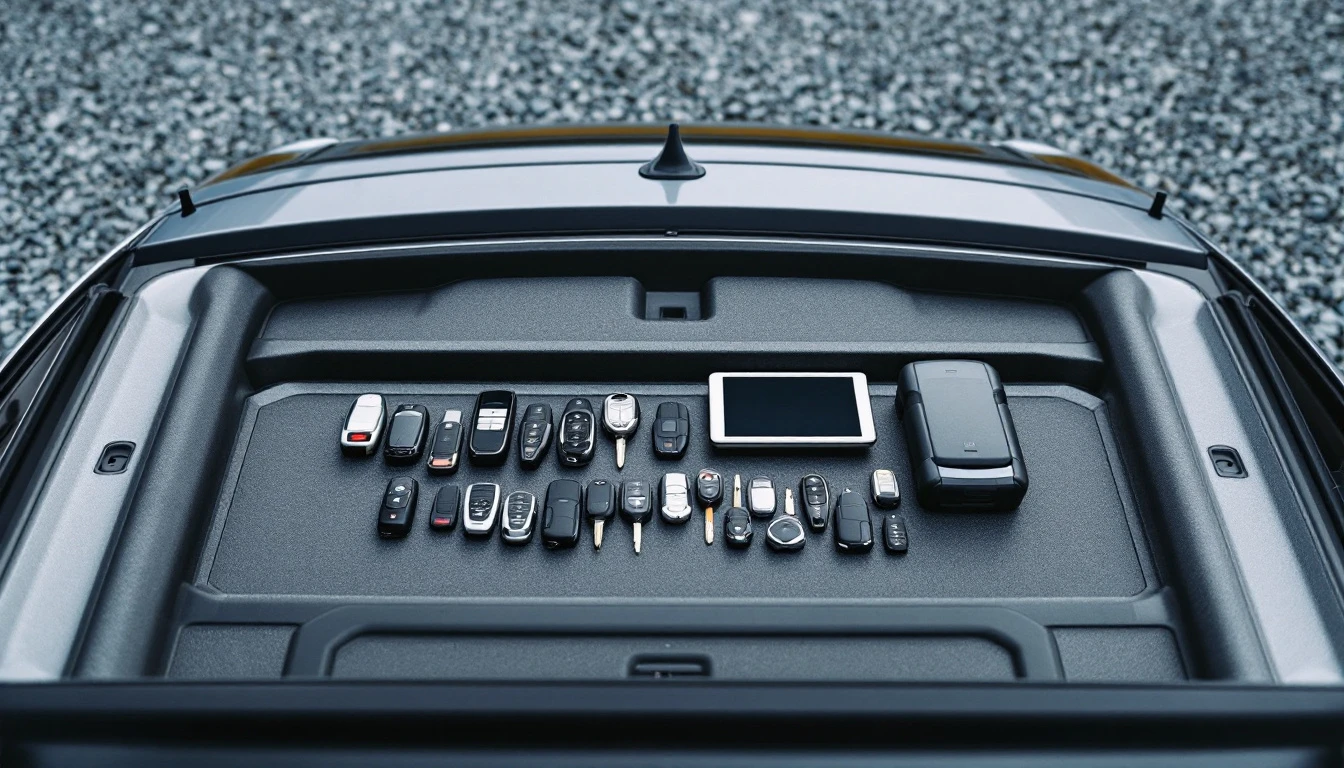
Two key types, and which one you have
Subaru's current generation of Outback and Forester is push-button start with a Keyless Access proximity fob on most trims: passive entry, push-button start, remote functions, and an emergency blade concealed in the housing for when the coin cell dies.
Earlier cars and base trims use a bladed transponder key — a metal key with a chip in the head, read by an antenna ring at the ignition cylinder. Plenty of these are still in daily service around Grand Prairie, because Subarus are kept.
The distinction is roughly a $100 swing on the price of a spare, and it is not reliably predictable from the model year alone because trim decides it too. A base Forester and a Touring from the same year can take different keys.
On either type the mechanical blade needs cutting to the factory code from the VIN. On the proximity cars that blade is the thing that gets you into the cabin when a fob battery dies in a car park two hours from home — which is a scenario Subaru owners hit more often than most, and worth having tested rather than assumed. Our car key replacement page covers the range.
The all-keys-present rule, and why it catches people out
Here is the practical detail that separates a smooth Subaru appointment from an annoying one. On these platforms, enrolling a new key generally rewrites the vehicle's whole trusted list from what is physically present at that session. Keys not in the technician's hand are not on the new list.
The failure mode is quiet and delayed. You get your new spare, everything works, and three weeks later your partner tries the old key that lived in their bag the whole time and it does nothing. Nobody connects the two events, and it reads as a fault in a key that was fine.
So: gather them before the appointment. Every fob, every bladed key, the one in the kitchen drawer, the one in the other car, the one the previous owner handed over in an envelope. If a key genuinely cannot be found in time, say so on the phone — it is not a disaster, but the technician needs to know it will be dropped rather than discovering it later.
This is a Subaru characteristic more than a Subaru flaw; several Japanese makes behave this way, and it exists precisely because a security system that lets absent credentials survive a registration session is a weaker one. Our car key programming page covers the enrolment step.
Grand Prairie pricing, as of August 2026
Bladed transponder key, spare with a working key present: $150–$240. Keyless Access proximity fob, spare with a working key present: $190–$300. All keys lost, either type: $250–$500 depending on model year and fob variant.
Second key at the same visit: 30–50% of the first, and closer to a third on an all-keys-lost job — the access work happens once. Emergency blade or mechanical key cut only: $45–$85. Fob shell or button-pad transplant reusing your existing board: $60–$120, with no programming at all.
Those figures include the key or fob, the blade cut to factory code, every registration the car requires, verification, and the mobile trip inside the core service area. Outlying addresses may add a $20–$50 trip charge. No tow is included because none is needed — all-keys-lost is completed where the car stands.
For the full picture across makes and scenarios see our 2026 Grand Prairie cost guide, and for the same class of proximity-key work on a comparable crossover our Honda Civic and CR-V smart key guide.
Why so many Subarus are down to one key
It is an artefact of how long these cars stay in service. A car sold new with two keys passes to a second owner with one, because the first owner kept a spare in a drawer and forgot it in the move. The second owner never thinks about it, because one key works fine right up until the moment it does not.
The consequence is that the Subaru population running on a single credential is unusually large, and the people driving them tend to be exactly the people for whom a lost key is most disruptive — the car is loaded with something, it is somewhere with a trailhead or a campsite rather than a kerb, and there is no second vehicle nearby.
The arithmetic is not subtle. A spare bought calmly today: $150–$300. All keys lost bought under duress: $250–$500, plus the afternoon, plus whatever the interruption cost. The spare is roughly half the price of the event it prevents.
And if you bought your Outback or Forester used with one key, do the phone call first. A second fob very often still exists with the previous owner or the selling dealer, sitting in a drawer. Ten minutes on the phone is worth $200, and if one turns up it also has to come to the appointment for the reason above.
Before you buy: the checks worth two minutes
The coin cell first. A weak battery in a proximity fob measures fine at rest and sags under transmission load, so it works at two feet and fails at ten. Subaru provides a backup: hold the fob against the start button and press the brake. If the engine fires, you need a battery, not a fob.
Trust loss after a flat 12V or a jump start. An interrupted supply can leave the security module refusing an otherwise valid key. It presents exactly like a dead fob and is not; a relearn resolves it with no new parts.
Worn buttons and a cracked shell around a healthy board. On a car that has done a decade of school runs and gravel roads, the case fails long before the electronics do. A shell or button-pad transplant reusing your existing board is $60–$120 and needs no programming, because the car already trusts that board. Ask for it by name; very few shops volunteer it. See our key fob replacement page.
And on a bladed-key car, a sticky ignition is usually the key, not the cylinder. Brass is softer than the wafers it rides against, so the key wears first. A fresh cut to the factory code is both the test and, most of the time, the fix — the same pattern our Lancer and Mirage ignition guide works through in detail.
What the visit looks like
A spare-key visit runs 20–40 minutes at your home, office or kerbside. VIN and trim confirmed, ownership verified, blade cut to factory code from the VIN, diagnostic tool connected at the OBD-II port, and the new key enrolled — along with every other key you brought, for the all-keys-present reason above.
Verification should be done with the other keys well out of range. Engine start on the new key alone; remote lock and unlock at realistic distance rather than arm's length; passive entry at each door that has it, plus the tailgate; and the remote-start function if the trim carries one. Skipping the passive-entry check is the commonest shortcut and the commonest callback.
All keys lost runs 60–110 minutes and begins with documents: photo ID plus title, registration, or insurance matching the VIN, with the names lining up. That is not negotiable, and a shop willing to waive it has told you something about itself.
You should have an all-in figure in writing before work starts. Our mobile locksmith page covers what comes to the car, and our 2026 guide to choosing a Grand Prairie locksmith covers what to ask before you book.
Mobile versus dealer for a Subaru key
Subaru is a well-supported platform for credentialed mobile shops, and the structural case is the familiar one. No tow is needed even for all-keys-lost — and per AAA roadside and repair-cost research, avoiding a flatbed is the single largest structural saving on any immobilised-vehicle job. Parts come through trade channels rather than a parts counter at list. And the work happens where the car already is, on the day you call.
The dealer genuinely wins on warranty work, on recall or campaign work that must be recorded in the manufacturer's system, and on the small set of very recent configurations where programming access routes through manufacturer-side authorisation. An honest shop names those categories and checks your VIN before dispatch.
The framework under which credentialed independents access vehicle security functions is maintained by the National Automotive Service Task Force; certification standards are published by ALOA; and Texas locksmith licensing runs through the DPS Private Security Program — not TDLR, despite how many listings say otherwise.
One pricing warning. An advertised “$29 car key” is not a price for a programmed proximity fob; per the FTC's locksmith scam guidance, that is the documented opening of a quote that changes on arrival. Get the all-in number before anyone is dispatched. Our locksmith versus dealership comparison lays out the decision tree.
A Real-World Example
Operator: A Grand Prairie household bought a 2018 Subaru Outback used with a single Keyless Access fob and drove it that way for two years. When they finally booked a spare, they mentioned in passing that a second fob had come with the car in an envelope and was "somewhere in the garage".
Before:
- One working fob in daily use, shared between two drivers
- A second original fob believed to exist but not located
- Assumption that the spare would simply be added alongside whatever else existed
What changed:
The technician explained the all-keys-present characteristic before booking and asked the household to find the envelope first. It turned up in a box of paperwork, with a flat battery — which is why it had been assumed dead and set aside. A fresh coin cell brought it straight back to life. Rather than buying a spare at all, the household now had two working fobs; a third was enrolled anyway at their request, with all three physically present so none was dropped from the trusted list.
Results:
- Time on site: 33 minutes
- Coin cell for the "dead" original fob: $10 — it was never faulty
- Third fob cut, enrolled and verified with all keys present: $255
- Household went from one working key to three, with none silently deregistered
Net: Two useful things happened. A fob written off as dead was a $10 battery, and the all-keys-present conversation happened before the appointment rather than three weeks after it — which is the difference between three working keys and one working key plus two expensive paperweights.
What Experts Say
“The thing I tell every Subaru owner before I even quote is: find every key you own and have them all in your hand when I arrive. On these cars the programming session rewrites the list from what is in front of me, and anything not present drops off. Nobody notices on the day. They notice three weeks later when the other half tries the key that lived in their handbag and the car ignores it, and by then nobody remembers the appointment. It is the single most avoidable second call-out I see. And while you are looking for them — half the time the "missing" spare turns up with a flat battery and it is a six dollar fix, not a three hundred dollar one.”
Per ALOA's automotive certification standards, on platforms whose registration routine rewrites the immobilizer's trusted-credential table from the set presented during the session, all credentials intended to remain valid must be present at programming — a procedural requirement of the security design rather than a defect, and one that is properly communicated to the customer before the appointment.
Frequently Asked Questions
How much is a spare key for a Subaru Outback or Forester in Grand Prairie?
As of August 2026, a bladed transponder key spare runs $150–$240 and a Keyless Access proximity fob spare runs $190–$300, both with a working key present. All keys lost runs $250–$500 depending on model year and fob variant. Those figures include the key, the cut blade, all registrations, verification and the mobile trip inside the core service area.
Why do I have to bring all my Subaru keys to the appointment?
Because the registration session generally rewrites the vehicle's trusted-key list from whatever is physically present. A key left in a drawer at home is dropped from that list and stops working — usually noticed weeks later, when nobody connects it to the appointment. Gather every fob and bladed key you own before the technician arrives.
I bought my Subaru used with one key. Is a second one worth it?
Almost always, on pure arithmetic. A spare bought calmly is $150–$300; all keys lost is $250–$500 plus the afternoon it consumes. But make one phone call first — a second fob very often still exists with the previous owner or the selling dealer. If it turns up, bring it to the appointment too.
Does a Subaru have to be towed if I have lost every key?
No. A credentialed mobile shop completes all-keys-lost where the car sits, in roughly 60 to 110 minutes, entirely through the OBD-II port. Bring photo ID plus title, registration, or insurance matching the VIN, with the names lining up.
My Forester fob only works up close. Is it dying?
Usually the coin cell, which reads fine at rest and sags under transmission load — that is exactly the short-range symptom. Hold the fob against the start button and press the brake; if the engine starts, the electronics are fine. If a fresh battery does not restore range, look for a cracked shell letting moisture reach the board.
The buttons on my fob have worn through. Do I need a whole new key?
Usually not. If the board and transponder inside are healthy, a shell or button-pad transplant reusing your existing electronics costs $60–$120 and needs no programming at all, because the car already trusts that board. Ask for it by name. Visible corrosion on the board is the case where replacement is the honest answer.
The Bottom Line
A spare key for a Subaru Outback or Forester is $150–$300 in Grand Prairie as of August 2026, against $250–$500 once every key is gone. The Subaru-specific rule is the one to remember: bring every key you own to the appointment, because the session rewrites the trusted list from what is physically present. And before you buy anything, put a fresh coin cell in the fob you think is dead — on this make it is remarkably often the whole answer.
Next Steps
Call (214) 949-1847 with your VIN, model year and trim, and say whether your current key is a metal bladed key or a push-button-start fob. Gather every key you own before the appointment, including any that seem dead. See car key replacement Grand Prairie, smart key programming, and key fob replacement for the underlying services.
Sources cited in this article
- Associated Locksmiths of America (ALOA) certification
- National Automotive Service Task Force (NASTF)
- AAA roadside assistance and repair-cost research
- FTC consumer guidance on locksmith scams
- Texas DPS Private Security Program
- SAE International vehicle security standards
- National Highway Traffic Safety Administration (NHTSA)
- Federal Communications Commission (FCC) equipment authorization