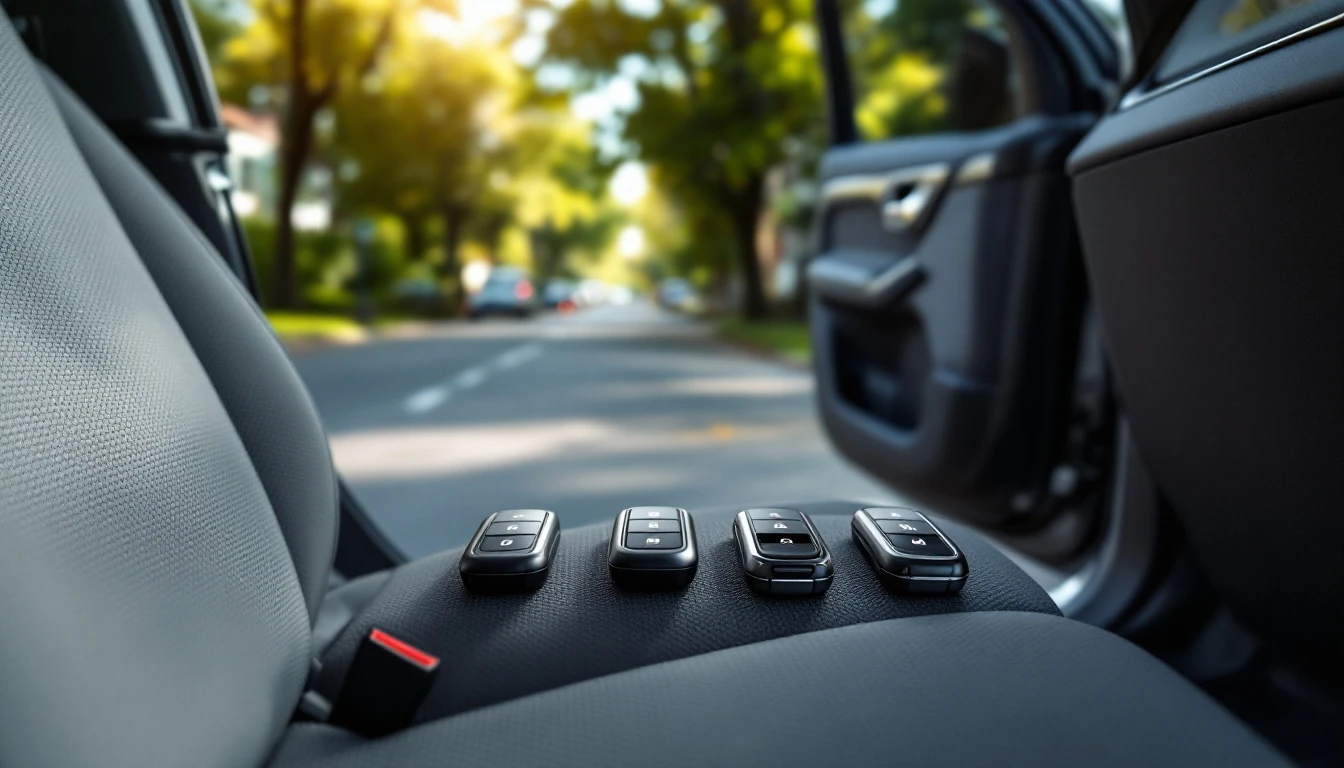
Honda’s immobilizer and Smart Entry, in plain terms
Honda's engine immobilizer authenticates a transponder before the engine is allowed to run, and the authority for that decision is tied closely to the powertrain control side of the vehicle. That coupling is why Honda immobilizer work is a genuine programming discipline rather than a simple key-copy operation — the credential is registered into a system the engine controller consults, not merely into a door remote.
Bladed transponder keys appear on older Civics and CR-Vs and on base trims into the mid-2010s. The transponder lives in the key head, read by an antenna ring around the ignition cylinder. These are the quickest jobs: cut the blade by VIN code, register the transponder, verify.
Smart Entry — Honda's proximity system with push-button start — adds two more registrations. The fob must be known to the immobilizer for engine authority, to the remote-keyless system for lock and unlock, and to the passive-entry system so that touching the door handle works with the fob in your pocket. A fob registered for only the first of those produces the very common complaint: “the new key starts it, but I still have to press the button to get in.”
The failure signature to recognise: on an immobilizer fault the engine may crank and die, or refuse to start, with the security indicator behaving abnormally. That is authentication, not fuel or spark. Owners tow Civics in for engine diagnosis when the actual problem is a key the car no longer trusts.
The two-key question — and why you should bring every key you own
Across Honda model years, programming procedures differ in an important way. Some routines add a key to the existing table, leaving your other keys untouched. Others rebuild the table, registering only the keys physically present during the procedure and dropping everything else.
The practical consequence is the single most common Honda complaint we hear after someone else's programming visit: a spare key that lived in a drawer stopped working. Nothing broke. The routine rewrote the table, the drawer key was not there to be included, and the car simply forgot it.
The fix is free and takes no effort: bring every key you own to the appointment. Kitchen drawer, spouse's handbag, the one in the toolbox, the one you are not sure works. If the technician runs a rebuild-style routine, every key present is re-registered and nothing is lost. If they run an add-style routine, nothing is lost either. There is no downside.
It is also worth asking the technician directly which routine applies to your model year, and asking them to confirm the number of keys registered at the end of the job. A good technician volunteers both. It is a reasonable question and the answer takes five seconds.
Grand Prairie pricing for Civic and CR-V keys
As of July 2026, honest mobile pricing in this market: bladed transponder key, working key present: $160–$240 all-in. Bladed transponder key, all-keys-lost: $260–$400. Smart Entry proximity fob, working key present: $200–$300. Smart Entry, all-keys-lost: $330–$520. Second key at the same visit: 30–50% of the first.
Those figures include the key or fob, cutting the blade or emergency blade to factory code, all required registrations, and the mobile trip within the core service area. No tow is included because none is needed — the entire job happens at the vehicle, including all-keys-lost.
Where you land depends mostly on model year and fob type, plus whether you want an OEM-branded fob or a quality aftermarket equivalent from a recognised trade supplier. Both are legitimate and program identically; the failure stories attached to “aftermarket” almost always trace to cheap marketplace listings with weak transponders rather than to trade-sourced parts. For the wider comparison, see our 2026 Grand Prairie cost guide.
What the on-site visit looks like
The technician confirms VIN and model year, verifies ownership, and asks how many keys exist and which are present — the two-key question above. The blade or emergency blade is cut to factory code from the VIN. Then the diagnostic tool connects at the OBD-II port and the appropriate routine is selected for the model year and key type.
On Smart Entry vehicles, the three registrations are performed and then verified separately: engine start with the new fob only, remote lock and unlock at a realistic distance, and passive entry at each door that has it, plus the tailgate on a CR-V. Skipping the passive-entry verification is the most common shortcut and the most common callback.
Typical time on site is 25–45 minutes for a spare with a working key present and 60–110 minutes for all-keys-lost. Before the technician leaves, run the full test with your original key locked in the house — a fob that behaves perfectly while another registered key is three feet away tells you very little.
All keys lost on a Civic or CR-V
With no working key, authority has to be established from outside the vehicle rather than from a trusted credential you hand over. The framework governing legitimate technician access to that class of vehicle security data is maintained by the National Automotive Service Task Force, and it is deliberately gated — which is why proof of ownership is mandatory: driver's licence plus title, registration, or insurance matching the VIN.
Before any of that, a good technician runs a pre-flight diagnostic, because a real share of “lost key” calls are not lost keys. On Honda the usual false alarms are a coin cell too weak to transmit (hold the fob against the start button — if it starts, you need a battery), a fob damaged by water, and immobilizer trust lost after a dead battery or jump start, which a relearn resolves without new parts.
If it is genuinely all-keys-lost, expect 60–110 minutes on site and the upper price bands above. And expect the technician to strongly recommend leaving with two keys rather than one — on an all-keys-lost job the second key is roughly a third of the first, because the expensive part of the work has already been done. Our all-keys-lost guide and our can a locksmith make a key without the original page cover the process in more depth.
Common Honda problems we see in Grand Prairie
CR-V that starts only with the fob held against the start button. The inductive backup path working as designed — the car reads the transponder directly when the radio link is too weak. Nearly always a coin cell that measures fine at rest and sags under transmission load. Replace it before assuming anything failed.
Civic where the new key starts the car but passive entry does not work. A missed registration, not a faulty fob. The passive-entry system is separate from the immobilizer and from the basic remote. This is a five-minute fix on site and a return trip once the van has gone.
Spare key that mysteriously stopped working after a programming visit. The rebuild-style routine, as described above. If this has already happened to you, the spare is not broken — it simply needs re-registering, and it should be done at the same time as anything else so the table is complete.
Worn blade on a high-mileage Civic. A key that needs jiggling in the door on a decade-old Civic is a worn key far more often than a worn cylinder. A fresh cut to factory code is cheap and frequently resolves it outright. If a new cut key still binds, that is genuine ignition repair.
Fob buttons worn through on a daily-driven CR-V. The board and transponder inside are usually healthy. A shell or button-pad transplant reusing your existing electronics costs a fraction of a new programmed fob and requires no programming at all — the car already knows that board. Ask for it by name; see our keyless entry repair page.
Where the honest boundary sits on newer Hondas
The great majority of Civic and CR-V key work across the last two decades sits comfortably inside credentialed mobile capability. The boundary is at the newest model years, where more of the programming path routes through gated manufacturer-side access and coverage depends on current tool licensing rather than general competence. A credentialed shop verifies your specific VIN before dispatch instead of discovering the limitation in your driveway.
Hybrid and electrified variants deserve the same check, as do vehicles where a relevant module has been replaced previously. And a car another shop has already attempted — partially written table, module left mid-procedure — is a materially different job. Say so when you call; it changes the tooling loaded into the van and it saves everyone a wasted trip.
What you should never accept is “any Honda, any year” from a dispatcher who has not asked for a VIN. Vehicle-specific coverage is the whole discipline, and confident vagueness on the phone reliably predicts an unpleasant conversation on arrival. Per the FTC's consumer guidance on locksmith scams, that pattern is well documented.
Mobile versus dealer for a Honda key
The structural case is the same as it is across brands but the numbers are friendly on Honda specifically, because Honda is a well-supported platform. No tow is needed, including for all-keys-lost — and per AAA roadside and repair-cost research, avoiding a flatbed is the single largest structural saving on that job. Parts come through trade channels rather than a manufacturer parts counter at MSRP. And same-day mobile beats a scheduled service-drive appointment for anyone whose car is a daily necessity.
The dealer genuinely wins on warranty work, on recall or campaign work that must be recorded in the manufacturer's system, and on the small set of very recent configurations requiring manufacturer-side authorisation. An honest shop names those categories rather than pretending they do not exist.
For everything else — which is the overwhelming majority of Civic and CR-V key work in Grand Prairie, Arlington, and Irving — mobile is faster and cheaper for an identical outcome. Our locksmith vs dealership comparison lays out the decision tree, and for how the same economics look on a European luxury car, see our Mercedes key replacement Grand Prairie guide.
A Real-World Example
Operator: A Grand Prairie family with a 2019 Honda CR-V EX had a smart key programmed elsewhere six months earlier. Afterwards, the spare fob they kept in a kitchen drawer stopped working entirely — it would not unlock the doors and would not start the car, despite a fresh battery.
Before:
- Family assumed the drawer fob had failed and priced a replacement Smart Entry fob
- The fob had not been present during the earlier programming visit and had not been mentioned by the previous shop
- Credentialed mobile shop asked one question on the phone: was the drawer key present during the last programming appointment
What changed:
The answer was no. The earlier visit had used a routine that rebuilds the key table, registering only the fobs physically present — so the drawer fob had been dropped from the vehicle's trusted list rather than failing. On site, the technician re-registered both existing fobs together, verified engine start, remote functions, passive entry at all four doors, and the tailgate on each.
Results:
- Time on site: 31 minutes
- Total billed: $95 for re-registration, against $200–$300 for an unnecessary replacement Smart Entry fob
- Both fobs confirmed registered and fully functional, with the technician stating the registered key count at the end of the job
- Family advised to bring every key to any future programming visit, regardless of which routine is used
Net: Nothing had broken. A perfectly good fob was written out of the vehicle's memory because it was in a drawer during a procedure that rebuilt the table. Bringing every key you own to any Honda programming appointment costs nothing and eliminates this failure mode entirely — and asking the technician to confirm the registered key count at the end takes five seconds.
What Experts Say
“The Honda mistake I clean up most often is not a technical one — it is a scheduling one. Somebody gets a key programmed with the spare sitting in a kitchen drawer, and depending on the routine that model year uses, the car ends up knowing only the keys that were in the driveway. The drawer key did not fail. The car forgot it. So my first question on any Honda booking is how many keys exist and where they are, and my instruction is always the same: bring every one of them, including the one you are not sure still works. There is no downside and it takes one failure mode completely off the table.”
Per ALOA's automotive certification standards and the NASTF framework for vehicle security access, immobilizer key tables are authoritative lists rather than cumulative records — procedures that rewrite a table register only credentials present at the time, which is why complete key inventory at the point of service is standard professional practice.
Frequently Asked Questions
How much does Honda key programming cost in Grand Prairie?
As of July 2026, a bladed transponder key runs about $160–$240 with a working key present and $260–$400 all-keys-lost. A Smart Entry proximity fob runs about $200–$300 with a working key and $330–$520 all-keys-lost. A second key programmed during the same visit is typically 30–50% of the first.
Why should I bring all my Honda keys to the appointment?
Because some Honda programming routines rebuild the key table rather than adding to it, registering only the keys physically present and dropping everything else. A spare left in a drawer can stop working as a result — it did not fail, the car forgot it. Bringing every key you own eliminates that risk entirely and costs nothing.
My new Honda key starts the car but I still have to press the unlock button. Why?
Passive entry is a separate registration from the immobilizer and from the basic remote. A fob registered only for engine authority and core remote functions will ignore the door-handle sensors. It is a quick addition while the technician is on site — test engine start, remote lock and unlock, passive entry at every door, and the tailgate before the van leaves.
Can a locksmith make a Honda CR-V key with no working key?
Yes, on the great majority of model years, at whatever location the vehicle is parked and with no tow required. Authority is established through authorised channels rather than from an existing key, so you will need a driver's licence plus title, registration, or insurance matching the VIN. Expect 60–110 minutes on site.
My Civic cranks and dies. Is that the key or the engine?
Almost certainly authentication rather than a mechanical fault — the engine ran, so fuel, spark, and compression are fine. On an immobilizer failure the car withholds fuel and spark after the initial start. Try your spare key first: if the spare keeps it running, the daily key or its transponder is at fault and the vehicle needs nothing.
My CR-V fob buttons are worn through. Do I need a whole new key?
Usually not. If the board and transponder inside are healthy, a shell or button-pad transplant reusing your existing electronics costs a fraction of a new programmed fob and needs no programming — the vehicle already knows that board. Ask for it by name; many shops do not volunteer it. Visible corrosion on the board is the case where replacement is the honest answer.
The Bottom Line
Honda Civic and CR-V key work in Grand Prairie is well-supported, mobile, and reasonably priced — $160–$300 for a spare and $280–$520 for all-keys-lost as of July 2026. The one Honda-specific trap is the key table: some routines rebuild it rather than adding to it, which quietly drops any key that was not present. Bring every key you own to the appointment, and ask the technician to confirm the registered key count before they leave.
Next Steps
Call (214) 949-1847 with your VIN, model year, and how many keys exist and where they are — that last answer genuinely changes how the job is run. See Honda key replacement Grand Prairie, smart key programming, and car key programming for the underlying services.
Sources cited in this article
- Associated Locksmiths of America (ALOA) certification
- National Automotive Service Task Force (NASTF)
- AAA roadside assistance and repair-cost research
- SAE International vehicle security standards
- FTC consumer guidance on locksmith scams
- Texas DPS Private Security Program
- National Highway Traffic Safety Administration (NHTSA)
- U.S. Bureau of Labor Statistics OEWS data