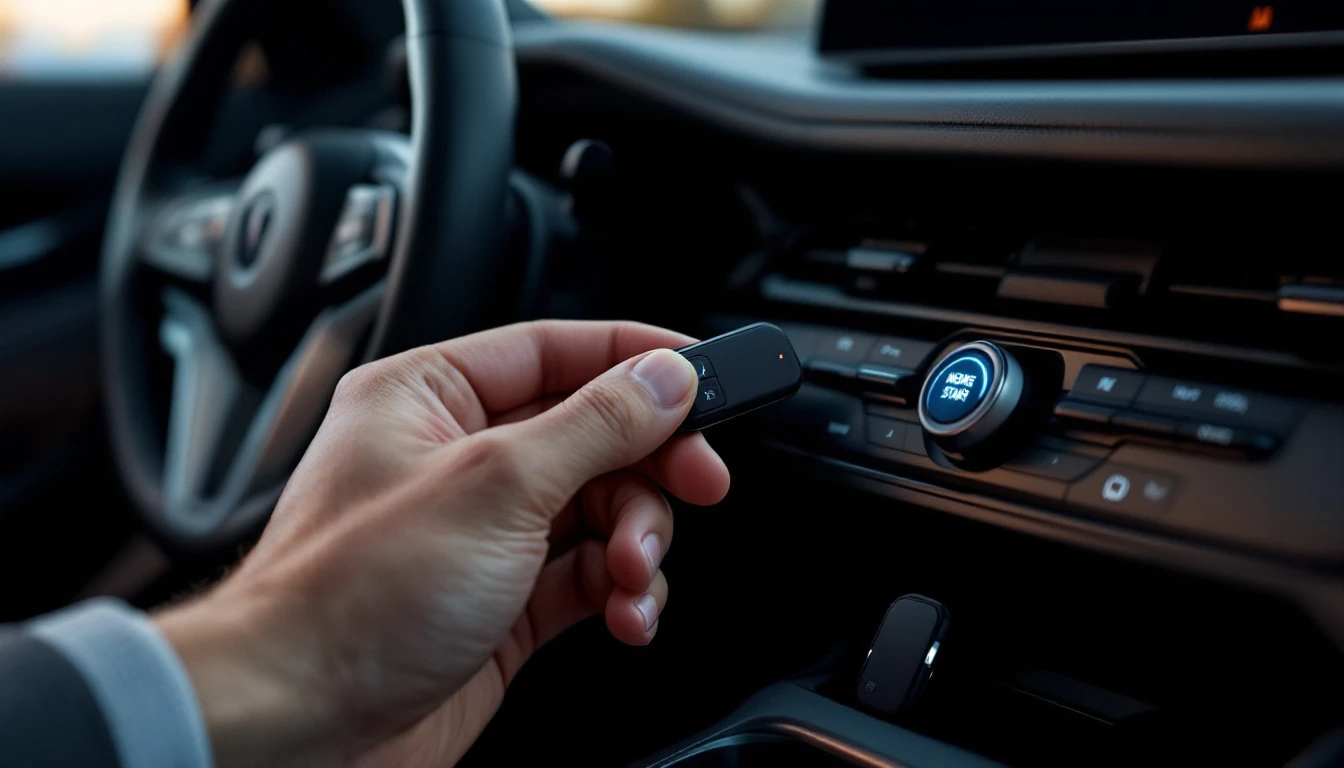
What a Nissan Intelligent Key has to be taught
The fob on a modern Maxima or Murano is a proximity credential doing three jobs at once. It authenticates to the immobilizer so the vehicle will run. It transmits lock, unlock and remote functions. And it participates in passive entry, so the door responds to a touch on the handle with the fob in your pocket.
Each of those is a separate registration inside the car, and a fob registered for only some of them produces the complaint we hear constantly: “the new key starts it but I still have to press the button to get in.” That is not a defective fob. It is an unfinished job, and it takes minutes to complete while the technician is still on site.
Concealed inside the fob is a mechanical emergency blade, and the driver door has a cylinder for it behind a small cover. That blade should be cut to the vehicle's factory code as part of any spare-key purchase. A spare with a registered transponder and an uncut blade fails you precisely when a spare matters most — a flat fob battery in a car park.
Both OEM and quality aftermarket fobs from recognised trade suppliers program identically on this platform. The bad experiences attached to “aftermarket” almost always trace to the cheapest marketplace listings with weak transponders, not to trade-sourced parts. Ask which your quote assumes. Our Nissan key replacement page covers the range.
The electronic steering lock — the Nissan fault people misdiagnose
Both of these vehicles use an electronic steering lock: a motorised mechanism that releases the steering column when the vehicle authorises a start. When it works, you never think about it. When it does not, the car presents a steering-lock warning, the wheel stays locked, and the vehicle will not start — even though the fob is detected and the dash lights up normally.
Owners read that as a key failure because the key is the thing they were using. It is not. The tell is that the car acknowledges the key — the dash wakes, the message centre displays a steering-lock message specifically, and often you can hear or feel the mechanism attempting and failing to release.
Before assuming the worst, try the standard technique: rock the steering wheel firmly left and right while pressing the start button. A column under load from the steering rack can prevent the release, and relieving that load is sometimes all that is required — exactly as with a mechanical steering lock, for the same physical reason.
Where the mechanism itself has failed, that is a repair rather than a key job, and an honest locksmith will tell you so rather than selling you a fob. A shop that sells a $250 key to somebody with a steering-lock message has either not read the message or has chosen not to. Our keyless entry repair page covers the adjacent electronic work.
Grand Prairie pricing, as of August 2026
Spare Intelligent Key, working key present: $180–$290 all-in, including the fob, the cut emergency blade, every registration, verification, and the mobile trip. All keys lost: $300–$500 depending on model year and fob variant. Second key at the same visit: 30–50% of the first, and closer to a third on an all-keys-lost job.
Emergency blade cut only, no electronics: $45–$85. This will not start the car but it will open the door, which converts a dead-fob-battery event from a tow into an inconvenience. It is a legitimate half-step for a tight budget.
Fob shell or button-pad transplant reusing your existing board: $60–$120, with no programming required at all — the car already knows that board. On a Maxima or Murano that has been daily-driven for years, worn-through buttons are common and this is the correct fix, not a new programmed fob. Very few shops volunteer it; ask for it by name.
For the full picture across makes and scenarios see our 2026 Grand Prairie cost guide, and for the volume end of the Nissan range our Altima and Rogue key replacement guide.
Why the spare is dramatically cheaper than the replacement
Two entirely different jobs hide behind the phrase “I need a key”. With a working key present, the vehicle already trusts a credential and the new one is added through a short routine — 20 to 40 minutes on site. With no working key, authority must be established from outside the vehicle through the gated framework maintained by the National Automotive Service Task Force, with mandatory proof-of-ownership handling and 60 to 110 minutes on site.
That is why every make prices the two differently. It is not a penalty for losing your key; it is a longer, more restricted, more documented procedure. On these two Nissans the swing is roughly $120–$210 for the identical physical fob.
Proof of ownership is mandatory on any all-keys-lost job: photo ID plus title, registration, or insurance matching the VIN. A technician who does not ask is a technician who would help the next person take your car, and that is a reason to send them away.
There is also a resale argument owners consistently underrate. A used Maxima or Murano presented with one key invites a deduction from any informed buyer, and the deduction usually exceeds the cost of the key. Two keys plus a cut emergency blade is cheap documentation that the car has been looked after.
The Maxima and the Murano in local service
The Maxima is a large front-drive saloon bought by commuters and by people who wanted something quicker than a family sedan without moving to a premium badge. In this area that means a lot of highway mileage toward Dallas and Fort Worth and a lot of time parked in structures.
The Murano is the mid-size crossover doing school runs and errands, and it lives outdoors. The difference matters for one reason: heat. A fob left on a dashboard through a North Texas August is a fob whose coin cell and button-pad adhesive are being cooked, and both vehicles produce a seasonal wave of “my key stopped working” calls that are really battery and pad complaints.
Both vehicles are also old enough in their common used-market years that many are on their second or third owner with a single surviving key. A car bought privately with one fob is the single most common precursor to an expensive all-keys-lost call, and it is entirely avoidable in the first month of ownership for under $300.
The practical habit: keep the spare somewhere the first key is not. A drawer at home, with a partner, or at a workplace — not on the same ring and not in the vehicle. If it is a proximity fob kept indoors, keep it away from the front door and away from where the car parks, which reduces exposure to relay-style attacks.
Before you book: four checks that are free
One: the inductive backup. Hold the fob directly against the start button and press. If the car starts, the transponder is fine and the radio battery is flat. Buy a coin cell.
Two: the emergency blade. Release it from the fob and open the driver door with it. This proves you have cabin access regardless of what the electronics are doing, and it is worth knowing you can do it before you need to.
Three: read the message centre. A steering-lock message is a steering-lock condition. A key-not-detected message with a dead dash is a 12-volt condition. These are different faults with different fixes and the car is telling you which one you have.
Four: search the vehicle properly. A Murano's boot area and a Maxima's deep centre console both swallow small objects, and twenty minutes of genuine searching resolves more “lost key” calls than anyone likes to admit. Our key fob troubleshooting guide works through the full diagnosis order.
Mobile versus dealer for a Nissan spare
Nissan is a well-supported platform for credentialed mobile shops, and the structural case is clear: no tow is required even for all-keys-lost, parts come through trade channels rather than a manufacturer parts counter at list price, and same-day service beats a scheduled service-drive appointment for anyone whose car is a daily necessity. Per AAA repair-cost research, avoiding the flatbed is the largest structural saving on the job.
The dealer genuinely wins on warranty work, on recall or campaign work that must appear in the manufacturer's records, and on a small set of very recent configurations requiring manufacturer-side authorisation. A shop that names those categories rather than claiming “any Nissan, any year” is the one to book — VIN-level verification before dispatch is the whole discipline.
In Texas, locksmith licensing runs through the DPS Private Security Program, not TDLR. Credentialing standards are published by ALOA. Both are reasonable things to ask about, and both take seconds to answer.
On bait pricing: an advertised “$29 car key” is not a price for a programmed proximity fob and never has been. The FTC's locksmith scam guidance describes the low-quote-then-revise pattern precisely. Our locksmith versus dealership comparison lays out the full decision tree.
A Real-World Example
Operator: A Grand Prairie owner of a 2017 Nissan Murano SV called reporting that the vehicle "would not take the key" and displayed a warning about the steering. The car had been parked nose-in against a sloped kerb outside an apartment building for two days.
Before:
- Owner had been quoted $260 for a replacement Intelligent Key by the first shop contacted by phone
- The dash was waking normally and the vehicle was clearly detecting the fob
- The message centre was displaying a steering-lock message that had not been mentioned to the first shop
What changed:
On the phone, the technician asked what the message centre actually said and what the car had been parked against. The wording pointed at the electronic steering lock rather than at credential detection. The owner was talked through rocking the steering wheel firmly left and right while pressing the start button — relieving the load the sloped kerb had placed on the steering system. The vehicle released the column and started on the third attempt.
Results:
- No callout charged — resolved by telephone in under six minutes
- Zero parts sold; the original fob was working correctly throughout
- Replacement key avoided: $260 for a component with nothing wrong with it
- Owner subsequently booked a spare Intelligent Key at $215 as a deliberate purchase rather than an emergency one
Net: The car was reporting exactly what was wrong and the first shop had not asked. A steering-lock message means the vehicle recognised the key and could not release the column — a mechanical load condition, not a credential failure. Reading the message centre out loud on the phone is a free diagnostic that a shop should always ask for, and it is the difference between a $260 fob and a six-minute conversation.
What Experts Say
“The question I ask every Nissan caller before anything else is: what exactly does the screen say. Not "it says something about the key" — the actual words. Because on these cars there are three completely different problems that all present as "it will not start", and the car names which one you have. Steering lock message means I am not selling you a key. Nothing on the dash at all means twelve volts and I am not selling you a key either. Key not detected with everything else awake, now we are talking about a fob, and even then I want them to hold it against the start button first. Half my Nissan calls end with a coin cell or a wiggle of the steering wheel, and I would rather spend six minutes on the phone than sell somebody a fob they did not need.”
Per ALOA's automotive certification standards and the NASTF vehicle security access framework, no-start conditions on proximity-key vehicles must be separated into credential-detection faults, supply-voltage faults, and steering-lock or start-inhibit faults before credential work is authorised, because all three present identically to the driver and only one is resolved by a key.
Frequently Asked Questions
How much is a spare key for a Nissan Maxima or Murano in Grand Prairie?
As of August 2026, a spare Intelligent Key programmed on site with a working key present runs $180–$290 all-in, including the fob, the cut emergency blade, all registrations, and the mobile trip. All keys lost runs $300–$500. A second key at the same visit is 30–50% of the first.
My Nissan says "steering lock" and will not start. Do I need a new key?
No. A steering-lock message means the vehicle detected your key and could not release the column — a different fault entirely. Rock the steering wheel firmly left and right while pressing the start button, especially if the car is parked against a kerb or on a slope. Where the mechanism itself has failed, that is a repair, not a key purchase.
My Murano fob works sometimes and not others. Is it dying?
Usually it is the coin cell, which measures acceptably at rest and sags under transmission load — a pattern that shows up strongly in North Texas summer heat. Replace the battery first. If a fresh cell does not fix it, worn button pads or water damage are next, and a shell or pad transplant reusing your existing board costs $60–$120 and needs no programming at all.
Can I start a Nissan if the fob battery is completely dead?
Yes. Hold the fob directly against the start button and press — the vehicle reads the transponder inductively when the radio link is too weak. If it starts that way, nothing is wrong with the key beyond a battery worth a few dollars. This is also the definitive test that separates a flat fob from a genuinely lost or failed key.
Do I need proof of ownership for a lost-key job?
Yes, and it is mandatory rather than a formality: photo identification plus title, registration, or an insurance document matching the VIN. A technician who does not ask for it would do the same for whoever tried to take your vehicle next, which is a reason to send them away rather than a convenience.
Where should I keep the spare Intelligent Key?
Somewhere the first key is not — a drawer at home, with a partner, or at a workplace. Not on the same ring and not inside the car. If it is a proximity fob stored indoors, keep it away from the front door and away from where the vehicle parks, which reduces exposure to relay-style signal attacks.
The Bottom Line
A spare Nissan Intelligent Key for a Maxima or Murano is $180–$290 in your Grand Prairie driveway as of August 2026, against $300–$500 for the same fob once every key is gone. Before buying anything, read what the message centre actually says: a steering-lock message is not a key problem, a dead dash is a 12-volt problem, and a fob held against the start button will tell you in five seconds whether all you need is a coin cell.
Next Steps
Call (214) 949-1847 with your VIN, model year, how many keys you have, and the exact wording on the message centre if the car will not start. See Nissan key replacement Grand Prairie, push-start key replacement, and smart key programming for the underlying services.
Sources cited in this article
- Associated Locksmiths of America (ALOA) certification
- National Automotive Service Task Force (NASTF)
- AAA roadside assistance and repair-cost research
- FTC consumer guidance on locksmith scams
- Texas DPS Private Security Program
- SAE International vehicle security standards
- National Highway Traffic Safety Administration (NHTSA)
- U.S. Bureau of Labor Statistics OEWS data