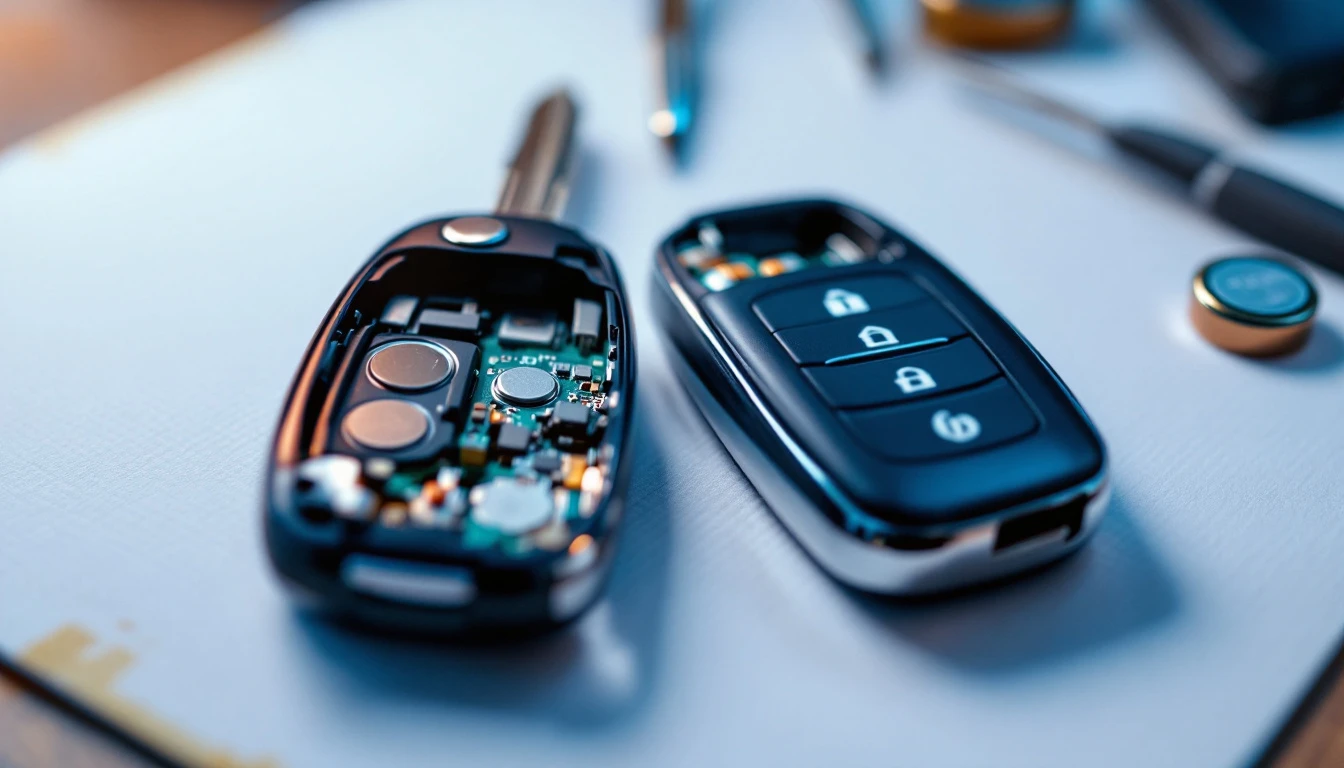
The five-minute diagnostic: run this before you buy anything
Step 1 — test the second fob. If a spare fob works and the primary does not, the problem is inside the primary fob and nothing is wrong with the car. That single check eliminates the entire vehicle side of the diagnosis. If neither fob works, the problem is on the vehicle side — receiver, module, or antenna — and buying a new fob will not help.
Step 2 — use the mechanical or inductive backup. Every keyless car has one. On bladed systems, there is a physical key. On proximity systems, there is an emergency blade hidden in the fob for the driver door, and the car can read the transponder inductively when you hold the fob against the start button or in a marked slot. If the inductive path starts the car, the transponder is alive and only the radio side has failed — a very different repair.
Step 3 — change the coin cell. It is a two-dollar part and it is the answer more often than anything else on this list. Critically, a battery that measures fine at rest can still sag under the current draw of a transmission burst. “I tested it and it read 3 volts” is not a clearance — swap it anyway before spending real money.
Step 4 — check range and interference. If the fob works at two feet but not twenty, that is a weak transmitter or a weak receiver, not a dead one. And if the failure only happens in one specific parking area, you may be sitting in RF interference rather than looking at a fault. Try the same fob at home before concluding anything.
What is actually inside a keyless entry system
There are two independent radio systems in your key, and confusing them is the single most common diagnostic error. The immobilizer transponder is a passive chip with no battery — it is energised by a field from an antenna ring at the ignition or start button, and it authorizes the engine. The remote keyless entry transmitter is battery powered, sends on a UHF frequency (315 MHz is standard in North America), and handles lock, unlock, trunk, panic, and remote start.
Because they are separate, they fail separately. A fob that starts the car but will not lock the doors has a healthy transponder and a sick transmitter. A fob that locks the doors but will not start the car has the reverse. Knowing which one you are looking at tells a technician within thirty seconds whether this is a shell repair, a programming job, or a vehicle-side fault.
Modern remotes use rolling code — each press sends a new value derived from a counter, so a recorded transmission cannot be replayed. That design detail has a practical consequence: if a fob has been pressed hundreds of times far from the car, some systems drop out of sync. Most self-resynchronise on the next in-range press, but occasionally a re-register is needed, which is a programming visit rather than a parts purchase.
On the vehicle side, the receiver is often integrated into the body control module rather than being a discrete box. That is why some keyless entry faults turn out to be BCM issues, and why our BCM programming service is part of this conversation at all.
Grand Prairie pricing by failure mode
As of July 2026, here is what each outcome costs in this market. Coin-cell battery replacement: $8–$25, and most owners can do it themselves with a small flat driver. Shell, blade, or button-pad transplant using your existing board and transponder: $45–$110. This is the one people never ask for, and it is frequently the right answer for a physically damaged fob.
New programmed fob (bladed transponder): $120–$220. New programmed proximity fob: $180–$300, varying by make. Vehicle-side diagnosis when neither fob works: $75–$150, typically credited against the repair. Receiver or body control module work: $180–$350 plus diagnosis, depending on whether the module can be reprogrammed or has to be replaced and coded to the vehicle.
The reason to know the shell-transplant number is that it changes decisions. A three-year-old proximity fob that went through the wash, or one whose buttons wore through, usually has a perfectly good board and transponder inside a dead shell. Moving those into a fresh shell costs a fraction of a new programmed fob and requires no programming at all — the car already knows that board. Ask for it by name; some shops do not volunteer it. For the wider price picture across services, see our 2026 Grand Prairie cost guide.
When it is the car and not the key
Three signatures point at the vehicle. Neither fob works. Two independent fobs do not fail on the same morning; something they share did. Range collapsed for all fobs simultaneously. Same logic. Some functions work and others do not, identically on both fobs — for example, lock and unlock work but the tailgate never responds.
The usual vehicle-side suspects are a blown fuse on the keyless circuit, a receiver antenna with a broken lead (common where the antenna runs into a door or under a headliner), water intrusion at a connector, or a body control module that has lost its keyless configuration after a battery event or a jump start.
That last one is worth dwelling on, because it is fixable without parts. A deep voltage sag can leave modules out of sync, producing symptoms that look exactly like dead fobs. A relearn restores it. Any shop that sells you two new fobs without first checking whether the car simply forgot them is not diagnosing — and you will be back in a week with two expensive fobs and the same problem.
If the car side is confirmed, the work sits in the module-programming family: reading the module, restoring or reconfiguring the keyless setup, and re-registering the existing fobs. Our keyless entry repair page covers the service scope, and BCM programming covers the module side.
Aftermarket fobs, marketplace fobs, and the myth in between
“Aftermarket fobs are junk” is one of the most persistent beliefs in this trade, and it is roughly half true. A fob from a recognised trade supplier — the kind a credentialed locksmith buys through professional distribution — is functionally equivalent to the manufacturer part and programs identically. A five-dollar fob from an online marketplace listing frequently has a weak or wrong transponder, a poorly toleranced blade, or a board that fails within months.
The distinction is supplier provenance, not the word “aftermarket.” This matters practically: most shops will happily program a fob you supply, but very few will warranty a part they did not source, and if it fails you will pay the programming labor twice. If you want to supply your own, ask explicitly what happens if it does not take.
There is also a middle option worth knowing about: a used OEM fob from a recognised recycler. On many platforms, a used fob can be cleared and re-registered to your vehicle. On some it cannot, because the fob is permanently married to its original VIN. Which camp your car falls into is make-and-generation specific, and it is a fair question to ask before buying one off a marketplace.
The remote-start and comfort-access complications
Two features complicate an otherwise simple fob replacement. Factory remote start is a separate function that has to be enabled and registered along with the basic lock and unlock. A replacement fob programmed only for the core functions will lock, unlock, and start the car with a press of the button — and completely ignore the remote-start request. Test it before the technician leaves.
Passive entry — the feature where touching the door handle unlocks the car with the fob in your pocket — relies on low-frequency antennas distributed around the vehicle. A new fob must be registered to that system as well as to the remote and the immobilizer. When one of those three registrations is skipped, you get the classic complaint: “the new key starts it but I still have to press the button to get in.”
Aftermarket remote-start systems installed by a previous owner are their own category. They sit between the fob and the vehicle and can produce genuinely baffling symptoms. If your car has a piggybacked alarm or remote-start module, say so when you call — it changes the diagnosis substantially and it is the one thing most likely to make a straightforward job take an hour longer.
What a mobile keyless entry visit looks like
The technician starts on the vehicle side or the key side depending on your answers to the two-fob question. If it is a key-side fault, the fob is opened, the board inspected for corrosion and cracked joints, the battery contact tension checked, and the transponder verified. A surprising share of “dead” fobs are a battery contact that lost spring tension after a drop.
If it is vehicle-side, the diagnostic tool goes on the OBD-II port and the keyless circuit is checked for fuses, module communication, and stored fault codes. Where the module has lost configuration, a relearn is run. Where the receiver or antenna lead has failed, that is a repair or replacement, and the existing fobs are re-registered afterwards.
Typical time on site is 20–40 minutes for a key-side repair and 45–90 minutes for vehicle-side work. Before the van leaves, test every function from a realistic distance: lock, unlock, trunk or tailgate, panic, remote start if equipped, passive entry at every door if equipped, and engine start. Functions are easy to fix while the technician is present and annoying to chase down later. If the outcome is that you need a whole new key rather than a repair, our key fob replacement page covers that path.
When to stop repairing and just replace
There is a point where repair stops making sense. Water damage with visible corrosion on the board is usually terminal — you can clean it and it will work for a month. A cracked or delaminated transponder cannot be repaired. A fob that has already had two shell transplants is telling you the internals have taken enough abuse.
The economic line is roughly this: if the repair is more than about half the cost of a new programmed fob and the internals are not clean, replace. If the internals are healthy and only the exterior failed, repair — that is the case where you save real money.
And if you are down to one working fob for the whole household, the right answer is neither: it is to add a spare while a working key still exists. Every make in this market prices a spare at a fraction of an all-keys-lost call, and the fob you are currently nursing along is the only thing standing between you and that call. Our all-keys-lost guide spells out what the expensive version of that day looks like, and the Mercedes key replacement Grand Prairie guide shows how steep the gap gets on luxury platforms.
A Real-World Example
Operator: A Grand Prairie driver reported that the key fob on a family crossover had "died" — the doors would not lock or unlock remotely from any distance, though the vehicle still started normally with the fob in the cabin. They had already ordered a replacement fob online.
Before:
- Owner assumed a dead fob and bought a marketplace replacement listed for a fraction of trade pricing
- The second household fob was in a drawer, untested, and had not been used in over a year
- Credentialed mobile shop asked two questions on the phone: does it still start the car, and does the spare work
What changed:
The spare fob worked perfectly, which isolated the fault to the primary fob rather than the vehicle. On site the technician opened the primary fob, found a battery contact that had lost spring tension after a drop plus a hairline crack at one solder joint, re-tensioned the contact, reflowed the joint, and fitted a fresh coin cell. No programming was required — the vehicle already knew that board.
Results:
- Time on site: 22 minutes
- Total billed: $65 for the repair and battery, against $180–$300 for a new programmed proximity fob
- The marketplace fob the owner had ordered was returned unopened; its transponder type did not match the vehicle
- The drawer spare was tested, batteried, and put back into service, restoring the household to two working keys
Net: The two-fob test on the phone did the entire diagnosis. Because the spare worked, the vehicle side was ruled out before anyone was dispatched, and because the board was healthy, the fix was a contact and a battery rather than a programmed fob. The most expensive mistake available here was the one already in progress: buying a replacement fob for a problem that was never the fob's electronics.
What Experts Say
“The question I ask before anything else is whether the second fob works, because that one answer splits the entire diagnosis in half. If the spare works, nothing is wrong with the car and I am looking at a battery, a contact, or a cracked joint — usually under a hundred dollars. If neither fob works, buying fobs is the worst thing you can do, because two independent remotes do not fail on the same morning. Something they share did. I would guess a third of the keyless calls we take end with a coin cell and a re-tensioned battery contact, and the customer had already ordered a replacement fob before calling.”
Per SAE International vehicle-systems standards, remote keyless entry and immobilizer authentication are architecturally distinct subsystems operating on separate radio paths — which is why a key can retain full engine-start authority while its remote functions fail completely, and why the two failures require different repairs.
Frequently Asked Questions
My key fob stopped working — how much does keyless entry repair cost in Grand Prairie?
As of July 2026 it depends entirely on what failed. A coin-cell battery is $8–$25. A shell or button-pad transplant reusing your existing board is $45–$110. A new programmed fob is $120–$300 depending on type. Vehicle-side diagnosis is $75–$150, usually credited against the repair, and receiver or body control module work runs $180–$350 plus diagnosis.
How do I know if it is the fob or the car?
Test your second fob. If the spare works, the fault is inside the primary fob and the vehicle is fine. If neither fob works, the problem is vehicle-side — receiver, antenna, fuse, or body control module — and buying a new fob will not fix it. Two independent remotes do not fail on the same day; something they share did.
My fob starts the car but will not lock the doors. What does that mean?
Your immobilizer transponder is healthy and your remote transmitter is not. Those are two separate radio systems in the same shell — the transponder is passive and battery-free, the remote is battery powered. That split usually points to a coin cell, a weak battery contact, or a cracked solder joint, all of which are repairs rather than replacements.
Can you repair a fob that went through the washing machine?
Sometimes. If the board is clean and only the shell, buttons, or battery contacts failed, a shell transplant reusing your existing board and transponder runs $45–$110 and needs no programming — the car already knows that board. If there is visible corrosion on the board itself, repair is usually temporary and replacement is the honest recommendation.
Should I buy a replacement fob online to save money?
Be careful. Fobs from recognised trade suppliers are functionally equivalent to manufacturer parts; very cheap marketplace listings frequently carry the wrong or a weak transponder and fail early. Most shops will program a fob you supply but will not warranty a part they did not source — so if it does not take, you pay the programming labor twice. Ask about that before ordering.
Why does my new fob start the car but not unlock it when I touch the handle?
Passive entry is a third registration, separate from the immobilizer and the remote. A fob programmed only for engine start and basic remote functions will ignore the door-handle sensors. The same applies to factory remote start. Test lock, unlock, passive entry at every door, remote start, and engine start before the technician leaves.
The Bottom Line
Keyless entry faults in Grand Prairie split cleanly into key-side and vehicle-side, and the two-fob test tells you which in about ten seconds. Key-side faults are usually a battery, a contact, or a shell — $8 to $110 as of July 2026. Vehicle-side faults are a receiver, antenna, or body control module — $180 to $350 plus diagnosis. The expensive mistake is buying a new fob for a problem that was never the fob, which is exactly what happens when nobody runs the diagnostic first.
Next Steps
Call (214) 949-1847 and be ready to answer two questions: does the fob still start the car, and does your spare work. Those two answers usually determine the price before anyone is dispatched. See keyless entry repair Grand Prairie for the service, key fob replacement if repair is not viable, and what to do if your key fob stops working for the quick-reference version.
Sources cited in this article
- SAE International vehicle systems standards
- Associated Locksmiths of America (ALOA) certification
- National Automotive Service Task Force (NASTF)
- FTC consumer guidance on locksmith scams
- AAA roadside assistance and repair-cost research
- Texas DPS Private Security Program
- National Highway Traffic Safety Administration (NHTSA)
- U.S. Bureau of Labor Statistics OEWS data