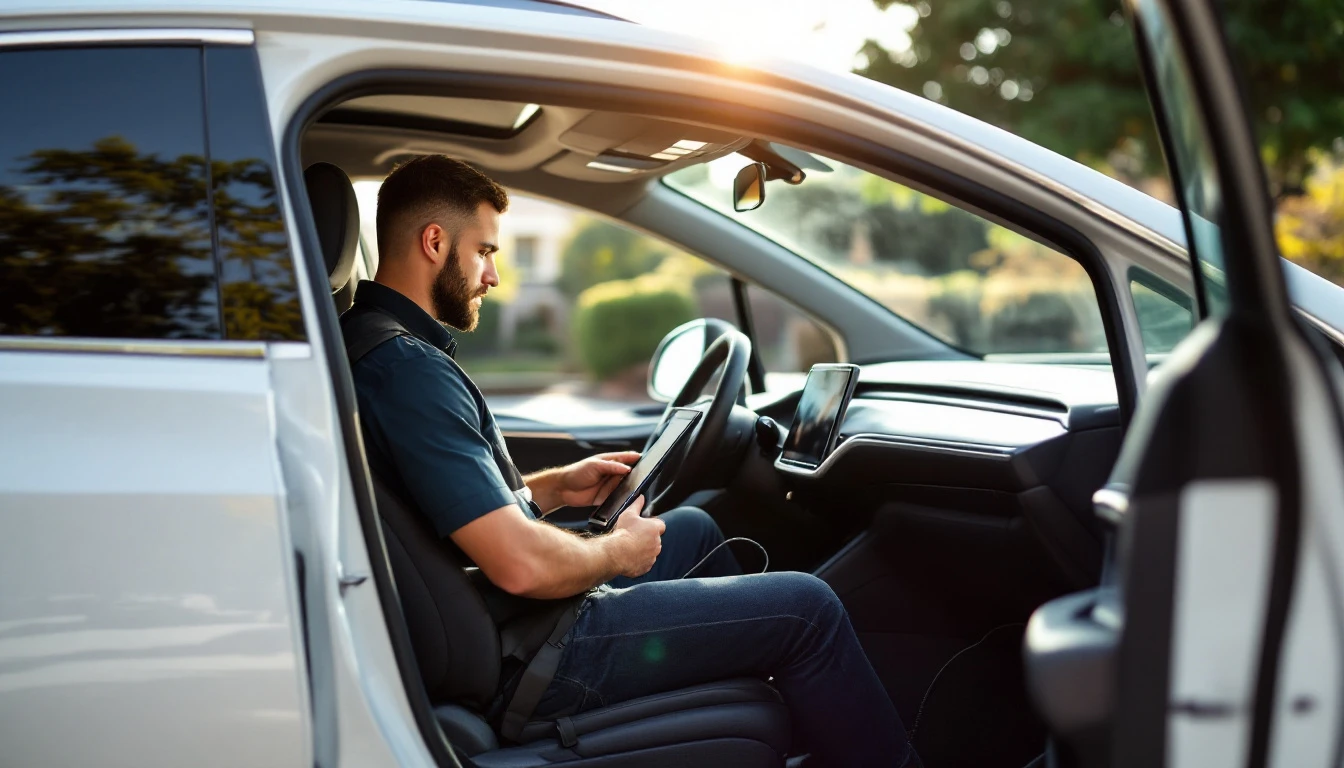
Why a three-row EV is a different conversation about keys
The Kia EV9 and the Hyundai Ioniq 9 are big, expensive, family-sized electric SUVs built on the same underlying architecture, and they are increasingly common on Grand Prairie school runs and in driveways off Lake Ridge and Camp Wisdom. From a key perspective the security is entirely conventional — a proximity smart key, push-button start, an immobilizer, and an emergency blade concealed in the fob body. There is nothing exotic about programming one.
The difference is the failure mode, and it catches EV owners specifically. On a combustion car, being locked out is annoying. On an electric SUV whose entire interface with you is electronic — flush or pop-out door handles, no keyhole visible anywhere, everything mediated by a screen — being locked out with a dead 12-volt battery leaves you standing next to a car with an eighty percent traction charge and no way in at all.
That 12-volt battery is the whole story and it surprises almost everyone. These vehicles carry an ordinary small 12-volt battery alongside the high-voltage pack, and it powers exactly the things you need in order to open and wake the car: the door handles, the key receiver, the body electronics. The traction battery cannot help you, because the systems that would connect it are themselves on the 12-volt circuit. A car with a full charge and a flat 12-volt is, from the outside, a locked box.
This is not a defect and it is not unique to these two models. It is how the architecture works across the segment. We have written the mechanism up in detail in our Ioniq 5 and Ioniq 6 12-volt battery and key relearn guide — the platform differs but the logic is identical, and every EV owner should understand it before they need to.
The practical consequence for keys is simple. On these vehicles the mechanical backup route into the car matters far more than it does on a combustion vehicle, because it is the only route that works when the electronics are asleep. And that mechanical route depends on a blade most owners have never taken out of the fob.
Find the hidden door lock and the emergency blade today
This is the single most useful five minutes in this article and it costs nothing.
There is a mechanical lock on your driver door and you probably cannot see it. On modern vehicles with flush or streamlined handles the keyhole is normally concealed behind a small cap or cover on the handle itself, removed with the emergency blade used as a lever. Some designs hide it under the handle rather than on its face. Go and find yours now, with the owner's manual in your hand, while you are standing in daylight with a working car. Discovering it for the first time in the dark, in a car park, with a dead vehicle, is the wrong time.
Inside your smart key there is a small mechanical blade. It releases from the fob body, usually via a catch or a slide on the back. Take it out. On a great many vehicles delivered new, the blade in the spare fob was never cut — it is a blank, and a blank opens nothing.
Try it in the lock. If it goes in cleanly and turns, you are fine and you can stop thinking about this. If it will not enter, is visibly featureless, or needs forcing, have it cut to the factory code retrieved from the VIN. That is one of the cheapest jobs on this page, there is no programming involved at all, and it is the difference between a flat 12-volt being a jump start and being a tow.
Do not force a stiff blade. A snapped blade inside a door lock is a considerably worse afternoon than an uncut one, and extraction is $85–$180 on top of everything else you were already dealing with.
While you are in the manual, find two more things: the emergency 12-volt access point, and how to release the bonnet if the release is electric. On a number of electric vehicles the front compartment release is powered, which means a flat 12-volt battery can leave you unable to reach the very battery you need to jump. Manufacturers provide a documented workaround for exactly this, and it is worth knowing where yours is before you need it.
What the spare-key job actually involves on these vehicles
With one working key present, the new smart key is added through a procedure the vehicle already trusts. Ownership is verified, the technician connects to the diagnostic port, the existing key authorises the session, the new fob is written into the vehicle's memory, the emergency blade is cut to the factory code from the VIN, and everything is tested in front of you. On a healthy vehicle this is a driveway appointment measured in tens of minutes.
With no working key at all, the same job takes materially longer, because the security access that an existing key would have granted now has to be established from nothing. This is the largest single variable in automotive locksmithing and it is why the first question any competent shop asks is whether you still have a key that works. Our all-keys-lost guide for large Kia SUVs covers what that longer visit looks like.
The 12-volt battery has to be healthy before anybody starts. This is the one genuinely EV-specific piece of technique. Programming procedures draw current and take time with modules awake, and a marginal 12-volt battery can drop voltage mid-procedure. That is how an ordinary key job turns into a module fault. A competent technician checks battery condition and supports the vehicle before starting rather than after something goes wrong — and if your 12-volt battery is more than about four years old, or the car has been sitting, say so when you book.
Bring every key you want to keep working. Some procedures write the complete key set rather than appending to it, so a fob left at home in a drawer can be silently erased at the appointment and need a second visit to restore. Ask before you book. If a key has genuinely been lost, overwriting the whole set is the correct choice — it deregisters the missing key so it can no longer open or start the vehicle, which is the security half of what you are paying for.
Verification on these cars has more steps than on a saloon. A finished job means: the vehicle starts on the new fob with every other key well out of range, passive entry tested at each door that has it including the second and third-row doors, the tailgate tested, remote start tested where fitted, and the emergency blade physically tried in the hidden driver door lock. A fob that unlocks the doors but will not start the car is an unfinished job, not a partial success. Our smart key programming and proximity key programming pages describe the equipment that comes to the vehicle.
Digital keys, phone keys, and what they do not replace
Both of these vehicles can be specified with a phone-based digital key on some trims, and it is genuinely convenient. It is also not a spare key, and treating it as one is how people end up stranded.
A phone key depends on your phone. A flat handset, a phone left at home, a phone that has just been replaced, or an operating system update that has reset a wallet credential all remove your access. None of those are unusual events.
A phone key still depends on the car being awake. This is the point that matters most on an EV. If the 12-volt battery is flat, the vehicle is not listening — not to a fob, and not to a phone. The failure mode a phone key is least able to help with is the one most likely to happen on these cars.
Card keys have the same limitation. A slim NFC card is an excellent backup to carry in a wallet and a poor substitute for a physical fob with a mechanical blade in it, for the same reason: it needs the car to have power to read it.
Registering a digital key is also not the same job as programming a fob. It is usually an account and app operation performed by the owner rather than a locksmith operation, and it depends on the manufacturer's service being reachable at the time. Our Genesis GV60 digital key guide covers that flow on a closely related platform.
The honest recommendation: use the digital key daily if you like it, and keep two physical fobs with cut emergency blades anyway. The phone key is a convenience layer on top of the key system, not a replacement for it.
2026 Grand Prairie pricing for the EV9 and Ioniq 9
Every figure below is an all-in mobile price: the fob supplied, the emergency blade cut to your vehicle's factory code, all programming performed and verified at your address during normal weekday hours. There is no separate call-out fee inside the core service area.
Spare smart key, one working key present: $180–$420.
All keys lost: $250–$550.
Second smart key taken at the same visit: 30–50% of the first, and closer to a third of it on an all-keys-lost job.
Emergency blade cut only, where the fob electronics are healthy and the blade is uncut or a poor copy: the low end of the key bands, since no programming is involved. This is the cheapest genuinely useful thing you can buy for one of these cars.
Re-registering an existing healthy fob the vehicle has forgotten after a 12-volt event: a fraction of a replacement, because it is labour with no part. On EVs this case is more common than on combustion cars, for the reasons above — always ask for it to be checked before agreeing to buy hardware.
Vehicle lockout with the key visible inside: $65–$130, though on a vehicle with a flat 12-volt battery this becomes a different and slower job.
Evenings, weekends and overnight: add roughly $20–$40. Outlying addresses: $20–$50, disclosed when you book rather than on arrival.
For the same pricing organised across every make and key type, see our 2026 car key replacement cost guide. And treat a number far below these bands with suspicion: per the FTC's consumer guidance on locksmith scams, an advertised price well under prevailing rates is a booking device rather than a quotation, with the real figure assembled on arrival once you have waited and have no alternatives.
Mobile versus dealer on a large EV specifically
The tow is the decisive factor, and it is worse on these cars than on most. A dealer needs the vehicle at the service drive, and an EV with no working key cannot be driven there. Per AAA roadside and repair-cost research, towing is the single largest structural cost in the dealer-routed path for an immobilised vehicle, and it is incurred before any key work is quoted. A three-row electric SUV is also a heavy vehicle that in many cases has specific towing requirements, which does not make the flatbed cheaper.
The part. A dealer sells the smart key at manufacturer list through a parts counter. A credentialed independent sources an OEM-equivalent fob built to the same specification through trade channels. On a current, high-volume model this is a smaller gap than on an older car — the availability advantage matters less here than it does on a discontinued model — but the labour and the tow still separate the two routes.
The calendar. A tow plus a service appointment is commonly a day or more without a family vehicle. A mobile visit is measured in hours at the address where the car already sits.
Where the dealer genuinely still wins: warranty and goodwill work, recall and campaign work that has to be recorded in the manufacturer's system, and anything involving the high-voltage system, which is not locksmith territory and should not be treated as though it were. The framework under which credentialed independents obtain manufacturer-side security access is maintained by the National Automotive Service Task Force; certification standards for the technicians themselves are published by ALOA; and Texas licensing runs through the DPS Private Security Program — never TDLR, whatever a directory listing claims.
One free check before paying anyone for anything electrical. Run your VIN through the open-recall database published by NHTSA. If there is an open campaign covering your vehicle, a franchised dealer performs the work at no charge.
What to do this week if you drive one of these
Count your working keys. Not the keys in the house — the keys that currently start the car. Go and test the second fob. A fob that has lived in a drawer since delivery is an assumption, not a spare.
Find the hidden door lock and test the emergency blade in every fob you own. Five minutes, in daylight, with the manual open. This is the item most often neglected on vehicles of this type and the one most likely to matter.
Have the 12-volt battery load-tested if the vehicle is more than about three or four years old, or has spent long periods parked. Load-tested, not voltage-checked — a battery can read a healthy voltage at rest and still collapse under load, which is exactly the failure that leaves you standing outside a fully charged car.
If you are down to one working key, add the second now. A spare taken while a working key exists is 30–50% of the first, because the existing key authorises the work. The same key originated after the last one disappears is a $250–$550 job. That gap is the entire financial argument, and on a family vehicle the inconvenience gap is larger still.
Do not rely on the phone key as your backup. Keep it if you like it; keep two physical fobs as well.
When you call, have four things ready: the year, the model, whether you still have a working key, and ideally the VIN — plus a word about the age of the 12-volt battery. That is enough for an all-in figure before anyone is dispatched. See Kia key replacement, Hyundai key replacement, or lost car key service.
A Real-World Example
Operator: A Grand Prairie family with a three-row electric SUV parked it at home for eleven days over a holiday. On the morning they needed it the door handles were dead, the fob did nothing, and the touchscreen was black — with the traction battery showing a comfortable charge the last time anyone looked.
Before:
- Vehicle left standing eleven days with the original 12-volt battery from new
- Two fobs owned, but the second had never been taken out of the delivery pack and its emergency blade had never been cut
- No idea where the mechanical door lock was — the driver assumed the vehicle did not have one
What changed:
The problem was access, not keys. The concealed lock behind the driver door handle cap was located, and the emergency blade from the everyday fob — which had been cut — opened the door without damage. The 12-volt battery was supported so the vehicle could be woken and assessed, and it turned out to be at the end of its life rather than merely discharged. While a technician was on site the blade in the never-used second fob was cut to the factory code from the VIN, and both fobs were verified at the doors, the tailgate and the start button.
Results:
- Vehicle opened without damage and without a tow, despite being completely unresponsive
- Second fob turned into a genuine spare — blade cut, fob verified against the vehicle
- Root cause identified as an end-of-life 12-volt battery, not a key or fob fault
- Family now knows where the mechanical lock is, which was the actual failure on the day
Net: The traction battery was never the problem, and neither was the key. A small 12-volt battery and an uncut blade in the spare fob turned an ordinary flat battery into a morning nobody could go anywhere. Both were preventable in about five minutes.
What Experts Say
“On these big EVs the key work itself is honestly routine — proximity fob, immobilizer, same as a Telluride. What is not routine is what a flat twelve-volt does to you. People see eighty percent on the traction battery and cannot understand why the car is a brick, but the handles, the receiver and the body electronics all run off that little battery, and the traction pack cannot help because the contactors that would connect it are on the same circuit. So the two things I tell every EV9 and Ioniq 9 owner are the same two things: go and find the mechanical lock on your driver door before you need it, and pull the blade out of every fob you own and see whether it has actually been cut. On the new ones, half the time the spare blade is still a blank.”
Per AAA roadside assistance and repair-cost research, towing is the largest single structural cost in the dealer-routed repair path for an immobilised vehicle and is incurred before any programming labour is quoted — a gap that is wider on large electric SUVs, where vehicle weight and platform-specific towing requirements add cost to a route a mobile origination removes entirely.
Frequently Asked Questions
How much does a spare key for a Kia EV9 or Hyundai Ioniq 9 cost in Grand Prairie?
As of August 2026, roughly $180–$420 for a spare smart key supplied, cut and programmed at your address with one working key present, and $250–$550 if every key is gone. A second key taken at the same visit runs 30–50% of the first. Cutting the emergency blade on its own sits at the low end of the bands because no programming is involved.
Why does the 12-volt battery matter so much on an electric SUV?
Because it powers the parts of the car you need in order to get in. The door handles, the key receiver and the body electronics all run off the small 12-volt battery, not the traction pack — and the traction pack cannot step in, because the systems that would connect it are on the same 12-volt circuit. A vehicle with a full charge and a flat 12-volt battery is a locked box until it is opened mechanically.
Where is the keyhole on a Kia EV9 or Hyundai Ioniq 9?
On vehicles of this type the mechanical door lock is normally concealed behind a small cap or cover on the driver door handle, which is levered off using the emergency blade from the fob. The exact location and removal method are in your owner manual. Find it in daylight with a working car — not in the dark next to a dead one.
Is the emergency blade in my fob already cut?
Very often not, particularly in a second fob that has never been used. Release the blade from the fob body and try it in the driver door lock. If it will not enter, is visibly featureless, or needs forcing, have it cut to the factory code retrieved from the VIN. It is inexpensive, involves no programming, and it is the only thing that gets you into the car when the 12-volt battery is flat.
Does a digital or phone key count as a spare?
No. A phone key depends on your phone being charged, present and correctly provisioned, and — more importantly on an EV — it still needs the vehicle to have power to listen. The failure a phone key is least able to help with is the flat 12-volt battery, which is the most likely failure on these cars. Use it daily if you like it, but keep two physical fobs with cut blades.
Can you program a key at my house or does the vehicle need to go to a dealer?
At your address, including all-keys-lost work, with no tow. The dealer route requires the vehicle at the service drive, and a large EV with no working key cannot be driven there — the flatbed is incurred before any key work is quoted. The dealer remains the right route for warranty, recall and anything involving the high-voltage system.
My fob stopped working after the car sat for a while. Is the fob dead?
Often not. After a flat 12-volt battery or a deep discharge, a vehicle can lose its stored key registrations, leaving a perfectly healthy fob that the car no longer recognises. Re-registering it is labour with no part — a fraction of a replacement. Ask for that to be checked, and have the 12-volt battery load-tested at the same time, before agreeing to buy new hardware.
Do I need to bring both fobs to the appointment?
Bring every key you want to keep working. Some procedures write the complete key set rather than appending to it, so a fob left at home can be erased and need a separate visit to restore. If a key has genuinely been lost, overwriting the set is the right call — it deregisters the missing key so it can no longer open or start the vehicle.
The Bottom Line
Keying a Kia EV9 or Hyundai Ioniq 9 is technically ordinary: conventional proximity architecture, an immobilizer, and a blade hidden in the fob. What is different is the consequence of not having a proper spare, because on a large EV the small 12-volt battery is the single point of failure between you and a fully charged car. Expect $180–$420 with a working key present and $250–$550 with none, as of August 2026, all-in at your address. The two jobs worth doing this week cost almost nothing: find the concealed mechanical lock on your driver door, and check whether the emergency blade in every fob you own has actually been cut.
Next Steps
Take the emergency blade out of each fob, find the concealed lock behind your driver door handle, and try one against the other — five minutes, in daylight. If the blade is a blank or the second fob has never been tested, call (214) 949-1847 with the year, the model, whether you still have a working key, and ideally the VIN. Mention the age of the 12-volt battery. See Kia key replacement, Hyundai key replacement, and our 12-volt battery and key relearn guide.
Sources cited in this article
- AAA roadside assistance and repair-cost research
- NHTSA recall lookup by VIN
- National Automotive Service Task Force (NASTF)
- Associated Locksmiths of America (ALOA) certification
- Texas DPS Private Security Program
- FTC consumer guidance on locksmith scams
- SAE International vehicle security standards
- FCC equipment authorization (FCC ID)