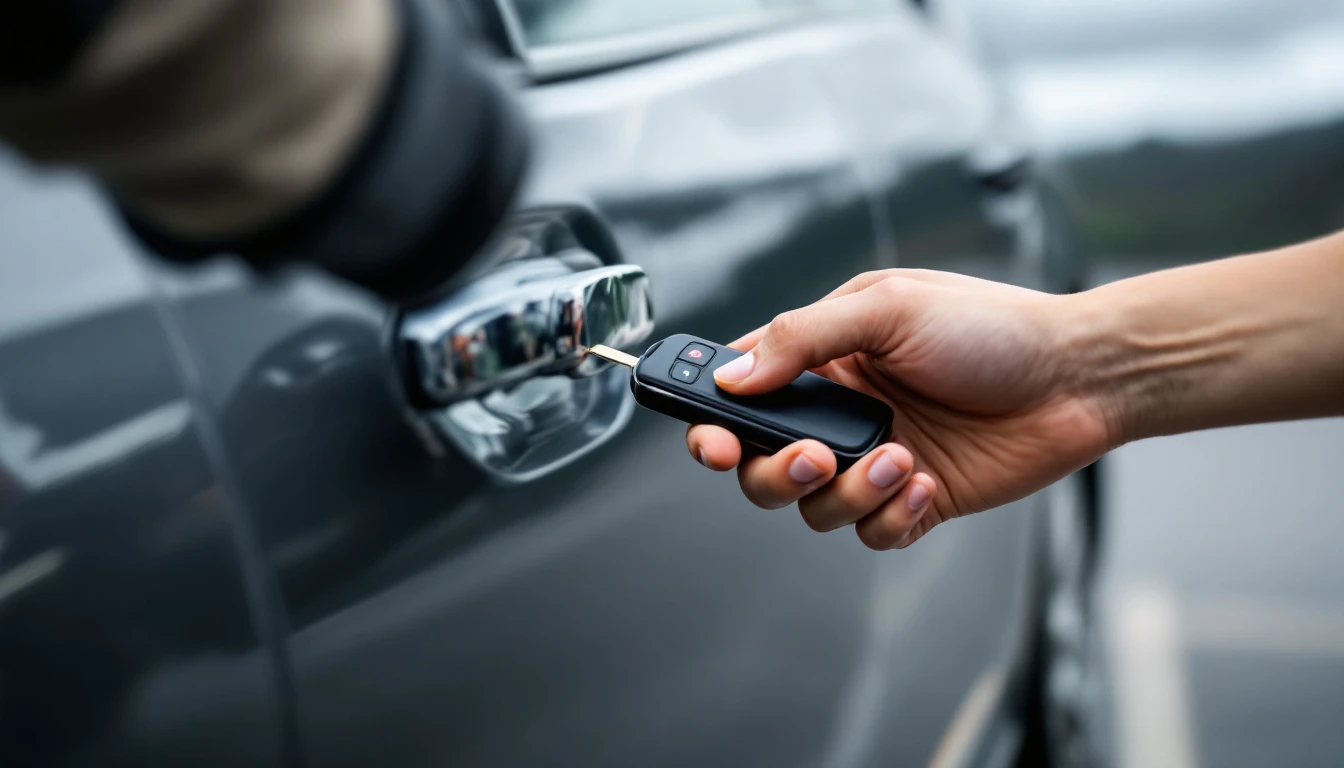
First, work out which of the two failure shapes you have
Every short-range complaint falls into one of two patterns, and telling them apart takes no tools and about thirty seconds of memory.
Pattern one: it faded. Six weeks ago it worked from across the car park. Then from twenty feet. Then ten. Now you are pressing it against the handle. A gradual, monotonic decline is a power problem essentially every time — the transmitter is running on a battery that no longer has the voltage to drive it at full output. The radio, the chip and the registration are all fine.
Pattern two: it fell off a cliff. It worked normally on Tuesday and on Wednesday it does nothing, or only works with the fob touching the car. A sudden change is not a battery going flat, because batteries do not do that. Something discrete happened: the fob got wet or was dropped, the car's 12-volt battery went flat or was disconnected, or a receiver or antenna circuit failed.
There is a third shape worth separating out. Pattern three: it is intermittent. It works, then it does not, then a second press works. That is the fingerprint of a mechanical fault — a worn button contact or a cracked solder joint that makes and breaks as the case flexes in your hand. It is not a battery and it is not the car.
Knowing which pattern you have narrows the causes below from six to about two, and it is the first thing a competent shop will ask you on the phone.
The six real causes, in order of how often they turn out to be the answer
1. The coin cell (the overwhelming favourite). A CR2032 or CR2025 in a daily-driven fob lasts roughly two to four years. As it sags, the transmitter's output power drops long before the fob stops working entirely, so range shrinks for weeks before anything dramatic happens. This is pattern one and it is the diagnosis in the large majority of cases.
2. A worn button contact. The conductive layer on the rubber pad wears through where your thumb lands. It fails intermittently and often only on the one button you use most — unlock works, lock does not, or vice versa. Pattern three.
3. Moisture inside the shell. A fob that has been through a wash cycle, dropped in a puddle on Main Street, or carried through a summer of pocket humidity can grow corrosion on the board. This kills range before it kills the fob outright, because corrosion on the antenna trace or the battery terminals raises resistance without breaking the circuit. Pattern two or three.
4. Radio interference at that specific place. Fobs transmit at low power on shared unlicensed bands. A nearby transmitter — a poorly shielded LED sign, a security camera link, a car park lighting ballast, or the electronics of the vehicle parked next to you — can raise the local noise floor enough to swallow the fob's signal. The tell is location-specific failure: fine at home, useless in one particular garage or car park. The spectrum these devices share is administered by the FCC's equipment authorization program, which is also where the FCC ID moulded into the back of your fob comes from.
5. The fob has lost its registration. A perfectly healthy fob can be forgotten by the car after the vehicle's 12-volt battery goes flat or is disconnected, after body-module work, or after a jump start that browned out the electronics. This usually presents as total failure rather than short range, but partial function — passive entry gone while the buttons still work — happens too. Nothing is wrong with the hardware; it needs re-registering, not replacing.
6. A receiver or antenna fault in the vehicle. The least common and the one people jump to first. The giveaway is that every fob behaves the same way. If you have two fobs and both suddenly need to be held against the car, the common factor is the car, not two fobs that failed the same week.
The ten-minute diagnostic you can run in your own driveway
Step 1 — test the second fob. This is the single most informative thing you can do and it costs nothing. If the spare has full range, your car is fine and the problem is entirely in the first fob. If both are short-range, the problem is in the car. Do this before anything else.
Step 2 — change the coin cell, correctly. Match the number printed on the old cell exactly. Do not touch the flat faces with your fingers — skin oil on the contact surface measurably raises resistance. Make sure the polarity matches and that the retaining clip actually springs down onto the new cell; a cell that sits a fraction of a millimetre proud will work when the case is squeezed and fail when it is not, producing a fault that looks exactly like a bad button.
Step 3 — test in a different place. Walk the car to another car park, or simply test at home versus at work. Range that is fine in one location and hopeless in another is interference, not hardware, and there is nothing to fix on the vehicle.
Step 4 — separate the fob from your phone and other fobs. A fob buried in a pocket against a phone, a second fob, or a metal card holder is being shielded and detuned. Test it held out in clear air.
Step 5 — open the shell and look. Green or white powder on the battery terminals, a brown tide-mark on the board, or a button pad worn shiny through to the plastic all tell you what you are dealing with in a glance.
Step 6 — check the vehicle's own battery health. A car whose 12-volt battery is on its last legs produces a whole family of odd electronic symptoms, and keyless entry is often the first to complain. This is especially true on hybrids and EVs, where a flat 12-volt battery can leave the car unable to recognise a perfectly good key at all — the mechanism is spelled out in our Hyundai Ioniq 5 and Ioniq 6 12-volt battery key relearn guide, and the same principle applies to conventional cars in milder form.
What each outcome costs in Grand Prairie as of August 2026
Coin cell. A couple of dollars at any hardware or grocery store, and two minutes. Nobody should be charging you a service call for this, and if a shop diagnoses a flat coin cell as a $300 fob, the problem is the shop rather than the car.
Shell, button pad and contact repair. Materially cheaper than a replacement fob, because it keeps your original electronics and — crucially — your original registration. No programming is involved, so there is no programming charge. If your fob is physically tired but electrically healthy, this is the right answer.
Re-registering an existing healthy fob. A fraction of the cost of a new one. This is the fix when the car has forgotten a fob that is otherwise fine, and it is the outcome most often missed by shops that go straight to selling hardware. Our keyless entry repair guide covers the distinction in detail.
A full replacement fob, supplied and programmed on site: $150–$280 for a remote-head or flip key and $180–$320 for a proximity fob on a mainstream vehicle, with premium and European proximity fobs at $250–$420. A second fob taken at the same visit is 30–50% of the first. The complete breakdown by fob type is in our 2026 key fob replacement cost guide.
A receiver or antenna fault in the vehicle. This is diagnostic work rather than key work — the antenna module, its wiring, or the body control module. It needs to be measured rather than guessed at, which is what dealer-level diagnostics is for. Replacing fobs against a receiver fault is the most expensive way to not fix this problem, and it is depressingly common.
Why short range is worth fixing now rather than living with
Most people adapt. You start walking closer to the car, then pressing the button twice, then holding the fob against the handle, and after a few weeks you have stopped noticing. That adaptation is the risk, because a fob at the end of its battery life is a fob that will eventually not work at all — and it will happen at whatever moment is least convenient.
On a push-button-start vehicle it matters more than on a turn-key one. When a proximity fob has too little power to be detected, the car cannot see it at all, and getting in and getting started falls back to the emergency blade hidden in the fob and a marked backup position for holding the fob against the start button. Both of those are documented in the owner's manual and almost nobody has read that page before they need it. Read it now, while you are not standing in a car park in August.
And there is a security dimension. A fob with degraded output is more likely to be pressed repeatedly and left transmitting in a pocket, and a fob whose shell has been opened and badly reassembled is easier to lose the innards from. Neither is dramatic, but keyless-entry systems are designed around a fob in known good condition, and vehicle security research collected by the National Highway Traffic Safety Administration consistently treats the condition of the key as part of the vehicle's security posture rather than an accessory concern.
The practical version: a two-dollar battery today, or an all-keys-lost job at $250–$550 in a month if the failing fob was your only one. That arithmetic is the entire argument.
When to stop diagnosing and call somebody
Both fobs are short-range. Two fobs do not fail identically the same week. The car is the common factor and it needs measuring, not guessing.
A fresh battery, correctly seated, changed nothing. You have ruled out the most likely cause. What is left is contacts, moisture, registration or the vehicle — and telling those apart needs equipment that reads what the car is actually receiving.
Passive entry stopped but the buttons still work. This is a specific and informative failure: the low-frequency side of the system has gone while the radio-frequency side is fine. It usually points at the fob's LF coil or one of the vehicle's door antennas, and it is not a battery.
It started right after the car battery went flat or was disconnected. That is the registration case, and it is a programming visit rather than a parts purchase. See car key programming.
You are down to one fob. Whatever the diagnosis turns out to be, fix the spare situation while you still have a working key. A second fob added now is 30–50% of the first; the same fob after the last one dies is an all-keys-lost job. If you want it dealt with today, keyless entry repair and key fob replacement both come to the vehicle, and our general guide to what to do when a key fob stops working is worth ten minutes first.
A Real-World Example
Operator: A Grand Prairie commuter reported that the fob on his 2018 Chevrolet Equinox had to be touched against the door to work, and had already bought a replacement fob online after a shop quoted him for a new one.
Before:
- Range down from across-the-car-park to roughly two inches over about a month
- One shop quoted a replacement fob and programming without testing anything
- A marketplace replacement fob already purchased and waiting in a drawer
What changed:
The diagnosis took under five minutes and started with the question nobody had asked: does the second fob have full range. It did — which immediately cleared the vehicle and put the fault entirely in the first fob. The pattern was a slow monotonic fade over weeks, the signature of a sagging coin cell. The cell was replaced with a correctly matched CR2032, seated properly under the retaining clip, and the range came straight back. The online fob was checked while the shell was open: the FCC ID did not match the vehicle and it would never have programmed.
Results:
- Fault resolved with a coin cell costing about two dollars
- Full range restored and verified from the far side of the car park
- The pre-purchased online fob identified as the wrong part before any labour was spent on it
- A spare-key conversation had while he still had two working fobs, rather than after
Net: The most expensive part of this job would have been the parts nobody needed. Testing the second fob is free, takes fifteen seconds, and immediately splits the diagnosis between “the fob” and “the car” — and it is the step most often skipped by whoever is quoting you for hardware.
What Experts Say
“When somebody tells me the fob only works up close, the first thing I ask is whether the other one does the same. If the spare is fine, I already know the car is fine and I am only working on one fob — and eight times out of ten that is a battery. The ones that hurt are the people who have quietly adapted to it for six months, because a fob that weak is going to fail completely one day, and it is never going to pick a convenient day to do it. Two dollars now, or an all-keys-lost job later. That is really the whole decision.”
Per the FCC's equipment authorization framework, remote keyless entry transmitters operate as low-power intentional radiators on shared unlicensed bands, which means their effective range is a function of both transmitter output and the local noise environment — so a fob whose range varies by location is exhibiting normal shared-spectrum behaviour rather than a hardware fault.
Frequently Asked Questions
Why does my key fob only work when I hold it against the car?
In roughly eight cases out of ten it is a flat coin cell. As the battery voltage sags the transmitter output drops, so range shrinks over weeks before the fob stops working altogether. The next most likely causes are a worn button contact, moisture inside the shell, radio interference at that one location, a fob that has lost its registration, or — least commonly — a receiver fault in the vehicle.
How do I tell whether the problem is the fob or the car?
Test your second fob. If the spare has full range, the vehicle is fine and the fault is entirely in the first fob. If both fobs are short-range, two fobs did not fail identically in the same week — the car is the common factor and the receiver or antenna circuit needs measuring. This test is free and takes fifteen seconds.
I changed the battery and the range did not come back. What now?
First re-check the basics: exact cell type match, polarity correct, retaining clip actually pressing down on the cell, and no finger oil on the flat faces. If it is genuinely seated and still short, you have ruled out the most likely cause — what remains is a worn contact, corrosion inside the shell, a lost registration, or a fault in the vehicle, and telling those apart needs equipment that reads what the car is receiving.
My fob works at home but not in one particular car park. Is it broken?
Almost certainly not. Fobs are low-power transmitters on shared unlicensed bands, and a nearby noise source — an LED sign, a lighting ballast, a camera link — can raise the local noise floor enough to swallow the signal. Location-specific failure with normal range everywhere else is interference, and there is nothing on the vehicle to repair.
Can a worn-out fob be repaired instead of replaced?
Frequently, yes, and it is much cheaper. A shell, button-pad and contact repair keeps your original electronics and your original registration, so there is no programming charge at all. This is the right answer when the fob is physically tired — worn buttons, cracked case — but electrically healthy.
What happens if my proximity fob goes completely flat while I am out?
Every push-button-start vehicle has two documented fallbacks: an emergency blade hidden inside the fob shell that opens the driver door, and a marked backup position — usually the start button itself or a spot in the console — where holding the fob lets the car read it by direct coupling. Both are in the owner’s manual. Read that page before you need it, not in a car park.
Is a short-range fob a security risk?
Not dramatically, but keyless-entry systems are designed around a key in known good condition. The larger practical risk is the failure that is coming: a fob weak enough to need holding against the handle will eventually stop working entirely, and if it is your only key that converts a two-dollar battery into a $250–$550 all-keys-lost job.
The Bottom Line
A fob that only works up close is a flat coin cell far more often than it is anything else, and the free test that proves it is trying your second fob — if the spare has full range, the car is fine. Gradual fade over weeks means the fob; a sudden overnight change means something discrete happened, usually moisture, a lost registration after a 12-volt battery event, or a vehicle-side receiver fault. Repairs run from a couple of dollars for a battery up to $150–$320 for a fully programmed replacement as of August 2026 — and the worst outcome is adapting to it until the fob fails completely.
Next Steps
Try the spare fob first, then a correctly seated fresh coin cell. If neither restores the range, call (214) 949-1847 with your year, make, model and whether both fobs behave the same way — that one answer decides whether we are working on the key or on the car. See keyless entry repair, key fob replacement, and dealer-level diagnostics.
Sources cited in this article
- FCC equipment authorization (FCC ID)
- National Highway Traffic Safety Administration (NHTSA)
- Texas DPS Private Security Program
- Associated Locksmiths of America (ALOA) certification
- National Automotive Service Task Force (NASTF)
- SAE International vehicle security standards
- AAA roadside assistance and repair-cost research
- FTC consumer guidance on locksmith scams