What PATS is and why Fords behave the way they do
PATS is Ford's engine immobilizer. A transponder in the key is read by an antenna at the ignition or start button, checked against a key table, and only then is the engine allowed to run. A PATS failure has an unmistakable signature: the engine starts and then dies within about two seconds, and the theft indicator on the cluster flashes rapidly rather than following its normal slow pattern.
That two-second start-and-die is diagnostic gold. It means fuel, spark, compression, and the starter are all fine — the engine ran. What stopped it was authentication. Owners routinely tow trucks in for fuel-pump diagnosis when the actual problem is a key the truck no longer trusts, so it is worth recognising.
PATS has been through several generations across the F-150 and Explorer lines, from early bladed transponder keys, through flip keys with integrated remotes, to proximity fobs with push-button start on later trims. The generation determines the tooling. What does not change is the underlying logic: the truck maintains a table of keys it trusts, and everything in this job is about who is allowed to write to that table.
Grand Prairie is a truck market. The F-150 is the most common vehicle we are called out to in this city, and the Explorer is not far behind among family vehicles. That volume is why the PATS routines below are worth knowing in detail.
The two-key routine — free, real, and widely misunderstood
On a large share of PATS-equipped Fords, an owner holding two already-programmed keys can add a third without any tool. The general shape of the routine is: insert the first programmed key, turn to ON for a few seconds, turn off and remove; insert the second programmed key within a short window, turn to ON for a few seconds, turn off and remove; then insert the new key and turn to ON. The theft light acknowledges the addition.
The exact timings and steps vary by model year, and the owner's manual for your specific truck is the authority — not a generic video. Get the sequence wrong and nothing bad happens; the routine simply does not take and you start over. There is no risk of bricking anything, which is why it is worth attempting before calling anyone.
Two hard limits. First, the new key must already be cut correctly and must contain the right transponder type for your truck — the routine adds a key, it does not cut one. Second, and this is where most people get stuck: the routine requires two working keys. With one key, the truck has no way to verify that you are authorised, and the on-board path is closed.
Newer F-150 and Explorer generations have moved away from the owner-accessible routine toward tool-based programming, and on those the on-board sequence simply does not exist regardless of how many keys you hold. Your model year decides. That is the most common reason an owner calls after “the ten-minute trick did not work” — it was never available on their truck.
Grand Prairie pricing for Ford key programming
As of July 2026, honest mobile pricing in this market: cut and program a spare bladed or flip key, working keys present: $140–$220 all-in. Program a customer-supplied key where cutting is not needed: $70–$130. Proximity fob for push-button-start trims, working key present: $180–$300. All-keys-lost, bladed: $250–$400. All-keys-lost, proximity: $320–$500.
Those figures include the key, the cutting, the programming, and the trip within the core service area. A second key at the same visit is typically 30–50% of the first, because the module routine has already been run. That discount is the reason the standing advice is always to leave with two keys, not one.
The newest F-150 and Explorer generations sit at the top of every band. More of the work moves through manufacturer-side authorisation, more of it needs current tool licensing, and the labor window is longer. A credentialed shop confirms coverage against your VIN before dispatch rather than discovering the limitation in your driveway. For where Ford sits relative to other brands, see our 2026 Grand Prairie cost guide.
What happens when you have one key
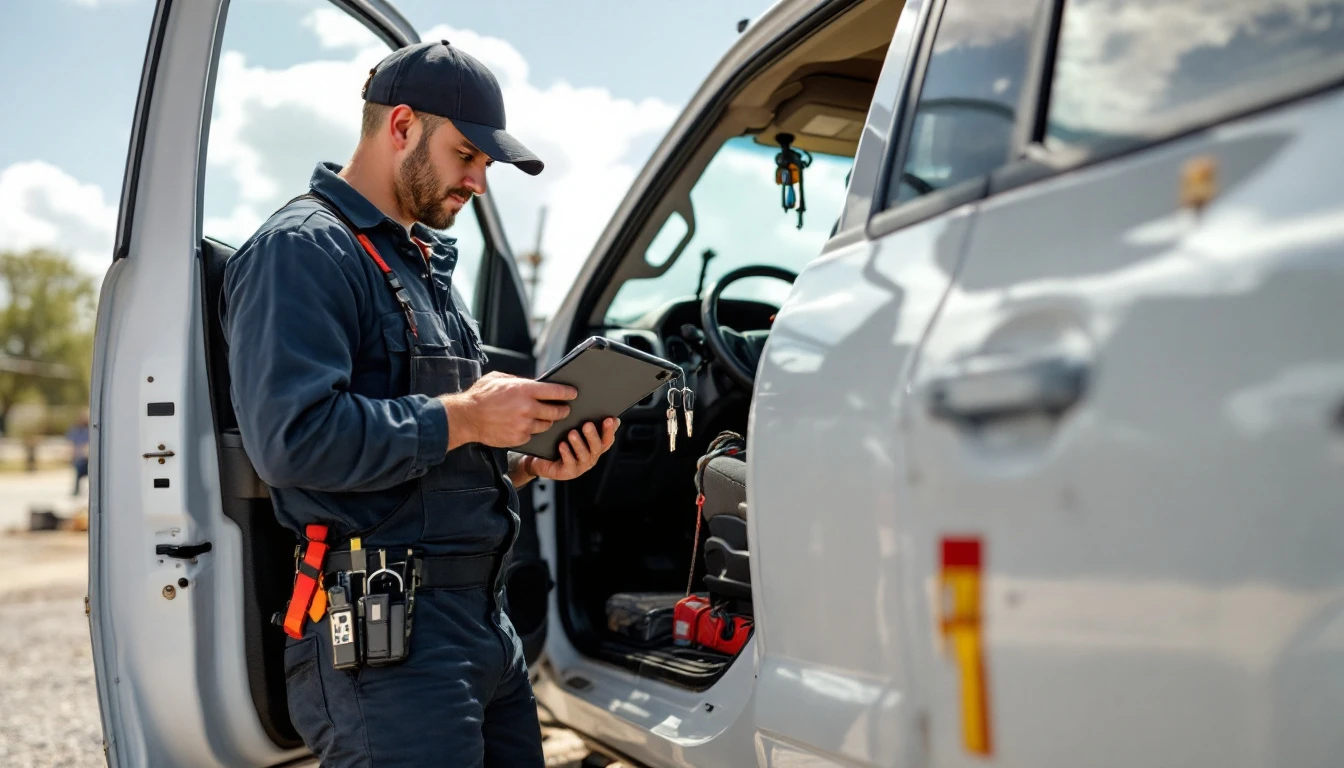
One working key is the most common call we take on Fords, and it is the situation the on-board routine cannot help with. The technician connects a diagnostic tool at the OBD-II port, uses the existing key as the authorisation credential, and writes the new key into the PATS table directly. On bladed trucks that is a 20–40 minute visit; on proximity trims, 30–50 minutes.
It is worth being blunt about the economics here. A Grand Prairie owner with one working F-150 key is roughly $180 away from having two, and roughly $350 away from having zero and needing an emergency call. The second key is not a luxury purchase — on a Ford specifically it also restores access to the free on-board routine for any future third key, which is a genuine ongoing benefit.
While the technician is there, ask for the truck's existing key table to be checked. Used trucks frequently carry keys the previous owner still holds. Clearing unknown keys from the table costs nothing extra during a programming visit and is a real security improvement on any vehicle bought second-hand.
What happens when all keys are lost
With no working key, authorisation has to come from outside the vehicle. The technician establishes it through authorised channels, then runs a routine that writes the first key into an empty or reset table. On some PATS generations this involves a timed security wait built into the vehicle deliberately — a delay you cannot shortcut, and one of the reasons all-keys-lost takes longer than owners expect.
Proof of ownership is mandatory. Expect to show a driver's licence plus title, registration, or insurance matching the VIN. The framework governing legitimate technician access to vehicle security data is maintained by the National Automotive Service Task Force, and it exists precisely so that a stranger with your plate number cannot have a key made to your truck.
Before any of that, a good technician runs a pre-flight diagnostic. Fords are particularly prone to a specific false alarm: after a dead battery, a jump start, or a battery swap, PATS can drop trust in keys that are perfectly healthy. The symptom is identical to all-keys-lost — the truck will not start with the key in hand — but the fix is a relearn, not new keys. Skipping that check is how owners get sold $400 of keys for a $90 problem. Our all-keys-lost guide covers the full sequence.
Common F-150 and Explorer problems we see in Grand Prairie
Starts and dies in two seconds, theft light flashing fast. The signature PATS failure. Ranked causes: damaged transponder in the key, failed antenna ring at the ignition, or trust lost after a voltage event. Try your spare key first — if the spare runs the truck, the daily key is the problem and nothing else needs touching.
F-150 keypad on the door pillar not responding. Ford's door keypad is a separate system from both the fob and the immobilizer. It has its own factory code (often on a label in the owner's literature or retrievable from the module) and its own personal codes. A dead keypad does not indicate a key problem at all, and it is frequently repaired without touching anything else.
Explorer proximity fob that works only against the start button. The inductive backup path doing its job. The transponder is fine; the radio side is weak. Nearly always a coin cell that reads acceptable at rest but sags under load. Replace it before assuming the fob failed — this is the same diagnosis covered in our keyless entry repair service.
Worn ignition on high-mileage F-150s. A key that needs jiggling on a work truck with 200,000 miles is usually a worn key first and a worn cylinder second. A fresh blade cut to factory code is cheap. If the new cut key still binds, you are into ignition repair.
Fleet trucks with mismatched keys. Common in the light-commercial fleets around this city — three trucks, five keys, nobody sure which starts what. Standardising a small fleet during one visit is far cheaper per key than handling each truck as a separate emergency later.
Where the honest boundary sits
Most F-150 and Explorer key work across the last two decades is comfortably inside credentialed mobile capability. The boundary is at the newest end, where more of the programming path runs through manufacturer-side authorisation and current tool licensing. A credentialed shop verifies your specific VIN against its coverage before dispatch — that phone call is the difference between a fixed truck and a wasted trip charge.
The second boundary is any truck a previous shop has already attempted. A partially written key table or a module left in an odd state is a materially different job. Mention it when you call; it changes what gets loaded into the van and it is not held against you.
The third is module replacement. If a PATS-related module has actually failed rather than merely lost sync, that is component work with its own configuration requirements — the immobilizer programming and BCM programming services cover that scope. A shop that quotes a key when the module has failed is guessing, and you will be back.
Mobile versus dealer for a Ford key
The structural case for mobile is strongest on all-keys-lost, because a truck with no working key cannot drive to a service drive. Per AAA roadside and repair-cost research, a flatbed is real money before any programming begins, and it is money the mobile route never spends. Add aftermarket trade parts sourcing versus manufacturer parts counters at MSRP, and same-day availability versus a scheduled appointment, and the gap is consistent.
The dealer genuinely wins on warranty work, on recall and campaign work that has to be recorded in the manufacturer's system, and on the small set of very recent configurations requiring manufacturer-side authorisation. Those are real categories, not concessions — and an honest locksmith will tell you when you are in one of them.
For everything else — which is the overwhelming majority of F-150 and Explorer key work in Grand Prairie — mobile is faster and cheaper for identical results. Our locksmith vs dealership comparison lays out the decision tree, and if you also run a European car, the Mercedes key replacement Grand Prairie guide shows how the same logic scales at the luxury end.
A Real-World Example
Operator: A Grand Prairie contractor running a 2016 Ford F-150 XLT work truck was down to a single key after the spare disappeared on a job site. Nothing was broken — the truck ran fine — but the crew shared the vehicle and a single key was becoming a daily logistics problem.
Before:
- Owner attempted the on-board two-key routine from a video and could not get it to take, because the routine requires two already-programmed keys and only one existed
- Dealer quoted a scheduled appointment plus manufacturer-parts pricing per key
- Credentialed mobile shop quoted $290 all-in in writing for two cut and programmed keys at the job site
What changed:
Technician confirmed the PATS generation by VIN, cut two blades to factory code, connected at the OBD-II port and used the existing key as the authorisation credential to write both new keys into the key table. The existing table was reviewed and two unrecognised entries from the truck's previous owner were cleared at the same time, at no extra cost.
Results:
- Time on site: 41 minutes, inside the 20–40 minute band plus the table cleanup
- Total billed: $290 for two keys — the second key priced at roughly 40% of the first
- Truck went from one key to three total working keys, restoring access to the free on-board routine for any future key
- Two unknown keys from the previous owner removed from the truck's trusted table
Net: The table cleanup is the part most owners never think to ask for. A used truck routinely arrives trusting keys the previous owner still has in a drawer, and clearing them costs nothing during a programming visit that is already happening. Going from one key to three also restored the free two-key routine — meaning the next key this contractor needs may cost nothing at all.
What Experts Say
“Ford gave owners a genuinely free path and almost nobody uses it, because the moment you need it is the moment you are down to one key — and one key is exactly when the routine stops working. My standing advice to every F-150 owner in this city is to keep three keys, not two. Three means you can always add a fourth yourself for the price of a cut blank. Two means you are one lost key away from a service call. One means you are one bad afternoon away from an all-keys-lost bill. The gap between those outcomes is a couple of hundred dollars spent at the right time.”
Per the National Automotive Service Task Force framework for legitimate technician access to vehicle security data and ALOA's automotive certification standards, immobilizer key tables are deliberately gated so that writing a new credential requires either an existing trusted key or documented proof of ownership — the design that makes owner-accessible routines possible only while working keys remain.
Frequently Asked Questions
How much does Ford key programming cost in Grand Prairie?
As of July 2026, cutting and programming a spare bladed or flip key runs about $140–$220 all-in with working keys present, and programming a key you supply runs $70–$130. Proximity fobs for push-button trims run $180–$300. All-keys-lost runs $250–$400 bladed and $320–$500 proximity. A second key at the same visit is typically 30–50% of the first.
Can I program a Ford key myself with the 10-minute routine?
On many PATS-equipped F-150s and Explorers, yes — but only if you already hold two programmed keys. The routine adds a third key using the two existing ones as authorisation, and it requires a key that is already correctly cut with the right transponder. With one key or none, the on-board path is closed. Newer generations removed the routine entirely.
My F-150 starts then dies after two seconds. Is that the key?
Almost certainly. That signature — engine starts, dies in about two seconds, theft light flashing rapidly — is a PATS authentication failure, not a fuel or spark problem. The engine ran, so mechanically it is fine. Try your spare key first: if the spare keeps it running, the daily key is the fault and nothing else needs attention.
Can a locksmith make a Ford key with no keys at all?
Yes, on the overwhelming majority of F-150s and Explorers. Authorisation is established through authorised channels rather than from an existing key, so you will need a driver's licence plus title, registration, or insurance matching the VIN. Some PATS generations include a deliberate timed security wait, which is why all-keys-lost takes longer than a routine spare.
How many Ford keys should I actually keep?
Three, if your truck supports the on-board routine. Three keys means you can add a fourth yourself for the price of a cut blank. Two means the next lost key becomes a service call. One means the next lost key becomes an all-keys-lost bill. The difference between those outcomes is a couple of hundred dollars spent while things are calm.
Does the door keypad on my F-150 need programming too?
The keypad is a separate system from both the fob and the immobilizer, with its own factory code and its own user codes. A non-responsive keypad does not mean you have a key problem, and repairing or recoding it does not affect your keys. It can usually be addressed during the same visit if you mention it when booking.
The Bottom Line
Ford PATS is one of the more owner-friendly immobilizer systems on the road, and the two-key on-board routine is genuinely free on a large share of F-150s and Explorers in Grand Prairie. The trap is that it only works while you still have two keys. Expect $140–$300 for a programmed spare and $250–$500 for all-keys-lost as of July 2026, and treat the third key as the cheapest insurance available — on a Ford it also buys back the free routine.
Next Steps
Call (214) 949-1847 with your VIN, model year, and how many working keys you currently hold — that last number decides both the price and the method. See car key programming Grand Prairie and Ford key replacement for the services, and how car key programming works for the plain-English version of the process.
Sources cited in this article
- National Automotive Service Task Force (NASTF)
- Associated Locksmiths of America (ALOA) certification
- AAA roadside assistance and repair-cost research
- SAE International vehicle security standards
- National Highway Traffic Safety Administration (NHTSA)
- Texas DPS Private Security Program
- FTC consumer guidance on locksmith scams
- U.S. Bureau of Labor Statistics OEWS data