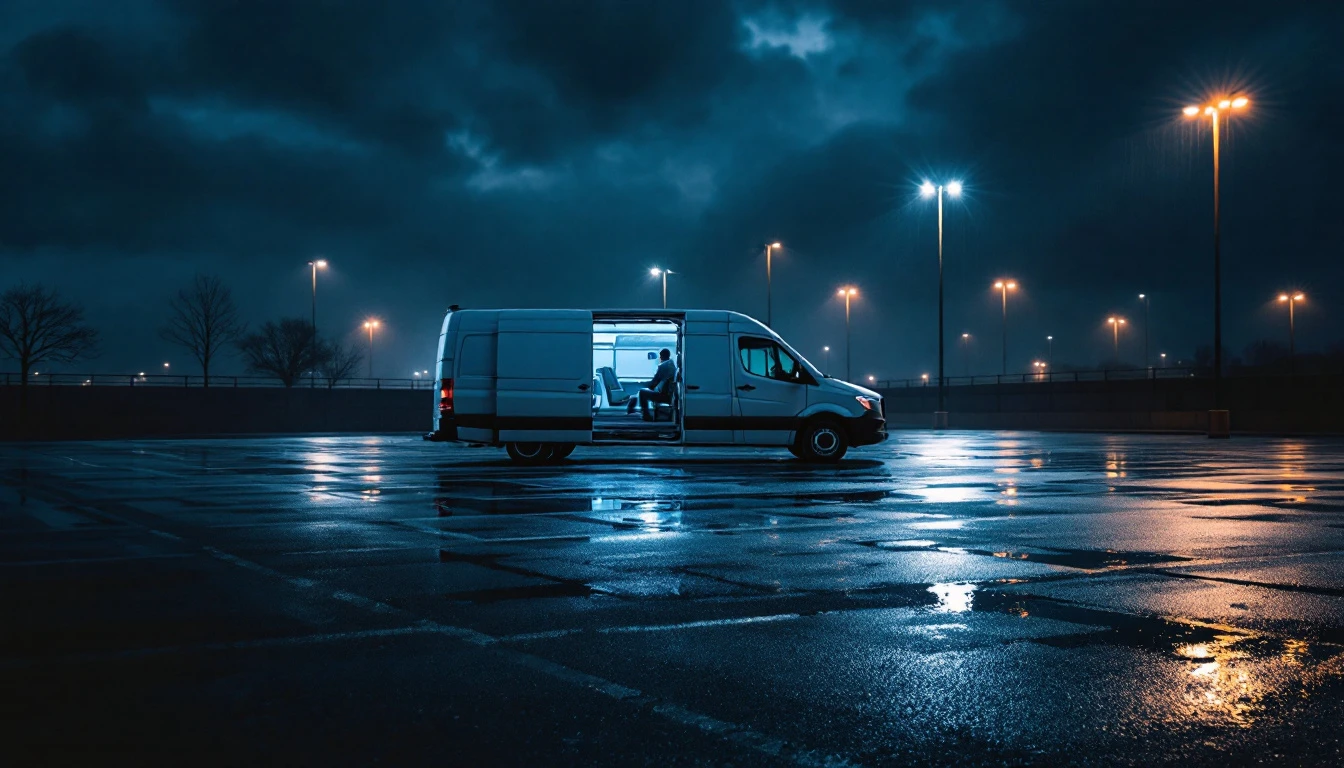
What actually happens between your call and driving away
The call itself should take four or five minutes, and a good one is mostly questions. What is the year, make and model, and can you read the VIN off the windscreen or the door jamb. Where exactly are you. How many keys exist and where are they. Are you locked out of the car as well, or do you have access to the cabin. Do you have identification and a document tying you to the vehicle.
Those answers decide what gets loaded into the van, and a shop that does not ask them is a shop that will improvise in your car park at midnight. The VIN in particular is what turns a guess into a quote — it identifies the key type, the fob variant, and whether your specific configuration is covered.
Arrival in Grand Prairie is typically 25–60 minutes depending on where you are and what else is running. Overnight is often faster than a weekday afternoon, because traffic on I-20 and SH-161 is not a factor at two in the morning.
On site: identification and ownership documents checked first, cabin access if you are locked out, key blade cut to factory code from the VIN, transponder or smart-key registration through the diagnostic port, then verification of every function before the technician leaves. Our emergency locksmith and lost car key pages describe the services.
The prices, stated plainly
Car lockout, keys visible inside, after hours: $75–$150. Spare key cut and programmed with a working key present, after hours: $180–$320 for mainstream vehicles. All keys lost, mainstream vehicle, after hours: $280–$480. All keys lost, luxury or European, after hours: $450–$800.
The after-hours premium itself is normally $50–$100 over the equivalent daytime price. That is a real cost — a technician awake and on the road at 2am — and it should be quoted to you on the phone as part of the total, not added when the work is finished. A quote that grows after the job is a red flag, not a surprise.
A legitimate all-in quote covers the key or fob, the cut blade, every registration the vehicle requires, verification, the mobile trip, and the after-hours premium. Ask explicitly: “is that the total, including the trip and the after-hours charge?” The answer tells you a great deal about who you are dealing with.
If cost is genuinely prohibitive tonight, there is a middle path worth knowing: an emergency blade cut only, $45–$85, gets you into the cabin without programming anything. It will not start the car, but it retrieves belongings and buys you daylight. For the full daytime picture see our 2026 Grand Prairie cost guide.
Three free checks before you spend anything
One: hold the fob against the start button. Almost every push-button-start vehicle can read the transponder inductively when the fob's radio battery is too weak to transmit. If the car starts that way, you need a coin cell from a petrol station, not a locksmith. This single check ends a meaningful share of midnight calls.
Two: find the emergency blade. Nearly every smart key has a small mechanical blade released by a catch on the fob body, and nearly every vehicle has a physical door cylinder, often hidden behind a small cover on the driver door handle. If you have the fob but the car is unresponsive, that blade gets you inside.
Three: search the car and yourself properly. Under seats, in seat rails, in the boot, in the door pockets, and in every pocket of whatever you are wearing — twice. It sounds patronising at midnight and it resolves more of these situations than anybody admits. Twenty minutes of searching against a $400 job is good arithmetic.
And if nothing on the vehicle responds at all — no lights, no chime, no handle presentation — that is a flat 12-volt battery, not a key problem, and it needs a jump rather than a key. Our key fob troubleshooting guide covers the whole diagnosis order.
The bait-quote pattern, and how to defeat it in one minute
The pattern is well documented and it is aimed specifically at people in your situation. An advertised price of “$29” or “$49 and up” produces a call. A technician arrives. The price becomes several hundred dollars, delivered to somebody stranded, tired, and out of options at one in the morning. The Federal Trade Commission's consumer guidance on locksmith scams describes the sequence in detail.
Four questions defeat it, and they take a minute. Ask for the total including the trip and after-hours charge. Ask what the company is actually called — a dispatcher who answers “locksmith service” rather than a business name is a call centre selling your job on. Ask for a licence number. Ask whether they will need to see proof of ownership — a shop that says no is telling you it does not care whose car it opens, which should worry you as the person who owns this one.
In Texas, locksmith licensing is administered by the Department of Public Safety Private Security Program — not TDLR, whatever a directory listing claims. Credentialing standards for automotive work are published by ALOA.
If a technician arrives and the price has changed, you are allowed to decline. It is uncomfortable and it is your right. Pay nothing, do not let work start, and call somebody else — there are shops running all night in this market and one of them will quote you honestly.
Staying safe while you wait
Where possible, wait somewhere with people and light rather than beside the car. A 24-hour petrol station, a hotel lobby, or an open shop is a better place to spend forty minutes than an empty car park, and the technician can call you when they arrive.
Tell somebody where you are and roughly when you expect to be moving. Share your location from your phone if that is easy. This is ordinary personal-safety practice rather than paranoia, and it costs nothing.
If you are on a road shoulder rather than a car park, that changes the priority order entirely: get away from moving traffic first. Hazards on, occupants out on the non-traffic side and behind a barrier if there is one, then make the call. No key is worth standing beside a live lane on SH-161.
Have the ownership documents to hand before the van arrives. Insurance apps hold a copy on your phone, which is usually the fastest route at midnight when the paperwork is in a filing cabinet at home. Our car lockout service page covers the access-only side of the problem.
Why mobile is the only real option after hours
The dealer route at midnight does not exist. The service drive is closed, and even in daylight the sequence begins with recovering an immobilised vehicle onto a flatbed. Per AAA roadside and repair-cost research, avoiding that tow is the single largest structural saving on any immobilised-vehicle job, and after hours it is not a saving so much as the difference between solving this tonight and solving it on Thursday.
A properly equipped van carries key blanks and fob stock for the common platforms, code-cutting equipment, and the diagnostic tooling to register credentials on site. That is why the whole job happens at the kerb: cut, register, verify, done. The access framework that makes independent credential work legitimate is maintained by the National Automotive Service Task Force.
The honest limit is coverage. A very new or unusual vehicle may be outside a given shop's current tool licensing, which is exactly why the VIN matters on the phone. A shop that verifies coverage before dispatch will occasionally tell you it cannot help tonight — and that answer, given at 12:40am rather than at 1:20am after a wasted callout, is worth more than a confident guess.
Coverage in this market extends beyond Grand Prairie itself: Arlington, Irving, Mansfield and the surrounding cities are inside the core overnight service area. See our 24-hour Arlington locksmith page and our after-hours locksmith guide for how out-of-hours dispatch works.
Tomorrow: make sure this never happens again
The arithmetic is brutally simple. A spare key bought in daylight, with a working key present, costs roughly $160–$300 on most mainstream vehicles. Tonight's job, with no key, after hours, costs $280–$480 or considerably more on a luxury car. The same physical fob, in two different circumstances, with a swing of several hundred dollars.
If you are having a key made tonight, have two made. The second one at the same visit is roughly a third of the price of the first, because the expensive part — establishing authority on a vehicle that trusts nothing — has already been done. Leaving with one key puts you exactly one dead battery away from repeating tonight at full price. This is the single best-value moment that vehicle will ever offer you.
Keep the spare somewhere the first key is not: a drawer at home, with a partner, at a workplace. Not on the same ring, not in the glovebox. And if it is a proximity fob stored indoors, keep it away from the front door and away from the driveway to limit relay-attack exposure.
Then check the coin cell in both fobs once a year, and get the emergency blade cut if it never was. Those two habits, plus a real spare, remove essentially every version of tonight from your future. Our all-keys-lost guide covers the full process in daylight.
A Real-World Example
Operator: A Grand Prairie shift worker finished at 11:40pm and could not find the single smart key to her 2016 Toyota Corolla anywhere in the employee car park. The vehicle had been bought used with one key and no spare had ever been cut.
Before:
- First number called quoted "$49 and up" and would not give a total when asked directly
- Second number answered "locksmith service" with no business name and could not provide a licence number
- She had no printed registration with her, but her insurance app held a copy of the policy document on her phone
What changed:
The third shop asked for the VIN off the windscreen, quoted $340 all-in for all-keys-lost including the after-hours premium and the trip, and confirmed exactly what identification would be needed. The technician arrived in 34 minutes, checked her photo ID against the insurance document on her phone, opened the cabin, cut a key to factory code from the VIN, registered the transponder, and — at her request — cut and registered a second key at the same visit.
Results:
- Arrival time: 34 minutes from the call
- Time on site: 71 minutes for all-keys-lost plus a second key
- Total billed: $455 — $340 as quoted, plus $115 for the second key programmed at the same time
- No tow required; the vehicle was driven home the same night
Net: The two cheap quotes were an opening position and a call centre. The shop that gave a real total on the phone charged exactly what it said it would. The second key added $115 to a job that would cost $280–$480 on its own if bought after a future loss — and it is the reason there will not be a future loss. Insurance app documents count as proof of ownership; a printed registration in a filing cabinet at home does not help at midnight.
What Experts Say
“The thing I wish people knew is that the price should be the price on the phone. I will give somebody a total at one in the morning including the after-hours charge and the trip, and that is what they pay. If a company will not do that, they are not planning to. And the second thing, which I say on every single lost-key job: have me cut two while I am here. The hard part of that job is getting the car to trust anything at all, and once that is done the second key is about a third of the first. People say no because they are looking at the total on a bad night, and about one a month calls me back six months later from another car park. It is the cheapest insurance in the trade and it lasts as long as the car does.”
Per ALOA's automotive certification standards and the NASTF vehicle security access framework, all-keys-lost procedures require ownership verification and establish vehicle trust from outside any existing credential; once that state is achieved, registering an additional credential within the same session requires only incremental labour, which is why simultaneous second-key programming is standard professional advice.
Frequently Asked Questions
How much does a 24-hour locksmith cost for car keys in Grand Prairie?
As of August 2026, an after-hours car lockout with the keys visible inside runs $75–$150. A spare key cut and programmed with a working key present runs $180–$320 on mainstream vehicles. All keys lost runs $280–$480 on mainstream vehicles and $450–$800 on luxury or European cars. The after-hours premium is typically $50–$100 over daytime rates and should be included in the phone quote.
How fast can somebody get to me at night in Grand Prairie?
Typically 25 to 60 minutes depending on your exact location and what else is running. Overnight arrival is often faster than a weekday afternoon because traffic is not a factor. Time on site is 20 to 40 minutes with a working key present, or 60 to 110 minutes if every key is gone.
Do I need to have my car towed to a dealer if I lost all my keys?
No. A credentialed mobile locksmith cuts and programs a key where the vehicle sits — car park, kerb, apartment lot or shoulder. Avoiding the flatbed is the largest single saving on the job, and after hours the dealer route is not available at all because the service drive is closed.
What do I need to prove the car is mine?
Photo identification plus title, registration, or an insurance document naming you and matching the VIN. A copy in your insurance app on your phone counts and is usually the fastest option at night. This is mandatory — a technician who does not ask would do the same for whoever tried to take your car next.
The quote changed when the technician arrived. What should I do?
Decline. Do not let work begin, pay nothing, and call another shop — several run overnight in this market. A price that grows on arrival is the documented bait pattern consumer regulators warn about, and it is aimed specifically at people who feel they have no alternative at 1am. You do.
Should I get a second key made while the locksmith is here?
Yes. On an all-keys-lost job the second key is roughly a third of the price of the first, because the expensive part of the work — getting a vehicle that trusts nothing to trust something — has already been done. Leaving with one key puts you one dead battery away from repeating tonight at full price.
The Bottom Line
An after-hours car key replacement in Grand Prairie is $220–$450 for most mainstream vehicles and $400–$800 for luxury or all-keys-lost work as of August 2026, with arrival typically inside an hour and no tow required. Before you spend anything, hold the fob against the start button and search the car properly. When you do call, get a total that includes the trip and the after-hours charge — and have a second key cut while the technician is already there.
Next Steps
Call (214) 949-1847 now with your VIN, your exact location, and whether you have photo ID plus registration or insurance for the vehicle. Ask for the total including the trip and after-hours charge — you will get one. See emergency locksmith Grand Prairie, lost car key service, and car lockout service.
Sources cited in this article
- FTC consumer guidance on locksmith scams
- Texas DPS Private Security Program
- Associated Locksmiths of America (ALOA) certification
- National Automotive Service Task Force (NASTF)
- AAA roadside assistance and repair-cost research
- National Highway Traffic Safety Administration (NHTSA)
- SAE International vehicle security standards
- U.S. Bureau of Labor Statistics OEWS data