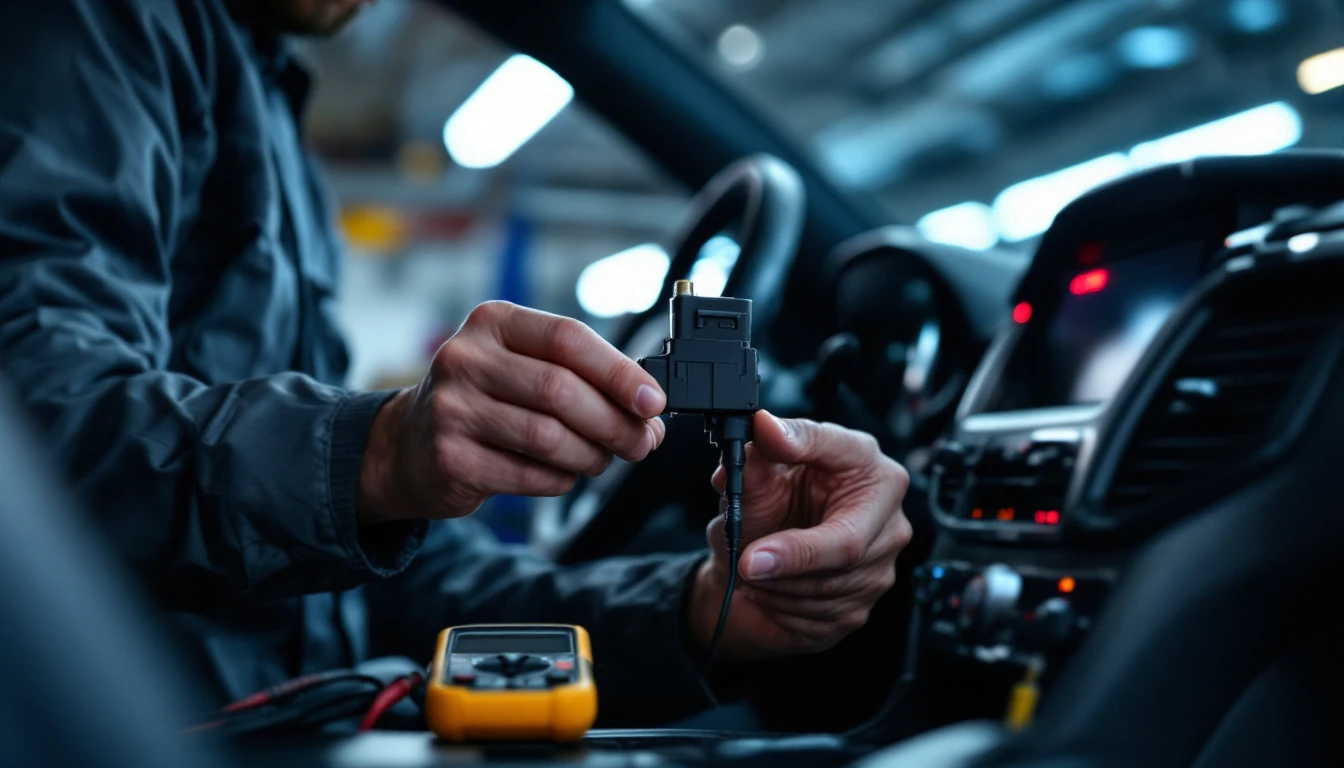
What the WIN module is and why it matters
On most Charger and 300 model years, the ignition is not a simple mechanical barrel wired to a switch. It is the Wireless Ignition Node — a module that houses the key receptacle or push-button interface, reads the key's transponder through an integrated antenna, participates in the immobilizer conversation, and controls the ignition states the car sees.
Consolidating those functions into one module makes the car cheaper to build and gives it more capability. It also means a single failure takes out several things at once. That is why WIN faults present so confusingly: a mechanical symptom (key will not turn), an electrical symptom (no crank), and a security symptom (key not detected) can all be the same underlying failure.
Platform siblings share this architecture, so a technician who works on Chargers regularly is also fluent on 300s and the related large-platform vehicles. That is worth asking about when you call — these modules have well-known failure patterns, and familiarity genuinely shortens the diagnosis.
Related to the WIN is the SKREEM/SKIM family — the immobilizer authority that holds the key table. Depending on model year, the key-authentication role sits in the WIN, in a separate immobilizer module, or is shared across the radio-frequency hub. Which one your car uses determines whether a replacement WIN needs the existing keys re-registered or the key table rebuilt entirely.
The four symptoms and what each usually means
Key will not turn at all. First rule out the two free causes: a bound steering lock (rock the wheel gently while turning the key) and an automatic not fully seated in Park. If those are clear, you are looking at either a worn key, a worn mechanical cylinder inside the WIN, or a WIN that has failed and is refusing to release.
Key turns but the engine will not crank. The mechanical side is fine and the electrical side is not. On these cars that frequently points at the WIN's switching function rather than at a starter or battery — particularly when the dash lights up normally and the failure is intermittent or heat-related.
“Key not detected” or a flashing security telltale with a good key. This is the authentication path: the WIN's antenna is not reading the transponder, or the immobilizer no longer trusts it. Try a spare key first — if the spare works, the daily key is at fault and nothing needs replacing on the car.
Key stuck in the ignition and will not come out. Sometimes this is the shifter interlock (the car does not believe it is in Park). Sometimes it is a worn cylinder whose wafers no longer align at the LOCK position. Sometimes it is a WIN that has lost the ability to release. The first is free, the second is a cylinder repair, the third is a module replacement — three very different prices, which is why diagnosis matters more than parts here. Our key stuck in the ignition guide covers the immediate steps.
Grand Prairie pricing for Charger and 300 ignition work
As of July 2026, honest mobile pricing in this market: fresh key cut to factory code when the cylinder and module are sound: $60–$120. Stuck-key extraction: $90–$180 on its own. Mechanical cylinder repair or replacement, keyed to your existing key: $180–$320. WIN module replacement including key programming: $280–$450. WIN replacement plus all-keys-lost key creation: $380–$600.
The variable that pushes toward the top is whether the replacement module needs the key table rebuilt from scratch and whether new keys have to be cut from VIN code rather than re-registered. On a car where the original keys survive and the module is simply swapped and configured, you are at the lower end.
Two things are worth insisting on. Keyed to your existing key — where a mechanical cylinder is being replaced and you still have a working key, the new cylinder can be pinned to match so you do not end up carrying two keys. And a written “up to” number on any job where teardown may reveal additional damage. Honest shops quote that way routinely. For the wider cross-brand picture, see our 2026 Grand Prairie cost guide.
Diagnosing before replacing — the checks that save money
Test the spare key. The single most informative thirty seconds available. If the spare turns and starts the car, the module is fine and the daily key is worn or its transponder is damaged. A fresh blade cut to factory code is a fraction of a module replacement.
Check for a recent battery event. A dead battery, a jump start, or a battery replacement can leave modules out of sync on these cars, producing no-start and no-key-detected symptoms with completely healthy hardware. A relearn resolves it. This is the most commonly missed free fix on the platform.
Note whether the fault is heat- or vibration-related. “It only does it after the car has been running for twenty minutes” or “it only does it when I hit a bump on Great Southwest Parkway” are extremely useful sentences. Intermittent, temperature-dependent electrical faults point toward the module; consistent mechanical resistance points toward the cylinder.
Scan for stored codes. A diagnostic pull frequently distinguishes an immobilizer communication fault from a switching fault outright, and it costs a fraction of guessing. Any shop replacing a WIN without scanning first is buying a part on a hunch with your money.
What a WIN replacement visit looks like
The technician confirms VIN and model year, verifies ownership, scans for stored faults, and runs the checks above. If the WIN is confirmed failed, the steering column shroud comes off and the module is released — on many of these cars via a retention mechanism that is straightforward with a functioning key and considerably less so without one.
The replacement module is fitted and then configured to the vehicle. This is the step that separates this from a parts swap: the module must be recognised by the vehicle's network and the key table must be established, either by re-registering your existing keys or by writing new ones. That work runs through the OBD-II port — the same discipline covered by our immobilizer programming service.
Typical time on site is 60–110 minutes. Before the van leaves, cycle the key or push-button through every state several times, confirm the key removes cleanly at LOCK, confirm accessory power behaves, and confirm remote functions still work — module changes can affect the remote-keyless side, and it is far easier to sort out in your driveway than a week later.
Common Charger and 300 problems we see in Grand Prairie
Intermittent no-crank that gets worse in summer heat. A very Texas symptom on this platform, and a classic module signature. Heat expands a marginal internal connection until it opens. Owners typically report it starting fine in the morning and refusing at three in the afternoon in a parking lot off Interstate 20.
Key stuck at ACC with the shifter apparently in Park. Frequently the shifter is almost in Park — a firm push into detent releases it. If not, the interlock solenoid or the module release is the next suspect. Do not force the key; a snapped key inside the barrel converts a $90 problem into a $250 one.
Fob works for locks but the car says no key detected. Split failure between the remote transmitter and the transponder path. The remote side is battery-powered and the transponder is passive, so they fail independently. This is diagnosed the same way as any keyless fault — see our keyless entry repair service.
Aftermarket remote-start interference. Chargers and 300s attract aftermarket alarm and remote-start installs, and a piggybacked module sitting between the key and the ignition circuit can produce faults that look exactly like a failed WIN. Mention any aftermarket system when you book; it changes the diagnosis materially.
Worn keys on high-mileage cars. These are frequently second- or third-owner vehicles with original keys well past their service life. A fresh cut is the cheapest thing on this entire page and it resolves a meaningful share of “my ignition is going out” complaints outright.
Where the honest boundary sits
Most Charger and 300 ignition work is squarely inside credentialed mobile capability, including WIN replacement and configuration. The boundary is at the newest model years and at vehicles where a module has already been replaced by another shop — a module locked to a different VIN, or a partially configured installation, is a materially different job from a clean failure.
A second boundary is the used-module question. Owners frequently ask whether a WIN from a salvage vehicle can be fitted. On some model years a used module can be cleared and configured; on others it is effectively married to its original VIN. Which camp your car falls into is generation-specific, and a technician should tell you before you buy a part off a marketplace, not after.
The third is scope honesty. If the underlying fault is a wiring harness, a starter, a body control module, or a battery-management issue rather than the ignition, a locksmith should say so and hand it back rather than replacing an expensive module that was never the problem. Our automotive locksmith guide covers where the trade boundary genuinely sits.
Mobile versus dealer on ignition work
A Charger with a failed WIN frequently cannot be driven, which means the dealer path opens with a flatbed. Per AAA roadside and repair-cost research, that tow is real money spent before diagnosis begins, and the mobile route never spends it — the van comes to the car.
The second advantage is parts sourcing through trade channels rather than manufacturer parts counters at MSRP, and the third is same-day availability against a scheduled service-drive appointment. For a daily driver, that scheduling gap is often the largest real cost in the whole equation.
The dealer is genuinely right for warranty-covered work and for any recall or campaign work that must be recorded in the manufacturer's system. Those categories are real and an honest locksmith will point you there. For an out-of-warranty Charger or 300 with a failed ignition module, mobile is faster and cheaper for identical results. The same structure holds at the luxury end of the market — see our Mercedes key replacement Grand Prairie guide for how it scales.
A Real-World Example
Operator: A Grand Prairie owner of a 2015 Dodge Charger SXT reported an intermittent no-crank that had gone from once a month to daily over one summer. The dash lit normally, the key turned freely, and the car would start again after sitting for twenty minutes — a pattern that had already produced one replaced battery and one replaced starter at another shop.
Before:
- A previous shop had replaced the battery, then the starter, neither of which changed the symptom
- Owner was quoted a dealer diagnostic plus tow, having concluded the car was "electrical" and beyond a locksmith
- Credentialed mobile shop quoted $95 diagnostic, credited against repair, with a written "up to $420" ceiling for WIN replacement and key programming
What changed:
Technician scanned first and found immobilizer communication faults consistent with a failing Wireless Ignition Node rather than a starting-system problem. The spare key produced the identical symptom, ruling out a worn key. WIN replaced, module configured to the vehicle, and both existing keys re-registered to the new key table rather than new keys being cut — which kept the job at the lower end of the quoted ceiling.
Results:
- Time on site: 88 minutes including diagnosis
- Total billed: $385 against the $420 written ceiling, with the $95 diagnostic credited
- Both original keys retained and re-registered — no new keys purchased, no second key to carry
- Intermittent no-crank resolved; the earlier battery and starter replacements had addressed neither cause
Net: The money already wasted on a battery and a starter exceeded the eventual repair. The distinguishing detail was always in the symptom description — an intermittent fault that worsened with heat and resolved after cooling points at a marginal electronic connection, not at a starter. A scan before parts would have found it the first time.
What Experts Say
“The Charger and the 300 put the ignition switch, the immobilizer antenna, and part of the key authentication into one module, so one failure shows up as three different complaints. Owners tell me the key will not turn, or the car will not crank, or the dash says no key detected — and all three of those sentences can describe the same failed part. The mistake I see most is a shop replacing a starter or a battery because the symptom is intermittent. Scan it first. On this platform the fault codes usually tell you within five minutes whether you are looking at a switching problem or an authentication problem, and those go to different repairs.”
Per SAE International vehicle-systems standards and ALOA's automotive certification standards, integrated ignition-and-immobilizer modules consolidate mechanical switching with security authentication, meaning a single component failure can present simultaneously as a mechanical, electrical, and security fault — which is why diagnostic scanning precedes component replacement.
Frequently Asked Questions
How much does Dodge Charger ignition repair cost in Grand Prairie?
As of July 2026: $60–$120 if it turns out to be a worn key, $90–$180 for a stuck-key extraction alone, $180–$320 for a mechanical cylinder repair or replacement keyed to your existing key, $280–$450 for a WIN module replacement with key programming, and $380–$600 if new keys must also be created from VIN code.
What is the WIN module on my Chrysler 300?
The Wireless Ignition Node — a module that combines the ignition switch, the immobilizer antenna, and part of the key-authentication logic into a single unit. Because those functions share one component, a single WIN failure can present as a key that will not turn, a no-crank condition, or a "key not detected" message on a car with a perfectly good key.
My key is stuck in the ignition — what do I do first?
Do not force it. Check that the transmission is fully in Park with a firm push into detent, and rock the steering wheel gently while applying light pressure to the key. Those two free checks resolve a large share of stuck-key calls. If neither works, stop — a key snapped inside the barrel turns a $90 extraction into a $250 job.
Can a locksmith replace a WIN module, or do I need the dealer?
A credentialed mobile locksmith replaces and configures the module in your driveway on most model years, typically in 60–110 minutes, with no tow required. The dealer is genuinely needed for warranty work and for recall or campaign work that must be recorded in the manufacturer's system. Newest model years and previously-attempted vehicles are checked by VIN before dispatch.
My Charger only fails to crank when it is hot outside. Is that the ignition?
It is a strong signature for a marginal internal connection in an electronic module — heat expands the fault open, cooling closes it. On this platform that frequently means the WIN rather than the starter or battery. Say so explicitly when you call: intermittent, heat-related faults point somewhere very different from consistent mechanical resistance.
Can I fit a used WIN module from a salvage car?
Sometimes. On some model years a used module can be cleared and configured to your vehicle; on others it is effectively married to its original VIN and cannot be reused. Which applies is generation-specific — ask before buying a part from a marketplace, because a non-transferable module is money that cannot be recovered.
The Bottom Line
Dodge Charger and Chrysler 300 ignition faults nearly always trace back to one of three things: a worn key, a worn mechanical cylinder, or a failed Wireless Ignition Node. Because the WIN combines switching, antenna, and authentication in one part, its failure looks like three different problems at once — which is exactly why a diagnostic scan should precede any parts purchase. Expect $60–$600 as of July 2026 depending on which it is, all of it mobile and none of it requiring a tow.
Next Steps
Call (214) 949-1847 and describe the symptom precisely, including whether it is intermittent and whether heat makes it worse — that detail alone narrows the diagnosis substantially. See ignition repair Grand Prairie for the service, Dodge key replacement if keys are part of the job, and key stuck in the ignition for immediate steps.
Sources cited in this article
- SAE International vehicle systems standards
- Associated Locksmiths of America (ALOA) certification
- National Automotive Service Task Force (NASTF)
- AAA roadside assistance and repair-cost research
- National Highway Traffic Safety Administration (NHTSA)
- Texas DPS Private Security Program
- FTC consumer guidance on locksmith scams
- U.S. Bureau of Labor Statistics OEWS data