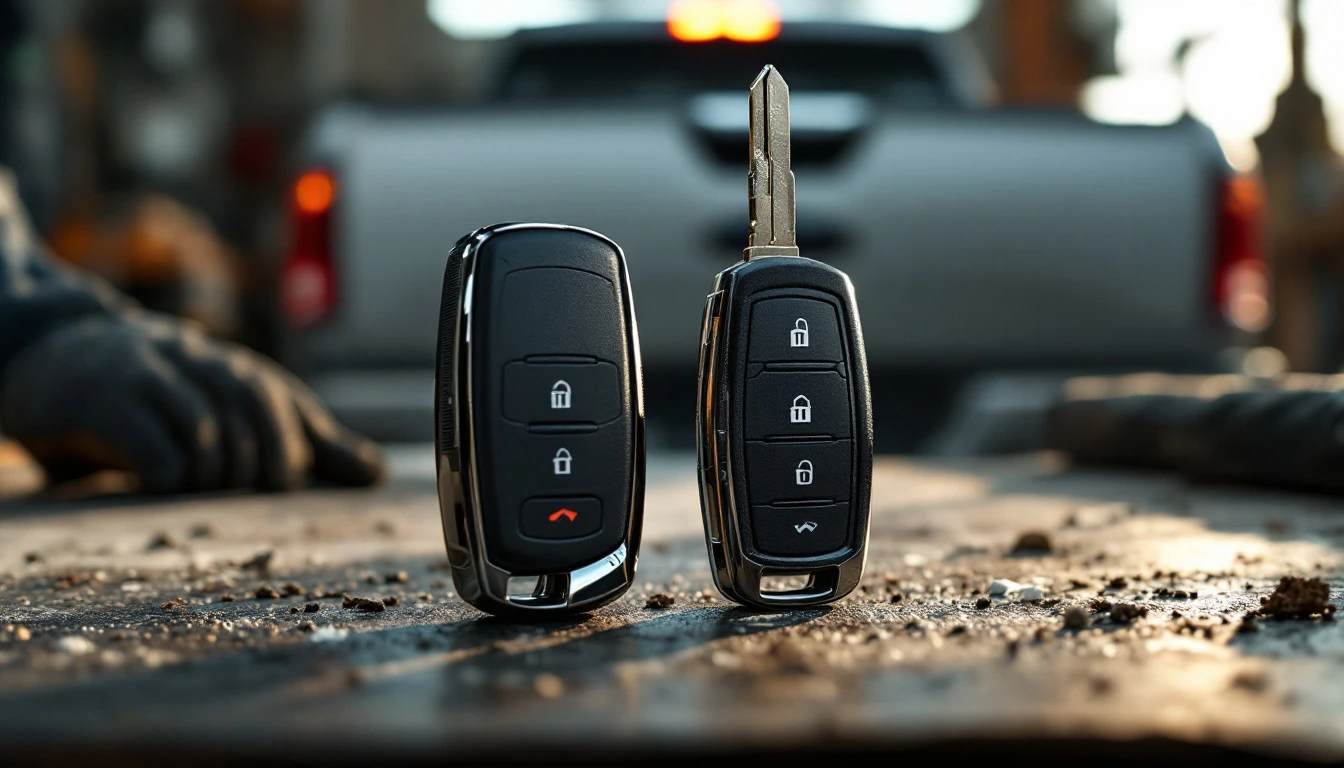
What key does your truck actually use?
Toyota's full-size range spans a wide period, and there are two very different key types in circulation. Bladed transponder keys appear on earlier Tundras and Sequoias and on base work-spec trims for longer than most people assume — a metal key with a transponder chip in the head, read by an antenna ring at the ignition cylinder. Smart Key proximity fobs with push-button start arrive on higher trims and later model years.
The distinction matters because it is roughly a $100–$150 difference in the price of a spare. A base-spec work Tundra with a bladed key is one of the cheaper vehicles on the road to key; a loaded Sequoia with a proximity fob and every remote function sits at the top of the mainstream band.
Trim decides the fob variant as much as model year does. A truck with remote start, power tailgate, or extended remote features uses a fob supporting them, and a key sourced against “a 2019 Tundra” rather than against your VIN may arrive missing one. The mismatch surfaces as a button that does nothing, discovered a week later.
On either key type there is a mechanical blade — either the key itself or an emergency blade concealed in the fob — and it needs cutting to the factory code. It is the part that gets you into the cabin when a fob battery dies on a jobsite. Our Toyota key replacement page covers the range.
Why work-truck keys fail early
Button pads wear through. A fob pressed twenty times a day by hands with dust and grit on them abrades in a way a commuter's fob never does. The rubber goes shiny, then thin, then splits. The board underneath is usually perfect.
Shells crack. Fobs get set on tailgates and driven off with, dropped onto concrete, and sat on in work trousers. A cracked shell lets moisture at the board, and moisture is what actually kills the electronics — a fob that survives the drop often dies three weeks later from what got in through the crack.
Heat and sweat. A North Texas summer in a front pocket is a genuinely hostile environment for a coin cell and for the contacts it sits against. The seasonal pattern is unmistakable: intermittent fobs from July onward, resolved by a battery in most cases.
Heavy key rings. On the bladed-key trucks this matters twice over: the mass hangs off the ignition cylinder while driving, accelerating wafer wear, and it stresses the key head where the transponder sits. Splitting the vehicle key onto its own quick-release ring is a two-minute change that measurably extends the life of both.
The repair most shops do not offer you
When a fob's buttons have worn through or its shell has cracked but the board and transponder inside are healthy, the correct fix is a shell or button-pad transplant: the existing electronics move into a new case. Cost is $60–$120, and no programming is required at all, because the vehicle already knows that board.
That is a fraction of a new programmed fob, and it is the right answer surprisingly often on work trucks specifically — because the failure mode on a work truck is mechanical, and mechanical damage does not touch the part the car actually cares about.
Very few shops volunteer it. Ask for it by name. The case where replacement genuinely is the honest answer is visible corrosion on the board, water damage that has reached the components, or a transponder that no longer reads — and a technician can tell you which you have in about a minute with the case open.
The same logic applies to a worn bladed key on an older Tundra. A key that needs jiggling in the ignition after fifteen years is a worn key far more often than a worn cylinder, and a fresh cut to factory code is both the test and, usually, the fix. Our keyless entry repair and key fob replacement pages cover both paths.
Grand Prairie pricing, as of August 2026
Bladed transponder key, spare with a working key present: $110–$200. Bladed transponder key, all keys lost: $220–$360. Smart Key proximity fob, spare with a working key present: $190–$320. Smart Key, all keys lost: $330–$560.
Shell or button-pad transplant reusing your board: $60–$120, no programming. Emergency blade or mechanical key cut only: $45–$85. Second key at the same visit: 30–50% of the first, and closer to a third on an all-keys-lost job.
Those figures include the key or fob, the cut blade, all registrations, verification, and the mobile trip inside the core service area. No tow is included because none is needed — the whole job happens at the vehicle, including all-keys-lost.
For a fleet or a household with more than one of these trucks, ask about doing several vehicles in one visit; the trip is the fixed cost and it only gets charged once. For the wider comparison across makes see our 2026 Grand Prairie cost guide and, for the closest competitor platform, our Chevrolet Silverado and Tahoe spare key guide.
The downtime maths for a working vehicle
For a personal car, losing a key is expensive and annoying. For a truck that carries tools to a site, it is a lost half-day for whoever was driving it and often for whoever was waiting on them. That cost is rarely counted, and it dwarfs the price of a spare.
Run the numbers honestly. A spare Smart Key today: $190–$320. All-keys-lost on a Thursday morning with a crew standing around: $330–$560 plus a half-day of two people's time plus whatever the delayed job costs in goodwill. The spare is not a luxury purchase.
For a shared vehicle there is a second argument: a second key means two people can move it. Anybody who has watched a crew wait forty minutes for the one person with the key to come back across town understands the value immediately.
Where should the spare live for a work truck? Not in the truck. A site office, a home drawer, or with a supervisor — somewhere retrievable within the working day and nowhere a thief who has just taken the vehicle would find it. Our Toyota all-keys-lost guide covers what happens when there is no spare at all.
What the visit looks like
A spare-key visit runs 20–40 minutes. VIN and trim confirmed, ownership verified, blade cut to factory code from the VIN, diagnostic tool connected at the OBD-II port, and the new key registered for every function the vehicle supports — immobilizer authority, remote functions, and on Smart Key trucks the passive-entry logic as well.
Verification should be done with every other key well out of range: engine start on the new key alone, remote lock and unlock at realistic distance, passive entry at each door that has it, plus the tailgate on a Tundra and the liftgate and glass on a Sequoia. Skipping the passive-entry check is the most common shortcut and the most common callback.
All-keys-lost runs 60–110 minutes and begins with documents. Proof of ownership is mandatory: photo ID plus title, registration, or insurance matching the VIN. On a company vehicle, that means paperwork tying the business to the truck and you to the business — worth sorting out before the van arrives rather than while it waits.
Before any of that, a competent technician runs a pre-flight check, because a real share of “lost key” calls are not. The usual false alarms on these trucks are a coin cell too weak to transmit — hold the fob against the start button, and if it starts you need a battery — water damage from a cracked shell, and immobilizer trust lost after a jump start, which a relearn resolves without new parts.
Mobile versus dealer for a Toyota truck key
Toyota is among the best-supported platforms for credentialed mobile shops, and the structural case is straightforward. No tow is required even for all-keys-lost — and per AAA roadside and repair-cost research, avoiding a flatbed is the single largest structural saving on any immobilised-vehicle job. Parts come through trade channels rather than a manufacturer parts counter at list price. And same-day service at the vehicle beats a scheduled service-drive appointment for anyone whose truck is how they earn.
The dealer genuinely wins on warranty work, on recall or campaign work that must be recorded in the manufacturer's system, and on the small set of very recent configurations where programming access routes through manufacturer-side authorisation. An honest shop names those categories rather than claiming “any Toyota, any year”, and verifies your VIN before dispatch instead of discovering the limitation in your yard.
The framework under which credentialed independents access vehicle security functions is maintained by the National Automotive Service Task Force; certification standards are published by ALOA; and Texas licensing runs through the DPS Private Security Program — not TDLR, despite what many listings say.
On pricing honesty: an advertised “$29 car key” is not a price for a programmed proximity fob. The FTC's locksmith scam guidance documents the low-quote-then-revise pattern, and work vehicles are a favourite target because the owner is under time pressure. Our locksmith versus dealership comparison sets out the decision tree.
A Real-World Example
Operator: A Grand Prairie landscaping contractor runs a 2018 Toyota Tundra SR5 shared between two crew members. The single Smart Key fob had worn through on two buttons and the shell had cracked at the seam after being dropped on a customer driveway.
Before:
- Remote lock and unlock had become unreliable; the crew was using the emergency blade daily
- Quoted $290 for a replacement programmed Smart Key by the first shop contacted
- No spare had ever existed — the truck had been bought used with one fob
What changed:
The technician opened the fob and found the board and transponder in good condition with no corrosion, despite the cracked shell. He transplanted the existing electronics into a new case with a fresh button pad, which required no programming at all because the vehicle already recognised that board. Separately, and at the contractor's request, a second Smart Key was cut and programmed as a genuine spare, verified independently with the first locked in the site office.
Results:
- Time on site: 38 minutes for both jobs
- Shell and button-pad transplant: $85, with no programming required
- Second Smart Key programmed and verified: $245
- Total $330 against the $290 originally quoted for a single replacement fob — and the truck left with two working keys instead of one
Net: The original fob was never electronically faulty; a cracked case and worn buttons had made it unreliable and would eventually have let moisture reach a healthy board. An $85 transplant fixed the actual fault. For $40 more than the quoted single-fob replacement, the contractor solved the real problem and eliminated the shared-vehicle scenario where one lost key stops two people working.
What Experts Say
“Work truck fobs almost never die from the inside. They die because somebody put one on a tailgate and drove to the next job, or sat on it in a pair of work trousers all summer. When I open one up the board is usually spotless — it is the case and the buttons that are finished. So I move the electronics into a new shell for eighty-odd dollars and nothing needs programming, because the truck already knows that board. Nobody offers this. You have to ask for it. And on a shared vehicle I push hard for a real second key as well, because the day the one key goes missing you are not losing a fob, you are losing a crew for half a day, and that is the number that actually matters on a job.”
Per ALOA's automotive certification standards, credential identity resides in the transponder and circuit board rather than in the housing, so a fob whose failure is confined to shell or button-pad damage is correctly repaired by housing replacement with the original electronics retained — a procedure that requires no re-registration because the vehicle's trust relationship is unchanged.
Frequently Asked Questions
How much is a spare key for a Toyota Tundra or Sequoia in Grand Prairie?
As of August 2026, a bladed transponder key spare runs $110–$200 and a Smart Key proximity fob spare runs $190–$320, both with a working key present and both including the cut blade, all registrations, and the mobile trip. All keys lost runs $220–$360 for a bladed key and $330–$560 for a Smart Key.
My Tundra fob buttons are worn through. Do I need a whole new key?
Usually not. If the board and transponder inside are healthy — which on work trucks they normally are, because the damage is mechanical — a shell or button-pad transplant reusing your existing electronics costs $60–$120 and needs no programming at all. Ask for it by name; very few shops volunteer it. Visible corrosion on the board is the case where replacement is the honest answer.
Does a Toyota truck have to be towed for all keys lost?
No. A credentialed mobile shop completes all-keys-lost where the vehicle sits — yard, jobsite, driveway or kerb. Expect 60 to 110 minutes on site and bring photo ID plus title, registration, or insurance matching the VIN. On a company vehicle you will also need paperwork tying the business to the truck.
Why is my Sequoia key more expensive than a base Tundra key?
Because they are often different key types. Base and earlier trucks use bladed transponder keys; higher trims and later model years use Smart Key proximity fobs with push-button start and more remote functions to register. That is roughly a $100–$150 difference on a spare. Trim also decides the fob variant, which is why the quote should be against your VIN.
My truck fob works intermittently in summer. What is happening?
Almost always the coin cell, which measures acceptably at rest and sags under transmission load — and North Texas heat plus a front pocket is a hard environment for one. Replace the battery first. If a fresh cell does not fix it, look for a cracked shell letting moisture reach the board, which is the usual second cause on a work truck.
Where should the spare key live for a shared work truck?
Not in the truck. A site office, a home drawer, or with a supervisor — somewhere retrievable inside the working day and nowhere a thief who has just taken the vehicle would look. A second key also means two people can move the truck, which on a crew is worth more than the key costs.
The Bottom Line
A spare key for a Toyota Tundra or Sequoia is $110–$200 for a bladed transponder key and $190–$320 for a Smart Key fob in Grand Prairie as of August 2026 — against $220–$560 once every key is gone. And before buying any replacement fob for a work truck, have somebody open the one you have: worn buttons and a cracked shell around a perfectly good board is an $85 transplant with no programming, not a $290 purchase.
Next Steps
Call (214) 949-1847 with your VIN, model year and trim, and whether your current key is a bladed key or a push-button-start fob. If the buttons are worn or the case is cracked, say so — that may be a much cheaper job than you expect. See Toyota key replacement Grand Prairie, key fob replacement, and smart key programming for the underlying services.
Sources cited in this article
- Associated Locksmiths of America (ALOA) certification
- National Automotive Service Task Force (NASTF)
- AAA roadside assistance and repair-cost research
- FTC consumer guidance on locksmith scams
- Texas DPS Private Security Program
- SAE International vehicle security standards
- National Highway Traffic Safety Administration (NHTSA)
- U.S. Bureau of Labor Statistics OEWS data