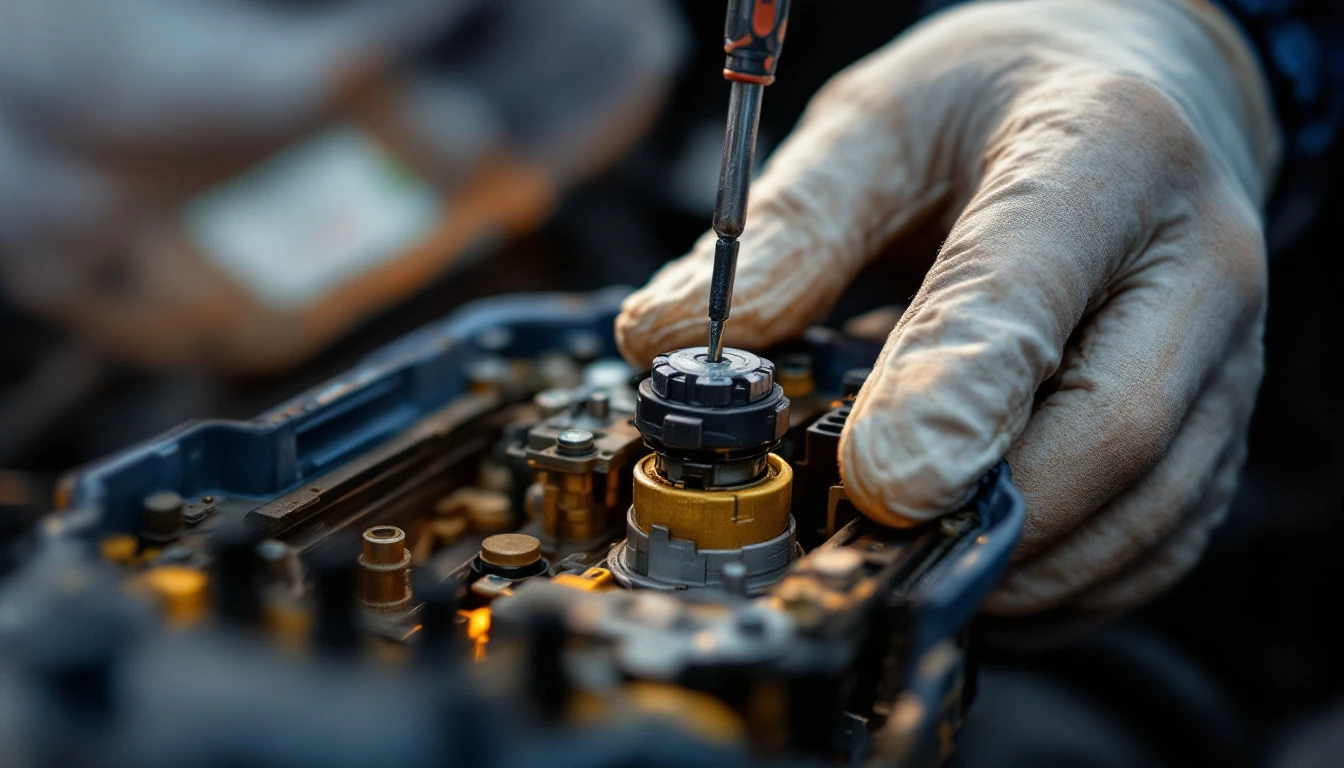
The two parts everyone calls "the ignition"
Almost every misdiagnosis in this area comes from treating one component as two, or two as one. Getting the vocabulary straight is genuinely what saves money here.
The ignition lock cylinder is the mechanical part. Your key goes into it, the wafers or discs inside line up against the cuts on the blade, and the whole assembly rotates. It is a lock, and it wears like a lock: metal against metal, thousands of cycles, grit carried in on the key.
The electrical ignition switch is a separate component sitting behind or beside the cylinder, connected to it by a linkage or a rod. As the cylinder rotates it moves this switch through its positions — off, accessory, on, start — and the switch is what actually sends power to the various circuits. It is electrical and it wears electrically: contacts pit, springs weaken, connections get intermittent.
On a push-button vehicle the cylinder is gone entirely and the switch has become a button and a module. The failure vocabulary changes but the split does not: there is still a thing you interact with, and a thing behind it that distributes power.
Why the distinction matters to your wallet. A car that will not start because the key will not turn is a lock problem. A car that starts fine but cuts out at a junction is an electrical problem. They are different parts, at different prices, and a shop that replaces the wrong one has taken your money and left the fault in the car. Our ignition repair page sets out what is actually assessed on arrival.
Symptoms of a worn ignition lock cylinder
These build gradually over months or years. Almost nobody notices the beginning of this pattern; nearly everybody remembers the day it finally stopped.
The key needs jiggling, lifting or pressure to turn. The single most reported symptom and the most reliable early warning. If you have developed a technique — pull the key back a fraction, lift the wheel, wiggle while turning — you have a worn interface between key and lock, and you have been compensating for it for a while.
The key is hard to insert or hard to remove. Debris, a worn keyway, or a bent blade. Related and often present at the same time.
The key sticks in the accessory position. The car runs, but you cannot get the key back to off and out. Frequently a mechanical binding in the cylinder rather than anything electrical.
The key turns with no resistance and nothing happens. This is the late stage: the cylinder has separated internally from the linkage it is supposed to drive. It spins freely and moves nothing. The car is now going nowhere without a repair.
Only one of your keys works. This is diagnostically valuable and often misread. If the spare turns smoothly and the everyday key does not, the lock is fine and the key is worn. That is the $65–$120 outcome, not the $180–$340 one, and it is the first thing an honest shop tests.
The steering lock is a separate thing, and it is not a fault. If the wheels were turned against a kerb when you parked, the column lock loads up against the cylinder and the key will not turn. Rock the wheel gently left and right while turning the key. This resolves it, and it catches out a remarkable number of people who were about to pay for a repair.
Symptoms of a failing electrical ignition switch
These are less familiar and considerably more serious, because this is the failure that can happen while the car is moving.
The engine cuts out while you are driving. The most important symptom in this article. The switch loses contact momentarily and the vehicle simply stops running — typically over a bump, on a rough surface, or when the column is knocked. If this has happened even once, treat it as urgent.
Dash lights flicker, or accessories cut in and out. Radio dropping, lights dimming, gauges sweeping to zero and back, particularly if it correlates with hitting a bump or bumping the key. This is an intermittent contact.
Intermittent no-crank with everything else normal. You turn the key fully to start, the dash is lit and healthy, and nothing happens at all. Try again and it goes. A worn start contact inside the switch is a common cause — though a failing starter solenoid produces something similar, which is why this one needs proper testing rather than a guess.
Anything that changes when you wiggle the key while the engine is running. If jiggling the key makes lights flicker or the engine stumble, that is very nearly diagnostic on its own.
Why this is a safety issue, not just an inconvenience. When the switch drops out of the run position on a moving vehicle you lose engine power, and with it power steering assist and brake booster vacuum. The car does not become unsteerable or unstoppable, but both take significantly more effort at exactly the moment you least expect it. Ignition and starting-system defects have been the subject of substantial recall activity across multiple manufacturers, and it costs nothing to check your VIN against the free open-recall database published by NHTSA before paying anybody. If there is an open campaign covering your vehicle, the work is performed at no charge by a franchised dealer.
One thing to stop doing today if you have any of these symptoms. Take everything off your key ring. A heavy bunch of keys and fobs hanging off the ignition applies constant leverage to a part that was never designed to carry it, accelerates wear in both the cylinder and the switch, and on a rough road can physically move the key out of the run position. Per NHTSA guidance issued during the ignition-switch recall campaigns of the past decade, drivers of affected vehicles were specifically advised to use the ignition key alone with nothing else attached. It is free advice and it applies to any car showing these symptoms.
Rule out the worn key first, because it is the cheapest answer
This is the section that saves people the most money, and it is the step most often skipped.
A key is a consumable. Every insertion drags the blade across the wafers inside the lock; every pocket, every keyring, every dropped bunch takes a little more off the peaks of the cuts. After a decade the cuts are measurably rounded. A rounded key in a perfectly healthy lock produces precisely the symptoms of a worn cylinder — jiggling, sticking, and eventually not turning at all — because the interface is worn from one side rather than the other.
The test is free and takes ten seconds: try your spare. If the spare turns smoothly and cleanly, your lock is fine. Your everyday key is worn out and needs replacing, not the ignition. If both keys behave the same, the fault is more likely in the lock.
The repair in that case is a fresh key cut to the factory code from the VIN, with the transponder registered: $65–$120. Note the phrase — cut to code, not copied. Copying your worn key just reproduces the worn shape in fresh metal, which is why a hardware-shop duplicate so often fails to fix this. Cutting to the original factory specification restores the interface the lock was built for. Our car key programming page covers the registration half of that job.
An honest shop tries this before selling you a cylinder, because on a genuine worn-key case it is the repair, and because it is a diagnostic step even when it is not: a brand-new key cut to code that still sticks or still will not turn tells you conclusively that the lock is the problem. You have spent the low number to be certain before spending the high one.
What each repair costs in Grand Prairie, as of August 2026
All figures are all-in mobile prices — the part supplied, the work performed and verified at your address, during normal weekday hours, with no separate call-out fee inside the core service area.
Fresh key cut to factory code with the transponder registered: $65–$120. On a worn-key case this is the whole repair.
Ignition lock cylinder replacement, keyed to your existing key: $180–$340. Keying the new cylinder to the key you already carry is worth asking for — it means you keep one key for doors and ignition rather than walking around with two.
Electrical ignition switch replacement: $230–$420.
Both together: $260–$460, and less than the sum of the parts because the column only comes apart once. If a technician is already in there and the other component is visibly at the end of its life, doing both is usually the cheaper decision over any reasonable horizon.
Broken key extraction from the cylinder: $85–$180, depending on how deep the fragment sits and whether it snapped under rotation. Our guide on a broken key stuck in the ignition covers what to do in the first ten minutes.
Push-button start button or module faults: genuinely variable by platform, and any shop that quotes one without knowing your exact vehicle is guessing. Expect a diagnosis first and a number afterwards.
Evenings, weekends and overnight: add roughly $20–$40. Outlying addresses: $20–$50, named when you book rather than on arrival. Per the FTC's consumer guidance on locksmith scams, a headline figure far below prevailing rates is a booking device rather than a quotation — the real total gets assembled once you have waited and lost your alternatives. For key pricing across every vehicle and key type, see our 2026 car key replacement cost guide.
Mobile locksmith, mechanic, or dealer?
The cylinder is locksmith work. It is a lock, it is keyed, and keying the replacement to your existing key is a locksmith operation that a general mechanic typically cannot perform — which is why the dealer route so often ends with you carrying two different keys. It is also mobile work: the column comes apart in your driveway and the vehicle never moves.
The electrical switch is shared ground. Locksmiths and mechanics both do it. The practical advantage of the locksmith route is that the cylinder and the switch sit in the same assembly, so one visit can address both, and if the fault turns out to be the key after all you are already with the person who can cut one to code.
The dealer genuinely wins in three situations. An open recall, where the work is free. Anything under warranty. And any repair where programming access has to route through manufacturer-side authorisation — the framework for which is maintained by the National Automotive Service Task Force, which exists so credentialed independents can obtain that access rather than it being dealer-only.
What to ask before agreeing to anything. Which component do you believe has failed, and what did you check to reach that conclusion? Did you test my spare key? Will the new cylinder be keyed to my existing key or will I be carrying two? And is that the all-in total? Certification standards for the technicians doing this work are published by ALOA, and Texas locksmith licensing runs through the DPS Private Security Program — never TDLR, whatever a directory listing claims.
Make-specific patterns exist and are worth knowing. Some platforms are famous for cylinder wear, others for the electrical half. Our guides to Kia Forte and Soul ignition repair, Hyundai Sonata and Veloster ignition repair and the Jeep Wrangler JK and TJ cylinder cover three of the most common in this market.
What to do this week
If the engine has ever cut out while driving, deal with it now. Not next month. That is the one symptom on this page with a safety consequence attached, and it does not improve on its own.
Take everything off the ignition key. Free, immediate, and it stops the wear you are trying to fix from continuing. A single key on its own, with the rest of the bunch on a separate ring, is the correct arrangement for any car showing these symptoms.
Try your spare key in the ignition and pay attention to the difference. Smooth spare, sticky everyday key means you need a key, not a cylinder. This one test is the difference between $65–$120 and $180–$340.
Check your VIN against the free NHTSA recall database. Two minutes, no cost, and ignition components have been recalled across a lot of vehicles. If there is an open campaign, a franchised dealer does the work at no charge and you should not be paying anyone else for it.
Stop lubricating it with the wrong thing. Oil and general-purpose penetrating sprays attract grit inside a lock and make the wear worse over time. If anything goes in there it should be a dry lubricant intended for locks.
When you call, describe the behaviour rather than naming the part. “The key only turns if I jiggle it, and my spare does the same” and “the dash lights flicker over bumps and it cut out at a junction last week” are two different repairs, and telling us which one you have is what gets the right technician and the right parts to your address the first time. See ignition repair, car key replacement, or our guide to a car that will not start with the fob in your hand if yours is a push-button vehicle.
A Real-World Example
Operator: A Grand Prairie driver with a 2012 sedan had spent about eight months developing a routine: pull the key back a couple of millimetres, lift the steering wheel slightly, and jiggle while turning. It worked every time until one Tuesday morning in a car park off Pioneer Parkway, when it did not.
Before:
- Eight months of jiggling the key to start — treated as a quirk rather than a fault
- Original key from purchase, visibly rounded cuts, carried on a heavy bunch with a house set and a bottle opener
- A quote already obtained for ignition lock cylinder replacement, without the spare key being tested
What changed:
The first thing tried on site was the spare key, which had lived in a drawer for years and was barely worn. It turned the ignition cleanly on the first attempt, which established that the lock cylinder was healthy and the everyday key was worn out. A fresh key was cut to the factory code retrieved from the VIN rather than copied from the worn original, the transponder was registered, and both the new key and the old spare were verified in the ignition and at the doors. The driver was advised to carry the ignition key on its own ring.
Results:
- Repair completed for the price of a key rather than a cylinder replacement
- Root cause was a decade of wear on the key, not on the ignition
- Heavy keyring identified as the accelerating factor and removed
- Old spare retained as a genuine spare, now with a known-good everyday key alongside it
Net: The cylinder quote would have replaced a healthy part and left the worn key still in service, so the symptom would have returned. Testing a spare key costs nothing and takes ten seconds, and on this job it was the entire difference between the two prices.
What Experts Say
“When somebody tells me they have to jiggle the key, the first thing I do is ask for their spare — not their story. If the spare turns clean, the lock is fine and the key is finished, and that is the cheap end of the job. If both keys fight it, then we are talking about the cylinder. The one I want people to take seriously is different, though: if your engine has ever cut out while you were driving, that is not a nuisance, that is the electrical switch dropping out of the run position, and it takes your power steering and your brake booster with it. Get that looked at now, and in the meantime take everything else off the key ring — the weight hanging off that switch is half of why it wore out.”
Per NHTSA, ignition-switch defects have driven major multi-manufacturer recall campaigns, with affected drivers specifically advised to carry the ignition key alone and remove all additional weight from the key ring — guidance that applies equally to any vehicle exhibiting intermittent electrical symptoms at the ignition, and a free VIN recall check should precede paying for any ignition repair.
Frequently Asked Questions
What are the first signs an ignition switch is going bad?
They split by component. A worn mechanical cylinder shows up as a key that needs jiggling or pressure to turn, sticks in the accessory position, or is hard to insert and remove. A failing electrical switch shows up as flickering dash lights, accessories cutting in and out, intermittent no-crank with a healthy dashboard, and — most seriously — the engine cutting out while driving.
Why do I have to jiggle my key to start the car?
Usually because the interface between key and lock is worn, and most often the key is the worn half rather than the lock. Try your spare: if the spare turns smoothly, your everyday key is worn out and a fresh key cut to the factory code from the VIN fixes it for $65–$120. If both keys stick, the cylinder is the more likely culprit at $180–$340.
How much does it cost to replace an ignition cylinder or switch in Grand Prairie?
As of August 2026, $180–$340 for ignition lock cylinder replacement keyed to your existing key, $230–$420 for an electrical ignition switch, and $260–$460 for both together — less than the sum because the column only comes apart once. A fresh key cut to code is $65–$120 and broken key extraction is $85–$180. Evenings and weekends add roughly $20–$40.
Is it dangerous to drive with a failing ignition switch?
If the engine has cut out while moving, yes, and it should be treated as urgent. When the switch drops out of the run position you lose engine power and with it power steering assist and brake booster vacuum. The car remains steerable and stoppable but both require considerably more effort, without warning. Purely mechanical symptoms like a sticky key are inconvenient rather than dangerous, though they usually get worse.
Can a locksmith fix my ignition at my house, or does the car need towing?
At your address, in almost every case. Cylinder replacement, electrical switch replacement, broken key extraction and cutting a fresh key to code are all mobile jobs — the column comes apart where the vehicle sits and it never has to be driven or towed anywhere.
Will a new ignition cylinder mean carrying two different keys?
Only if you let it. A replacement cylinder can be keyed to your existing key so one key still operates doors and ignition, and that is worth asking for explicitly before the work starts. It is a locksmith operation, which is one practical reason to route this repair through a locksmith rather than a general workshop.
Could the problem just be the steering lock?
Frequently, and it is not a fault at all. If the wheels were turned against a kerb when you parked, the column lock loads against the cylinder and the key will not turn. Rock the steering wheel gently left and right while turning the key. This is free, takes seconds, and resolves a surprising number of cars that were about to be booked in for a repair.
Should I spray lubricant into the ignition?
Not oil or general-purpose penetrating spray — both attract grit inside the lock and accelerate the wear you are trying to stop. If anything goes in, it should be a dry lubricant made for locks. The more useful free measure is removing every other key and fob from the ring so nothing is hanging off the ignition.
The Bottom Line
Ignition faults are two problems, not one. A worn mechanical cylinder makes the key stick and jiggle; a failing electrical switch makes lights flicker and, at worst, cuts the engine while you are driving. Before paying for either, try your spare key — if it turns cleanly, you need a $65–$120 key cut to code and not a $180–$340 cylinder. As of August 2026 in Grand Prairie the cylinder is $180–$340, the electrical switch $230–$420, and both together $260–$460, all done at your address. Check your VIN for an open recall first, and take everything else off your key ring today.
Next Steps
Try your spare key in the ignition and note whether it turns any differently, take everything else off the ignition key ring, and run your VIN through the free NHTSA recall lookup. Then call (214) 949-1847 and describe the behaviour rather than naming a part — whether the key sticks, whether the spare does the same, and whether anything electrical has ever cut out while driving. See ignition repair, car key programming, and our 2026 car key replacement cost guide.
Sources cited in this article
- NHTSA recall lookup by VIN
- National Highway Traffic Safety Administration (NHTSA)
- National Automotive Service Task Force (NASTF)
- FTC consumer guidance on locksmith scams
- Associated Locksmiths of America (ALOA) certification
- Texas DPS Private Security Program
- SAE International vehicle security standards
- AAA roadside assistance and repair-cost research